







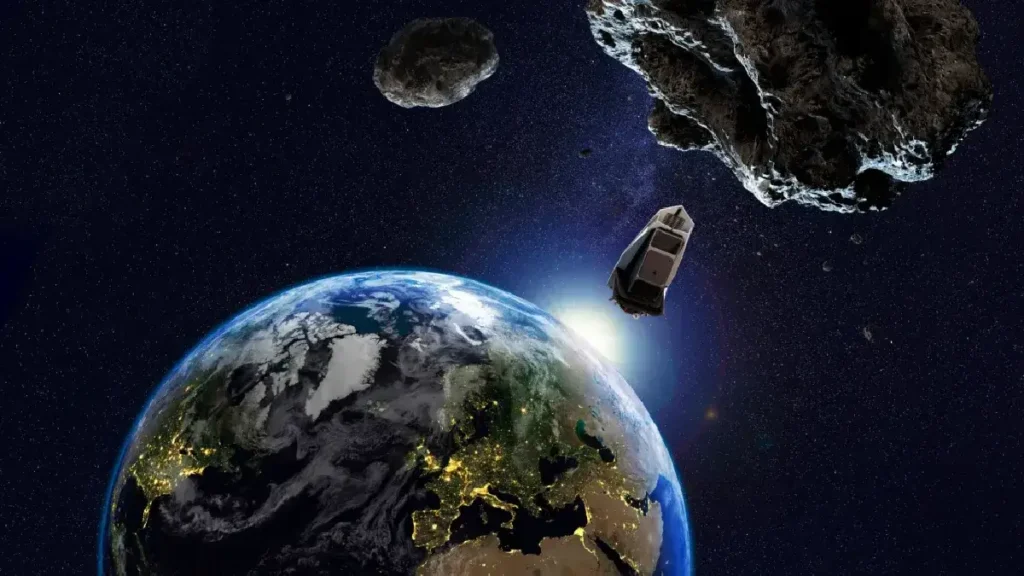
Thursday, September 17, 2026 — An asteroid is making a close approach to Earth today, but there is no danger. Asteroid 2026 NT2 will pass by our planet at a safe distance of approximately 16.1 lunar distances, which is roughly 6.2 million kilometers from Earth. The object is estimated to be about 314 meters in diameter and is traveling at a relative speed of 12.5 km/s.





It is not classified as a potentially hazardous asteroid, and there is no known impact risk. This is a routine close approach, the kind that happens regularly as near-Earth objects follow their orbital paths around the Sun. You can track the asteroid using NASA’s Asteroid Watch dashboard and ESA’s Near-Earth Object Coordination Centre tools.
Quick Answer Box
| Detail | Information |
|---|---|
| Date | September 17, 2026 |
| Asteroid | 2026 NT2 |
| Closest Approach | Expected during September 17, 2026 (UTC) |
| Distance from Earth | ~6.2 million km / ~16.1 lunar distances |
| Estimated Size | ~314 meters (approximately 1,030 feet) |
| Relative Speed | 12.5 km/s (45,000 km/h) |
| Impact Threat | None. Not classified as hazardous. |
| Live Tracking | NASA Asteroid Watch / ESA NEOCC |
Is an Asteroid Passing Earth Today?
Yes. Asteroid 2026 NT2 is making its close approach to Earth on September 17, 2026. It will pass at a distance of about 16.1 lunar distances from our planet, which translates to roughly 6.2 million kilometers.
To put that in perspective, 16.1 lunar distances means the asteroid is more than sixteen times farther away from Earth than the Moon is. The average Earth-Moon distance is approximately 384,400 kilometers. An object at 16.1 lunar distances is nowhere near Earth in any practical sense. It is a safe, distant pass.
Astronomers use the term “close approach” to describe any passage within a certain astronomical threshold. It does not mean the object is close in everyday terms. The threshold for a “close approach” in NASA’s database is typically 0.05 astronomical units, or about 19.5 lunar distances. Asteroid 2026 NT2 falls within this category, which is why it appears in close-approach listings.
There may be other asteroids passing at greater distances today, but 2026 NT2 is the most notable based on its size and approach distance.
Asteroid Passing Earth Today — Live Tracking
If you want to follow Asteroid 2026 NT2 or any other near-Earth object in real time, several official tools are available.
NASA Asteroid Watch Dashboard tracks asteroids and comets making relatively close approaches to Earth. It displays the date of closest approach, approximate object diameter, relative size, and distance from Earth for each encounter. The dashboard shows the next five close approaches, making it easy to see what is coming.
NASA Eyes on Asteroids is a real-time 3D visualization tool. It tracks over 30,000 asteroids near Earth’s orbit and lets you see the next five closest approaches. You can explore past, present, and future missions to asteroids and comets in an interactive simulation.
NASA/JPL Center for Near-Earth Object Studies (CNEOS) is the primary source for close-approach data. It computes high-precision orbits for near-Earth objects and maintains the close-approach database, which includes every known asteroid or comet pass within 0.05 AU of Earth.
ESA’s Near-Earth Object Coordination Centre (NEOCC) provides its own close-approach list and risk assessments. The ESA database includes details like miss distance in kilometers and lunar distances, estimated diameter, maximum brightness, and relative velocity.
It is important to understand that tracking data is not the same as a live video feed. These tools show calculated positions and orbital paths, not real-time telescope footage. There is generally no live video stream of a passing asteroid unless a major observatory is broadcasting a specific event.
When Will the Asteroid Be Closest to Earth?
Asteroid 2026 NT2 is expected to reach its closest point to Earth during September 17, 2026, in UTC time. The exact time within the day may be refined as additional observations are processed.
For readers in India, that corresponds to September 17, 2026, in India Standard Time (IST), which is UTC+5:30. If the closest approach occurs during the UTC day, the IST equivalent would fall on the same date, potentially in the afternoon or evening hours depending on the precise UTC time.
For other time zones:
- Eastern Time (ET): UTC-4 (during daylight saving). The approach would fall on September 17.
- Pacific Time (PT): UTC-7. The approach would fall on September 17.
- UK time (BST): UTC+1. The approach would fall on September 17.
Because the exact time is still being refined, readers should check NASA’s CNEOS close-approach database or the ESA NEOCC list for the most current timestamp.
How Far Will the Asteroid Pass From Earth?
The distance is approximately 16.1 lunar distances, or about 6.2 million kilometers.
In miles, that is roughly 3.85 million miles.
For comparison, the Moon is about 384,400 kilometers away. Asteroid 2026 NT2 will be more than sixteen times farther than the Moon. It is also well outside the orbit of geostationary satellites, which sit at about 35,786 kilometers. The asteroid will pass far beyond any human-made object in Earth orbit.
This distance is considered a close approach in astronomical terms because it falls within the 0.05 AU threshold that CNEOS uses to catalogue near-Earth encounters. But in absolute terms, it is a wide miss.
How Big Is the Asteroid?
Asteroid 2026 NT2 is estimated to be about 314 meters in diameter. That is approximately 1,030 feet, or roughly the length of three American football fields.
It is important to note that this diameter is an estimate, not a direct measurement. Asteroid sizes are calculated from their brightness (absolute magnitude) and an assumed reflectivity (albedo). A darker asteroid reflects less light, so it would need to be larger to appear as bright. A brighter asteroid could be smaller. The 314-meter figure is the best estimate based on available data, but the true size could fall within a range.
An asteroid of this size is significant but not planet-threatening. For context, the object that caused the Chelyabinsk airburst in 2013 was approximately 20 meters in diameter. The Tunguska event of 1908 involved an object estimated at around 50 meters. A 314-meter asteroid is larger than both, but its distance today means there is no risk.
How Fast Is the Asteroid Traveling?
Asteroid 2026 NT2 has a relative velocity of 12.5 km/s during its Earth encounter.
Converting that:
- 12.5 km/s = 45,000 km/h = 27,960 mph
This is the speed relative to Earth, not the asteroid’s orbital velocity around the Sun. Relative velocity depends on the geometry of the encounter and the asteroid’s own orbital path. Some asteroids pass faster; some pass slower. A speed of 12.5 km/s is on the moderate side for a near-Earth asteroid encounter.
For comparison, the International Space Station orbits at about 7.66 km/s. This asteroid is moving at roughly 1.6 times the ISS speed relative to Earth.
Will the Asteroid Hit Earth?
No. There is no known impact risk from Asteroid 2026 NT2.
The asteroid will pass at a distance of approximately 6.2 million kilometers. It is not on a collision course with Earth. NASA and ESA both maintain risk lists for objects with any non-zero impact probability, and 2026 NT2 is not on the risk list.
It is essential to understand the difference between a close approach and an impact. A close approach means an object passes near Earth within a defined astronomical threshold. An impact means it actually enters Earth’s atmosphere or strikes the surface. The overwhelming majority of close approaches are completely safe.
NASA has not issued any warning about this asteroid. ESA has not flagged it as a risk. There is no danger.
Is This Asteroid Potentially Hazardous?
No. Asteroid 2026 NT2 is not classified as a Potentially Hazardous Asteroid (PHA).
The PHA classification is based on two criteria defined by NASA/JPL:
- Size: The asteroid must be at least 140 meters in diameter.
- Orbital proximity: Its orbit must bring it within 0.05 AU (about 7.5 million kilometers) of Earth’s orbit.
Asteroid 2026 NT2 meets the size criterion at an estimated 314 meters, but it does not meet the orbital proximity criterion in a way that warrants a PHA label, or it has been assessed as not qualifying based on its specific orbital parameters.
Crucially, PHA does not mean “will hit Earth.” It is a watch-list classification. An asteroid can be a PHA and still never come close to impacting Earth for centuries. The label simply means astronomers pay closer attention to it. Asteroid 2026 NT2 is not on that watch list.
Can You See the Asteroid From Earth Tonight?
No, not with the naked eye. Asteroid 2026 NT2 is far too faint and too distant to be visible without equipment.
At a distance of 6.2 million kilometers, the asteroid will appear extremely dim. Its brightness would likely be far below the +6 magnitude limit of human vision under perfect dark-sky conditions. Even with binoculars or a small telescope, it would be a challenging target.
Observing a near-Earth asteroid of this size and distance typically requires a medium-to-large amateur telescope and precise coordinates. Professional observatories will track it, but casual stargazers will not be able to spot it.
Additionally, the asteroid’s position in the sky and the time of closest approach will determine whether it is above the horizon during nighttime hours at any given location. Without a confirmed apparent magnitude and sky position, it is not possible to provide reliable observing instructions.
Can People in India See the Asteroid?
No. There is no practical way for observers in India to see Asteroid 2026 NT2 tonight with standard equipment.
The asteroid will be at a distance of 6.2 million kilometers and will be extremely faint. It would require a large telescope and precise tracking to detect. Additionally, the closest approach may occur during daylight hours in India depending on the exact UTC time.
If any reliable observing data becomes available — such as an updated apparent magnitude or a confirmed position — it would still likely be beyond the reach of typical amateur setups. This is not an object for naked-eye or binocular viewing.
NASA’s Asteroid Watch Explained
NASA’s asteroid monitoring efforts are coordinated through the Center for Near-Earth Object Studies (CNEOS) at the Jet Propulsion Laboratory in Pasadena, California.
CNEOS maintains the close-approach database, a catalogue of every known asteroid or comet pass within 0.05 AU of Earth. The database includes:
- Object designation
- Close-approach date and time
- Miss distance (in AU, lunar distances, and kilometers)
- Relative velocity
- Estimated diameter
CNEOS also operates Sentry, an impact-monitoring system that continuously scans the catalog of near-Earth asteroids for possible future impacts. Scout is a complementary system that assesses newly discovered objects before their orbits are precisely known.
The Asteroid Watch dashboard provides a user-friendly interface showing the next five close approaches, with visual size comparisons and distance information.
NASA does not “control” asteroids. The agency tracks them, calculates their orbits, and shares data publicly. Orbital predictions become more precise as additional observations are collected.
How Scientists Know an Asteroid Will Miss Earth
Astronomers determine an asteroid’s path through repeated telescopic observations. Each observation provides a position measurement. With enough position measurements over time, computers can calculate the object’s orbital elements — its path around the Sun.
This process does not involve watching the asteroid and guessing. It involves mathematical modeling of gravity, orbital mechanics, and the object’s motion. Scientists calculate a range of possible trajectories based on the uncertainty in the observations. As more data comes in, that range narrows.
For Asteroid 2026 NT2, the current orbital solution shows a miss distance of about 6.2 million kilometers. The uncertainty in that prediction is small enough that there is no plausible scenario where the asteroid impacts Earth.
Why Do Asteroids Pass Earth So Often?
Asteroids pass Earth frequently because near-Earth objects are numerous and their orbits regularly bring them into our neighborhood.
As of August 2026, there are over 42,000 known near-Earth asteroids. Of these, about 2,549 are classified as potentially hazardous. New objects are discovered regularly.
Earth sits in a region of the solar system where asteroid orbits intersect our path around the Sun. Gravitational interactions with planets can nudge asteroids into orbits that cross Earth’s orbit. This is a natural consequence of solar system dynamics, not a sign of impending danger.
Most close approaches are by small objects that would burn up harmlessly if they ever entered the atmosphere. Larger objects are rarer, and their approaches are well-tracked.
Today’s Other Asteroid Close Approaches
Asteroid 2026 NT2 is the most notable object passing Earth today, but it is not the only one.
According to close-approach data, other objects have approached or will approach Earth in mid-September 2026. For example, 2026 RG39 has a close approach scheduled for September 21, 2026, at a distance of about 6.8 lunar distances. However, this is not today’s event.
On September 17 itself, 2026 NT2 is the primary object of interest based on its size and approach distance. No other asteroid of comparable size is expected to pass at a similarly close distance today.
What Happens If an Asteroid Enters Earth’s Atmosphere?
If an asteroid enters Earth’s atmosphere, several outcomes are possible depending on its size, speed, and composition.
A meteoroid is a small fragment of asteroid or comet debris. When it enters the atmosphere and burns up, the streak of light is called a meteor. If a piece survives and reaches the ground, it is called a meteorite.
Larger objects can produce an airburst — an explosion in the atmosphere before reaching the ground. The Chelyabinsk event in 2013 was an airburst caused by a roughly 20-meter object. The Tunguska event in 1908 was an airburst from a roughly 50-meter object.
Asteroid 2026 NT2 will not enter Earth’s atmosphere. It will pass at a distance of over 6 million kilometers. The atmospheric entry discussion is included for context only.
Asteroid Close Approach vs Meteor Shower
An asteroid close approach and a meteor shower are completely different phenomena.
A close approach involves a single, specific asteroid passing near Earth on its orbital path. The asteroid remains in space. It does not enter the atmosphere.
A meteor shower occurs when Earth passes through a stream of debris left behind by a comet or asteroid. The debris particles are typically tiny — sand-grain to pebble-sized — and they burn up high in the atmosphere, creating streaks of light. Meteor showers are predictable annual events, like the Perseids or Geminids.
Asteroid 2026 NT2 is not associated with any meteor shower. It is a single object on its own orbital trajectory.
How Often Do Large Asteroids Pass Close to Earth?
Large asteroids — those hundreds of meters in diameter — pass close to Earth less frequently than small ones. But “close” in astronomical terms still means millions of kilometers.
The frequency depends on the size threshold and the distance threshold. NASA’s close-approach database records passes within 0.05 AU (about 19.5 lunar distances). Within that threshold, objects of various sizes pass regularly, but large ones are rarer.
As of September 2026, 42,494 near-Earth asteroids are tracked, with 2,549 classified as hazardous. New discoveries happen weekly. The discovery rate has increased as survey telescopes have become more sensitive.
What Is the Next Closest Asteroid After Today?
The next notable close approach after Asteroid 2026 NT2 is Asteroid 2026 RZ1, scheduled for September 22, 2026.
- Designation: 2026 RZ1
- Date: September 22, 2026
- Distance: Approximately 10.4 lunar distances
- Estimated Size: Approximately 38 meters
- Speed: 9.1 km/s
This object is significantly smaller than 2026 NT2 and will pass slightly closer. It is also not classified as hazardous.
Frequently Asked Questions
Is an asteroid passing Earth today?
Yes. Asteroid 2026 NT2 is making a close approach to Earth on September 17, 2026. It will pass at a distance of approximately 6.2 million kilometers (16.1 lunar distances). There is no impact risk.
What asteroid is passing Earth today?
The primary object is Asteroid 2026 NT2, estimated at about 314 meters in diameter. It is traveling at 12.5 km/s relative to Earth and is not classified as hazardous.
What time will the asteroid be closest to Earth?
The closest approach is expected during September 17, 2026, in UTC time. The exact time may be refined as additional observations are processed. Check NASA CNEOS or ESA NEOCC for the most current timestamp.
How far will the asteroid be from Earth?
Asteroid 2026 NT2 will pass at approximately 6.2 million kilometers from Earth, which is about 16.1 lunar distances or 3.85 million miles.
Can I see the asteroid tonight?
No. Asteroid 2026 NT2 is far too faint and distant to be visible with the naked eye or typical binoculars. It would require a large telescope and precise coordinates to observe.
Can India see the asteroid?
No. The asteroid is too faint and distant for practical observation from India with standard equipment. The closest approach may also occur during daylight hours in India depending on the UTC timing.
Will the asteroid hit Earth?
No. Asteroid 2026 NT2 will pass at a safe distance of over 6 million kilometers. It is not on any impact risk list maintained by NASA or ESA.
Is the asteroid potentially hazardous?
No. Asteroid 2026 NT2 is not classified as a Potentially Hazardous Asteroid. It does not meet the criteria for that watch-list classification based on its orbital parameters.
How can I track the asteroid live?
Use NASA Asteroid Watch, NASA Eyes on Asteroids, or the ESA NEOCC close-approach list. These tools show calculated positions and orbital data, not live video.
Does NASA have an asteroid tracker?
Yes. NASA’s CNEOS maintains the close-approach database, and the Asteroid Watch dashboard shows upcoming approaches. Eyes on Asteroids provides a 3D visualization.
What is the next asteroid to pass Earth?
After 2026 NT2, the next notable approach is Asteroid 2026 RZ1 on September 22, 2026, at about 10.4 lunar distances. It is estimated at 38 meters.
How often do asteroids pass close to Earth?
Close approaches within 0.05 AU happen regularly. Over 42,000 near-Earth asteroids are known, and new ones are discovered frequently. Most passes are by small objects that pose no threat.
Live Asteroid Tracking Update
Last updated: September 17, 2026
Asteroid 2026 NT2 is on track for its close approach today at a distance of approximately 6.2 million kilometers. No changes to the impact risk assessment have been reported. Distances, orbital calculations, and visibility information can be updated as new observations become available. Readers should check NASA CNEOS and ESA NEOCC for the latest data.