







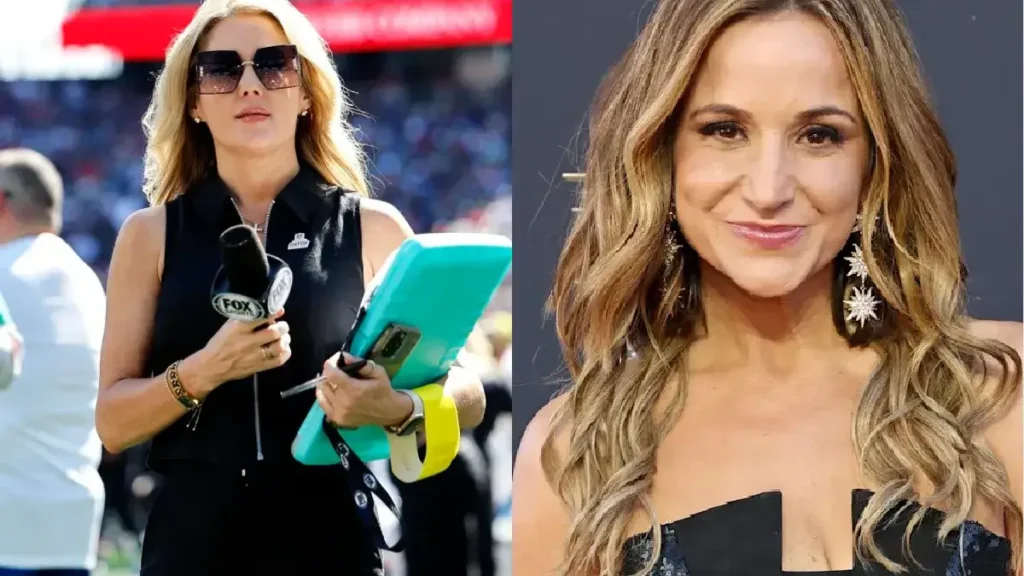
Fox Sports NFL sideline reporter Jen Hale says the fallout from the Dianna Russini-Mike Vrabel photo controversy is creating additional challenges for women working in sports media. In an appearance on The Craig Carton Show aired on September 18, 2026, Hale discussed how the controversy affects female reporters trying to build sources and professional credibility.




Her comments came as The Athletic completed an internal review of former NFL reporter Russini’s work, which found that Russini’s relationship with then-New England Patriots head coach Vrabel “clearly violated” the outlet’s standards. Hale’s remarks represent her personal perspective, not an established fact about the entire sports media industry. This article separates confirmed facts, Hale’s statements, The Athletic’s investigation findings, and unresolved questions.
What Jen Hale Said
Hale made her comments on The Craig Carton Show on September 18, 2026. When host Craig Carton asked whether the controversy had practical consequences for other female reporters, Hale responded: “It does. It opened the floodgates, absolutely. It makes everything harder, everything more difficult.”
Hale also shared a conversation she had with a young female reporter in a similar position, offering her own advice: “I said, ‘Listen, you need to understand, they’re always going to keep their job, and you’re not. You’re easily replaceable, they’re not.'” Hale said the young reporter found her comments “very condescending and sexist,” but Hale responded: “I disagree. I’m just telling you how it works.”
To illustrate the imbalance she described, Hale cited an example she witnessed during Week 1: her Fox Sports colleague Mark Schlereth handed his business card to a coach during an interview and said he wanted to stay in touch. Hale asked: “Can you imagine if I did that as a woman?” She said: “The rules are different. The interaction rules are different. Building sources is different.”
Hale also said women have to “work so hard to earn our reputation so you don’t walk into a room and have someone think, ‘Hmm, I wonder who she slept with to get there.'”
These comments reflect Hale’s personal perspective, not an established fact about the entire sports media industry.
Who Is Jen Hale?
Jennifer Hale is a Fox Sports NFL sideline reporter who has been with the network since 2011. As of 2024, she was entering her 14th season as a Fox NFL sideline reporter.
Her career includes several notable achievements:
- Awards: Hale has won multiple Emmy Awards, Edward R. Murrow Awards, and Associated Press Awards
- 2020: The New Orleans Touchdown Club named her the recipient of the Bob Roesler Award for excellence in sports journalism; she was the first woman to receive the honor
- Other coverage: She has covered the New Orleans Pelicans, the Westminster Dog Show, and NBA playoffs for TNT
- 2022-2023: Served as host of UNDISPUTED on FS1
- Background: She graduated from Louisiana State University with a bachelor’s degree in political science and earned a master’s in broadcast journalism from Northwestern University’s Medill School
- Health journey: Hale is a cardiomyopathy survivor who wore a defibrillator vest during the 2016 and 2017 seasons while awaiting word on whether she would need a heart transplant
- Charity work: She is the founder and CEO of All Access Sideline Pass, which provides educational scholarships for young women and girls in the Greater New Orleans area
Who Is Dianna Russini?
Dianna Russini was a senior NFL insider at The Athletic, joining the outlet in 2023. Before that, she spent eight years at ESPN, where she held roles including SportsCenter anchor, NFL analyst, and insider.
Russini resigned from The Athletic in April 2026, one week after Page Six published photos of her and Vrabel at a resort in Sedona, Arizona. Her resignation letter stated: “I built a body of work that I am proud of,” and said she was leaving “not because I accept the narrative surrounding this event, but because I refuse to give it more oxygen or let it define me or my career.”
She has not returned to media.
Who Is Mike Vrabel?
Mike Vrabel is a former NFL player who won three Super Bowls as a member of the New England Patriots. His coaching career includes:
- Tennessee Titans (2018-2023): He led the Titans to three playoff appearances, two AFC South titles, and was named NFL Coach of the Year in 2021
- New England Patriots: He became head coach in 2024 and led the team to the Super Bowl in his first season, where they lost to the Seattle Seahawks
- 2026: He is entering his second season as Patriots head coach
After the photo controversy emerged, Vrabel said in April 2026 that he had “difficult conversations,” including with family, coaching staff, team officials, and players. He said: “We never want our actions to be a negative for our team. We never want to be a reason for distraction.” He also left the team on the third day of the NFL Draft to seek counseling.
The NFL said it would not investigate Vrabel’s conduct.
The Russini-Vrabel Controversy Timeline
Here is a timeline of events based on verified reporting:
On or around March 28, 2026: According to Page Six, Russini and Vrabel were photographed at a boutique resort in Sedona, Arizona, with photos showing them holding hands, hugging, and spending time by the pool. The photos were reportedly taken before the annual NFL meetings began in Phoenix.
April 7, 2026: Page Six published the photos.
April 14, 2026: Russini resigned from The Athletic, just one week after the photos were published.
April 21, 2026: Vrabel said at a media session that he had “difficult conversations” and would seek counseling to become a “better husband, father, and coach.”
April 25, 2026: Vrabel left the team on the third day of the NFL Draft.
September 2, 2026: The Athletic published its full report on its investigation.
Both Russini and Vrabel initially downplayed what the photos depicted through written statements to Page Six. The Athletic initially defended Russini publicly, calling the photos “misleading” and lacking “necessary context,” but later, after Russini’s resignation, executive editor Steven Ginsberg said “as more information emerged, new questions were raised and became part of our investigation.”
What The Athletic Investigation Found
The Athletic’s internal review, published on September 2, 2026, was led by Mike Semel, the outlet’s standards and quality editor.
Scope of the investigation: Semel reviewed 903 articles with Russini’s byline, 77 videos, 204 episodes of podcasts she hosted, and approximately two dozen of her appearances on other platforms. He also interviewed The Athletic staff members who worked closely with Russini.
Core finding: The review concluded that Russini’s relationship with Vrabel “clearly violated” The Athletic’s standards. The report stated: “Whether or not the relationship was romantic in nature, it was a violation and should have been disclosed.”
Specifically, Russini failed to comply with the outlet’s policy requiring journalists to “disclose sources or associations that could call our credibility into question.”
Findings on reporting accuracy: The review found that Russini “had no inaccuracies in any of her reporting involving Vrabel or his teams.” The report also noted that her reliance on Vrabel as a source or subject was “rare,” and that “it was clear Russini built sources across the NFL, not just with Vrabel or the Patriots.”
The Athletic stated in its report that it neither completed an investigation into the full nature of Russini’s relationship with Vrabel nor reached any conclusion about it, but that “the totality of the public photos was sufficient to conclude a violation of company policy.”
Findings on reporting bias: The review found “no clear link to conclude that Russini used her platform to help promote Vrabel or help his teams while they were covered by The Athletic.” However, the report acknowledged “there were examples where Russini’s praise of Vrabel looks awkward or uncomfortable in hindsight.”
Actions taken: The Athletic added editor’s notes to one written article and three videos that “did not meet our standards.” The report also recommended that The Athletic “look for ways to tighten standards and try to avoid a similar episode,” including clarifying guidelines and conducting reviews with the standards editor during onboarding.
Key distinction: The Athletic’s review found a standards/conflict-of-interest violation, which is not automatically the same thing as proof that Russini’s journalism was biased. The investigation explicitly stated it found no inaccuracies in her reporting and no evidence she used her platform to unfairly help Vrabel.
Why Source Relationships Matter in Sports Journalism
Sports reporters build sources through relationships with coaches, players, agents, executives, team employees, and league officials. These relationships are essential for breaking news — insiders need trust to obtain information about team operations, contract negotiations, injuries, and other developments.
In NFL coverage, an insider’s value often depends on their proximity to key decision-makers. A reporter with strong relationships with a head coach or general manager may get information before competitors.
However, professional boundaries also matter. When a reporter’s relationship with a source becomes personal — especially romantic — it creates a conflict of interest. Even if the reporting remains accurate, the appearance of such a relationship can damage the credibility of both the outlet and the reporter. This is why many news organizations require disclosure of relationships that could influence or appear to influence coverage.
Why Jen Hale Says It Can Be Harder for Women
Hale’s comments focused on what she described as differential standards women face when building sources. Specific issues she raised include:
Double standards in source-building: Hale argued that a male reporter handing a business card to a coach is normal social behavior, while a woman doing the same might be interpreted differently.
Credibility assumptions: Hale said women have to work hard to earn a reputation to avoid people questioning how they got their position.
Unequal professional consequences: Hale pointed out that Russini resigned from The Athletic while Vrabel kept his job as Patriots head coach.
Spillover effects for women: Hale argued the controversy “opened the floodgates,” making it harder for all women in NFL media to build sources and professional relationships.
Important distinction: These are Hale’s personal views. While her comments reflect real professional challenges women in sports media face, they should not be generalized as a uniform description of every female sports reporter’s experience.
Conflict of Interest in Sports Journalism
Conflict of interest is a core concept in journalism ethics. A conflict exists when a journalist has a personal relationship, financial interest, or other association with a subject of coverage that could influence — or appear to influence — their objectivity.
Disclosure is the primary mechanism for managing conflicts. Many news organizations require journalists to disclose relationships or associations that could create a conflict of interest to their editors. This allows editors to decide whether to reassign coverage, add disclosure notes to reporting, or take other measures.
Professional boundaries are another key principle. While it is necessary for journalists to build trusting relationships with sources, when those relationships become personal, they blur the lines of professional distance.
The Athletic’s standards require disclosure of “sources or associations that could call our credibility into question.” The outlet’s review found that Russini’s relationship with Vrabel constituted such a disclosure obligation.
How Sports Media Organizations Handle Conflicts
Professional media organizations typically manage potential conflicts through:
- Disclosure to editors: Journalists are expected to report relationships that could create conflicts to their supervisors
- Reassignment: If a conflict cannot be managed, a journalist may be removed from coverage
- Independent review: Outlets may conduct internal investigations into affected coverage
- Transparency with readers: Editor’s notes or disclosure statements can inform audiences of potential conflicts
- Internal ethics investigations: Reviews like the one conducted by The Athletic to assess whether standards were violated
The Athletic’s investigation serves as an example of a media organization conducting an internal review after a potential conflict emerged. The review found a violation of disclosure policy and recommended tightening procedures.
What Has Been Confirmed vs. What Has Not
Confirmed/Documented
- Jen Hale made the comments on The Craig Carton Show on September 18, 2026
- The Athletic published its review on September 2, 2026, finding that Russini’s relationship with Vrabel violated its standards
- The review found no inaccuracies in Russini’s reporting and no evidence she used her platform to unfairly help Vrabel
- Russini resigned from The Athletic in April 2026
- Vrabel retained his head coaching position and returned to the team after the controversy
- The NFL said it would not investigate Vrabel’s conduct
- Vrabel acknowledged having “difficult conversations” and seeking counseling
Not Established
- The full nature of Russini and Vrabel’s relationship: The Athletic explicitly stated it did not “complete an investigation or reach any conclusion about the full nature of the relationship between Vrabel and Russini”
- Any alleged impact on Russini’s reporting: The review found no evidence of bias in her reporting
- Broader industry impact: Hale’s comments reflect her personal assessment, not industry-wide established data
The Broader Conversation About Women in Sports Media
The visibility of women in sports media has continued to grow, but they still face distinct challenges. These include:
- Building sources: Sports reporting relies heavily on personal relationships with players, coaches, and executives — historically male-dominated spaces
- Scrutiny: Female reporters may face additional scrutiny about their appearance, relationships, or credibility
- Social media pressure: Online harassment and targeted comments toward female sports journalists remain a concern
- Professional consequences: The question Hale raised — whether women face greater professional consequences than male counterparts — is central to the discussion around this controversy
However, it is important to note that a single controversy does not prove a universal trend. Hale’s comments provide a personal perspective, but systematic data on the experiences of women in sports media is limited.
What This Could Mean for NFL Reporting
The episode raises several questions about professional standards and practices in NFL reporting:
- Transparency and disclosure: How should relationships between reporters and the individuals they cover be disclosed to editors?
- Source relationships: How can reporters maintain necessary trust while preserving professional boundaries?
- Newsroom standards: Should media organizations clarify policies regarding personal relationships and disclosure?
- Public trust: How do controversies affect audience trust in NFL reporting?
- Treatment of female reporters: Will the concerns Hale raised prompt broader examination of the unique challenges women face in sports media?
These questions do not have simple answers, and the outcome will depend on how media organizations, journalists, and audiences respond.
Key Takeaways
- Jen Hale said the Russini-Vrabel controversy “makes everything harder” and “opened the floodgates” for women in NFL media
- Hale cited double standards in building sources, using an example of a male colleague handing a business card to a coach while a woman could not do the same
- The Athletic’s review found Russini’s relationship “clearly violated” its standards but found no inaccuracies in her reporting
- The review found no evidence Russini used her platform to help Vrabel, though it acknowledged some coverage looked “awkward” in hindsight
- Russini resigned from The Athletic; Vrabel retained his head coaching position with the Patriots
- Conflict-of-interest standards require disclosure of relationships that could damage journalistic credibility
- Hale’s comments are personal views, not established facts about the entire sports media industry
Frequently Asked Questions
What did Jen Hale say about Dianna Russini and Mike Vrabel?
Hale said the controversy “makes everything harder, everything more difficult” and “opened the floodgates.” She cited double standards in building sources, noted that Russini lost her job while Vrabel kept his, and said women must work hard to earn a reputation to avoid assumptions about how they got their positions.
Who is Jen Hale?
Jen Hale is a Fox Sports NFL sideline reporter who has been with the network since 2011. She has won multiple Emmy Awards, Edward R. Murrow Awards, and Associated Press Awards. In 2020, she became the first woman to receive the Bob Roesler Award from the New Orleans Touchdown Club.
Who is Dianna Russini?
Dianna Russini was a senior NFL insider at The Athletic, joining the outlet in 2023. Before that, she spent eight years at ESPN. She resigned from The Athletic in April 2026.
Who is Mike Vrabel?
Mike Vrabel is a former NFL player who won three Super Bowls and is currently the head coach of the New England Patriots. He previously coached the Tennessee Titans and was named NFL Coach of the Year in 2021.
What is the Dianna Russini-Mike Vrabel controversy?
In April 2026, Page Six published photos of Russini and Vrabel at an Arizona resort, showing them holding hands, hugging, and spending time by the pool. Both were married. Russini resigned from The Athletic one week later. Vrabel retained his coaching position.
What did The Athletic investigation find?
The review found that Russini’s relationship with Vrabel “clearly violated” The Athletic’s standards and constituted a conflict that should have been disclosed. However, it found no inaccuracies in Russini’s reporting and no evidence she used her platform to help Vrabel.
Did the investigation find that Russini’s reporting was biased?
No. The review explicitly stated there was “no clear link to conclude that Russini used her platform to help promote Vrabel or help his teams.”
Why are source relationships important for NFL reporters?
NFL insiders need to build trust with coaches, executives, and players to obtain breaking news and inside information about teams. These relationships are essential for professional success but require professional boundaries to avoid conflicts of interest.
Why did Jen Hale say the situation makes things harder for women in sports media?
Hale argued the controversy reinforced stereotypes about how women build sources and obtain positions. She cited an example of a male colleague handing a business card to a coach while a woman could not do the same without being questioned, and said women must work hard to earn their reputations.
What are conflict-of-interest rules in sports journalism?
Media organizations typically require journalists to disclose relationships that could influence or appear to influence their objectivity. The Athletic’s policy requires disclosure of “sources or associations that could call our credibility into question.” Violations can lead to discipline, reassignment, or editor’s notes.