







Chinese New Year 2027 begins on Saturday, February 6, 2027. The date marks the start of a new year in the Chinese lunisolar calendar and launches the Year of the Fire Goat—also translated in some English references as Ram or Sheep.





The date changes every year because Chinese New Year follows the lunisolar calendar rather than the Gregorian calendar. In 2027, the first day of the new lunar year falls on February 6, kicking off the traditional 15-day Spring Festival period.
The year is associated with the Goat (or Ram) and the Fire element in the Chinese zodiac system. This combination is traditionally linked with themes of gentleness, creativity, and warmth. Below is a complete guide to the date, calendar mechanics, zodiac meaning, and traditions of Chinese New Year 2027.
When Is Chinese New Year 2027?
Chinese New Year 2027 begins on Saturday, February 6, 2027. It is also known as Lunar New Year or the Spring Festival in Chinese communities around the world.
The festival date shifts each year within a range that typically falls between late January and late February. In 2027, it lands on February 6, which is relatively early in that range.
| Detail | 2027 Information |
|---|---|
| Chinese New Year | February 6, 2027 |
| Day | Saturday |
| Zodiac year | Fire Goat / Ram / Sheep |
| Festival period | 15-day Spring Festival period |
| Lantern Festival | February 20, 2027 |
The Spring Festival period traditionally begins earlier than the first day of the new year for some households, with preparations starting on the 23rd day of the 12th lunar month. However, the main public celebration centers on February 6 and the days that follow.
What Is Chinese New Year?
Chinese New Year marks the beginning of the new year according to the Chinese calendar. It is the most important traditional festival in Chinese culture and is celebrated with family reunions, festive meals, decorations, gift-giving, and public events.
The festival is also called the Spring Festival in mainland China, a name that reflects its timing near the end of winter and the beginning of the spring season.
Common traditions include:
- Family reunions and shared meals
- Red decorations and lanterns
- Red envelopes (hongbao) given to children and younger family members
- Lion and dragon dances in public celebrations
- Fireworks and firecrackers in some regions
- New clothes and gift exchanges
These traditions vary by region and family. Not every household observes every custom in the same way.
Chinese New Year vs. Lunar New Year
The terms Chinese New Year and Lunar New Year are often used interchangeably, but they are not identical in meaning.
Chinese New Year specifically refers to the Chinese New Year and Spring Festival tradition.
Lunar New Year is a broader term used for New Year celebrations based on lunar or lunisolar calendars in multiple Asian cultures. Vietnam celebrates Tết, Korea celebrates Seollal, and other communities have their own distinct traditions and terminology.
The shared timing reflects the use of lunar or lunisolar calendars across these cultures, but the customs, foods, and meanings differ. Treating all Lunar New Year celebrations as simply “Chinese New Year” overlooks these cultural distinctions.
What Is the Chinese Zodiac Animal for 2027?
2027 is traditionally associated with the Goat in the Chinese zodiac. English-language references vary between Goat, Ram, and Sheep for the same zodiac position.
This is a translation difference, not a distinction between different zodiac animals. The Chinese character for this zodiac sign has been rendered into English in multiple ways over time. In this article, Goat is used as the primary term, with Ram and Sheep noted as alternatives.
The Smithsonian Institution identifies 2027 as the Year of the Fire Goat (or Ram).
Why Is 2027 Called the Year of the Fire Goat?
The Chinese zodiac combines a repeating cycle of 12 animals with five traditional elements: Wood, Fire, Earth, Metal, and Water. Each year is associated with both an animal and an element.
The animal cycle repeats every 12 years. The animal-element combinations form a longer cycle. In 2027, the traditional combination is Fire + Goat.
The Fire element is traditionally associated with energy, warmth, and activity. Combined with the Goat’s symbolic associations, the Year of the Fire Goat is described in cultural terms as a period linked with creative expression and warmth.
These are traditional cultural associations, not predictions about events or individual outcomes.
What Does the Goat Represent in Chinese Zodiac Tradition?
The Goat is traditionally associated in Chinese zodiac culture with qualities such as kindness, peace, gentleness, creativity, and harmony.
These associations are part of a symbolic system, not a scientific framework for describing personality. People born in Goat years are not all alike, and the zodiac tradition does not claim to determine individual character.
The Goat’s gentle symbolism is sometimes paired with the idea of inner strength—a quieter form of resilience. Again, this is cultural interpretation rather than established fact.
What Does the Fire Element Symbolize?
In traditional Chinese thought, Fire is associated with energy, warmth, activity, and dynamism.
When Fire is paired with the Goat in the zodiac cycle, cultural descriptions often emphasize a combination of gentleness and warmth, or creativity and expression. These are symbolic readings, not forecasts.
The Fire element is traditionally linked with the color red, which is why the year is sometimes called the Year of the Red Fire Goat.
No predictions about wealth, health, relationships, or career outcomes should be drawn from this symbolism.
Why Does Chinese New Year Change Dates Every Year?
The Chinese calendar is lunisolar—it tracks both lunar phases and the solar year.
Lunar months are based on the cycle of the moon and are shorter than solar months. A year of 12 lunar months is about 354 days, roughly 11 days shorter than the 365-day solar year.
If the calendar followed only lunar months, the new year would drift earlier each year and eventually fall out of sync with the seasons. To prevent this, the lunisolar calendar periodically adds an extra month, keeping lunar months aligned with the solar year.
Because of this system, the Gregorian date of Chinese New Year shifts each year. It generally falls between January 21 and February 21. In 2027, the date is February 6.
How Is the Date of Chinese New Year Determined?
Chinese New Year begins with the first day of the first month of the Chinese lunisolar calendar. This date is tied to astronomical observations involving the Moon and the Sun.
It is not simply “the first new moon of the year.” The lunisolar calendar uses a more complex set of rules that account for both lunar phases and solar position, including periodic adjustments to keep the calendar aligned with the seasons.
The result is a date that moves within a predictable range but does not correspond to a fixed Gregorian date.
How Long Is Chinese New Year 2027?
The traditional Spring Festival period lasts 15 days. It begins on Chinese New Year’s Day and culminates with the Lantern Festival.
In 2027, the celebration begins on February 6 and the Lantern Festival falls on February 20.
The 15-day period includes different traditional activities and emphases on different days. The first few days are typically focused on family visits and celebrations, while the Lantern Festival marks the closing of the festival period with lantern displays and evening activities.
Actual public holidays and workplace closures vary by country and region. The 15-day traditional period does not mean that every person receives 15 days off work.
What Is the Lantern Festival?
The Lantern Festival is the traditional culmination of the Chinese New Year celebration. It falls on the 15th day of the first lunar month.
Common activities include lantern displays, evening celebrations, family gatherings, and cultural performances. Traditional foods such as tangyuan (glutinous rice balls) are associated with the festival in some regions.
Lantern Festival practices vary by location and community. Not every tradition is observed everywhere.
Chinese New Year Traditions
Chinese New Year traditions are diverse and vary by region and family. The following are commonly observed practices.
Family Reunions
Family gatherings are central to Chinese New Year. Many people travel long distances to be with family for the holiday.
Reunion Dinner
The New Year’s Eve family meal is often considered the most important meal of the year. The specific dishes served vary by region.
Red Envelopes
Red envelopes, called hongbao in Mandarin, are given during Chinese New Year. They typically contain money and are given to children, younger family members, and sometimes employees or service workers.
Red Decorations
Red is traditionally associated with celebration and good fortune in Chinese culture. Homes and public spaces are often decorated with red lanterns, couplets, and other ornaments.
Lion and Dragon Dances
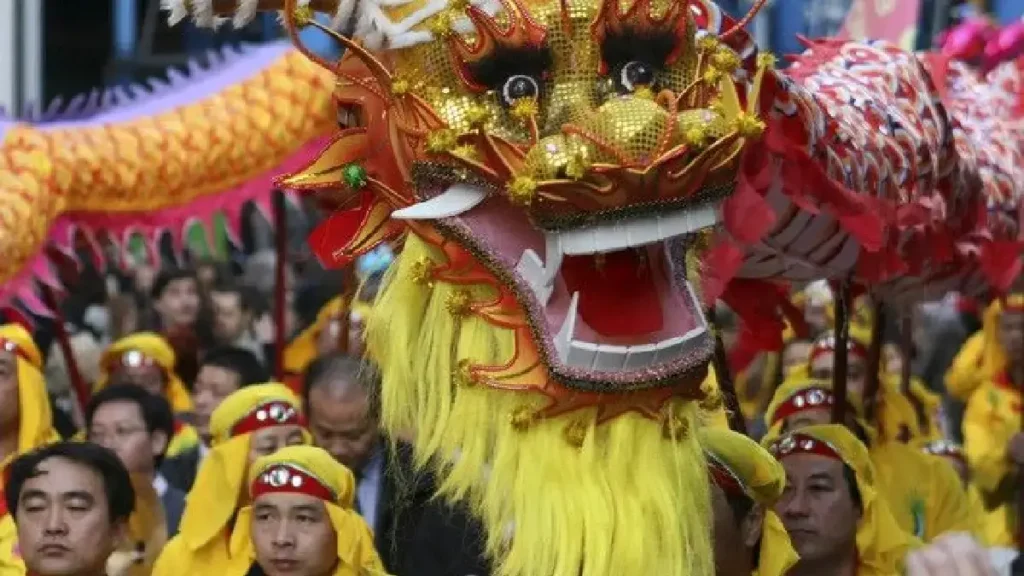
Lion and dragon dances are performed in public celebrations. They are believed to bring good luck and are a common feature of Chinese New Year festivities in many communities.
Fireworks
Fireworks and firecrackers are part of traditional celebrations in some regions. Safety regulations and community rules vary by location.
New Clothes
Wearing new clothes, especially in red or bright colors, is a traditional practice in many families.
Gift-Giving
Gift-giving is common, though the specific customs vary. Red envelopes are one form of gift exchange.
Traditional Chinese New Year Foods
Food plays a central role in Chinese New Year celebrations. Commonly associated foods include:
- Dumplings: Often eaten in northern China, sometimes shaped to resemble traditional ingots.
- Fish: The word for fish sounds similar to “surplus” in Chinese, making it a symbol of abundance.
- Longevity noodles: Long noodles symbolize long life.
- Glutinous rice cakes: Called nian gao, associated with growth and improvement.
- Tangyuan: Glutinous rice balls, often eaten during the Lantern Festival.
- Oranges and mandarins: Citrus fruits are associated with good fortune and are commonly exchanged as gifts.
These foods are not eaten by every family, and regional differences are significant. The list reflects common associations rather than universal practice.
What Are Red Envelopes?
Red envelopes are a central Chinese New Year tradition. They are small red packets, usually containing money, given during the festival period.
The Chinese term is hongbao. The red color is traditionally associated with good fortune and is believed to ward off negative influences.
Red envelopes are typically given by adults to children and younger family members. In some contexts, they are also given to employees or service workers. The amount can vary widely and is a personal or family decision.
Digital red envelopes have become common in recent years, especially through messaging and payment apps.
How Is Chinese New Year Celebrated Around the World?
Chinese New Year is celebrated in China, Hong Kong, Taiwan, Singapore, Malaysia, and many other countries with significant Chinese communities. It is also observed in the United States, United Kingdom, Canada, Australia, and other countries with Chinese diaspora populations.

In mainland China, Chinese New Year is a national holiday. Public holiday arrangements for 2027 have not yet been formally announced, though recent changes to China’s holiday system mean the Spring Festival holiday is now longer than in previous years.
In Hong Kong, the first four days of the Lunar New Year are public holidays, beginning February 6. In Malaysia, Chinese New Year’s Day and the second day are federal public holidays.
Celebrations in different countries reflect local cultures and traditions. They are not identical to celebrations in China.
Chinese New Year 2027 Holiday Period
Holiday schedules depend on the country and jurisdiction.
In mainland China, recent changes to the national holiday system extended the Spring Festival holiday. The revised system provides four statutory days for Spring Festival (New Year’s Eve and the first three days of the new year), with adjusted rest days bringing the total holiday to at least eight days.
Because New Year’s Eve 2027 falls on a Friday, the holiday can extend to nine consecutive days when connected with the weekend. This is a specific feature of the 2027 calendar.
The traditional festival period of 15 days is longer than the government-designated public holiday. The distinction between the two should be kept in mind.
2026 Year of the Horse → 2027 Year of the Goat
The Chinese zodiac animal changes at Chinese New Year, not on January 1.
2026 is the Year of the Fire Horse. 2027 is the Year of the Fire Goat, beginning February 6.
Someone born in January 2027 would still fall under the previous zodiac year (Horse) according to the Chinese calendar, even though their Gregorian birth year is 2027. The zodiac transition occurs on the date of Chinese New Year itself.
Is 2027 the Year of the Goat or Sheep?
English-language references use different translations for the same zodiac position:
- Goat
- Ram
- Sheep
These are translation choices for the same Chinese zodiac sign. They do not refer to three different zodiac animals.
The Smithsonian Institution uses “Goat (or Ram)”. Some other references prefer “Sheep”. In this article, Goat is used as the primary term, with the alternatives noted.
Chinese New Year 2027 Calendar at a Glance
| Event | Date |
|---|---|
| Chinese New Year | February 6, 2027 |
| First day of Year of the Fire Goat | February 6, 2027 |
| Spring Festival period begins | February 6, 2027 |
| Lantern Festival | February 20, 2027 |
Chinese New Year 2027 Wishes
Here are original wishes for the Year of the Fire Goat:
- Wishing you a warm and peaceful Year of the Fire Goat.
- May the new year bring creativity and harmony to your home.
- Happy Chinese New Year! May your family be blessed with health and happiness.
- Wishing you a bright and gentle year ahead.
- May the Fire Goat year bring you new beginnings and quiet strength.
- Happy Lunar New Year! May your days be filled with warmth and good company.
- Wishing you prosperity and peace in the Year of the Goat.
- May this new year bring you closer to the people you love.
- Happy Chinese New Year 2027! May your year be full of light and laughter.
- Wishing you a year of meaningful moments and gentle progress.
- May the Year of the Fire Goat bring you creativity and calm.
- Happy New Year! May your home be filled with joy and your heart with peace.
- Wishing you a wonderful Spring Festival and a happy new year.
- May this year bring you closer to your goals and your loved ones.
- Happy Chinese New Year! May the year ahead be kind to you.
FAQ Section
When is Chinese New Year 2027?
Chinese New Year 2027 begins on Saturday, February 6, 2027.
What animal is 2027 in the Chinese zodiac?
2027 is the Year of the Goat (also translated as Ram or Sheep).
Is 2027 the Year of the Goat or Sheep?
Both terms refer to the same zodiac position. English translations vary between Goat, Ram, and Sheep.
Why is Chinese New Year on February 6 in 2027?
The date is determined by the Chinese lunisolar calendar. In 2027, the first day of the new lunar year falls on February 6.
What is the Year of the Fire Goat?
It is the traditional zodiac designation for 2027, combining the Goat animal sign with the Fire element from the five-element system.
When does Lunar New Year 2027 end?
The traditional Spring Festival period lasts 15 days, ending with the Lantern Festival on February 20, 2027.
What is the Lantern Festival in 2027?
The Lantern Festival marks the end of the Chinese New Year celebration. In 2027, it falls on February 20.
Why does Chinese New Year change dates every year?
The Chinese calendar is lunisolar. Lunar months do not align exactly with the solar year, so the Gregorian date of Chinese New Year shifts annually. It generally falls between January 21 and February 21.
Is Chinese New Year the same as Lunar New Year?
Lunar New Year is a broader term covering New Year celebrations in multiple Asian cultures. Chinese New Year specifically refers to the Chinese tradition. The dates often coincide, but the customs differ.
What are common Chinese New Year traditions?
Common traditions include family reunions, reunion dinners, red envelopes, red decorations, lion and dragon dances, and gift-giving. Practices vary by region and family.
What foods are eaten during Chinese New Year?
Common foods include dumplings, fish, longevity noodles, glutinous rice cakes, tangyuan, and citrus fruits. Regional differences are significant.
What are red envelopes?
Red envelopes, called hongbao, are packets containing money given during Chinese New Year, typically to children and younger family members.