







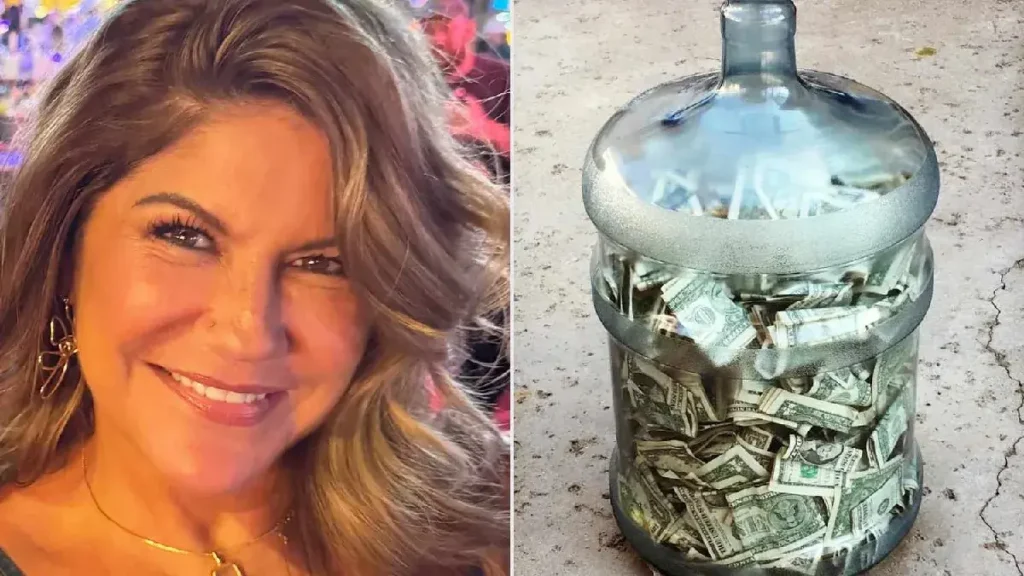
Most people dream of taking their family on an unforgettable vacation, but the cost can feel overwhelming. For Leslie DeVries, a 56-year-old hairstylist and mother of four from Lakewood, California, the solution was surprisingly simple. She saved over $16,000 for a family vacation by stashing spare $1 bills over the course of a decade. It’s a story that proves small, consistent actions can lead to remarkable results.





DeVries, who admits she’s not naturally good at saving money, discovered a method that worked for her — and it might work for you too. This article explores her clever money-saving strategy, why it’s so effective, and how you can apply similar principles to save for your own family adventures.
How One Mom Saved Over $16,000 with $1 Bills
Leslie DeVries is a hairstylist who has operated her own small barbershop for 15 years. She describes herself as someone who struggles with saving money, even joking about her “Amazon problem.” But when it comes to $1 bills, she has a different approach entirely.
Her method is refreshingly straightforward: whenever she receives $1 bills as change, she doesn’t spend them. Instead, she crumples the bill, reaches into the back of her closet where she keeps a large five-gallon water jug, and stuffs the dollar inside. Then she forgets about it.
DeVries got the idea from a client and thought it sounded like a fun challenge. She purchased the jug, placed it out of sight in her closet, and began her savings experiment. About a year later, she was reaching into the back of the closet and could feel money at the bottom of the jug. She emptied it, counted the bills — which totaled around $1,500 — and opened a dedicated savings account at the bank. Then she started the process all over again.
After a decade of this practice, DeVries has accumulated approximately $16,500 in savings. Her clients have even gotten involved, sometimes paying her entirely in $1 bills to help contribute to her fund.
She also created a helpful rule for herself: if she ever needs to take a bill or two from the jug because she’s out of cash, she “punishes” herself by putting five bills back.
Since the COVID-19 pandemic, when many people shifted to touchless payments and moved away from cash, DeVries admits her savings have grown a bit more slowly. Even so, her most recent count shows roughly $16,500 in savings from her $1 bill collection.
What Will She Spend the Money On?
DeVries plans to treat her entire family — including her four daughters and two of their spouses — to an all-inclusive tropical vacation. At her current savings rate, she estimates the trip will happen within the next year and a half. She jokes that her benchmark keeps shifting because her children keep getting married and adding new spouses to the equation.
“I want so badly to be able to pay for it all, because that’s the fun of the game,” she told PEOPLE. “And I’m just gonna lay by the pool and drink.”
Why This Simple Savings Method Works
There’s a reason DeVries’s strategy is so effective, and it goes beyond the actual money saved. Here’s why the $1 bill method works:
Consistency is key. By saving $1 bills consistently over many years, DeVries built a substantial fund without feeling deprived. It wasn’t about making huge sacrifices; it was about a small, repeated action.
Out of sight, out of mind. The jug was stored in the back of her closet where she couldn’t see it. This prevented the temptation to dip into the savings for everyday purchases.
Visible progress. There was something satisfying about watching the jug fill up over time. The physical accumulation of cash provided a visual reminder of her progress, which kept her motivated.
A specific goal. DeVries had a clear goal — a family vacation — which gave her savings purpose. Knowing why she was saving helped her stay committed.
Behavioral reinforcement. She created a simple rule: if she borrowed from the jug, she had to put back five times as much. This discouraged unnecessary withdrawals.
How Saving Small Amounts Can Add Up
DeVries’s story isn’t about saving thousands of dollars at once. It’s about the power of small, consistent savings over time. Here’s a simple illustration of how $1 bills can accumulate:
- **$1 per day** adds up to $365 in a year.
- **$5 per day** adds up to $1,825 in a year.
- **$10 per day** adds up to $3,650 in a year.
Over a decade, those amounts become $3,650, $18,250, and $36,500 respectively. Of course, DeVries wasn’t saving exactly one dollar per day — she was saving whatever $1 bills came her way — but the principle is the same. Small amounts, set aside consistently, grow into significant sums.
Could Saving $1 Bills Work for You?
DeVries’s method isn’t complicated, but it does require some discipline. Here’s how you can try it yourself:
Step 1: Get a container. Use a jar, a jug, or any container that will hold cash. Place it somewhere you won’t see it every day — a closet, a drawer, or a cupboard.
Step 2: Commit to the habit. Every time you receive a $1 bill as change, put it in the container. This works best if you use cash regularly.
Step 3: Don’t touch it. Once the money is in the container, leave it there. Resist the temptation to dip into it for everyday purchases.
Step 4: Set a goal. Think about what you’re saving for. It could be a family vacation, a special purchase, or even a rainy-day fund. Having a goal makes it easier to stay motivated.
Step 5: Consider a bank transfer. When the jug gets full, or after a set period, take the money to the bank and deposit it into a dedicated savings account. This prevents the money from being used and keeps it safe.
Simple Money-Saving Tips for Families
Beyond the $1 bill challenge, there are many other ways families can save money for vacations.
Create a dedicated vacation fund. Open a separate savings account specifically for your trip. Consider setting up automatic transfers from your checking account each payday.
Use a money-saving challenge. Many people find saving more fun when it’s framed as a challenge. The “$1 bill challenge” is one example, but there are countless others. You could also save every $5 bill you receive or challenge yourself to save a certain amount each week.
Reduce unnecessary spending. Take a look at your daily expenses. Could you cut back on takeout coffee, dining out, or subscription services you don’t use?
Sell unused items. Clutter in your home could be cash in your pocket. Sell items you no longer need online or at a local market. One financial expert, Skyler Fleming, suggests that this “clutter could turn into a sunset cruise.”
Involve the whole family. If you’re saving for a family trip, get everyone involved. Children can contribute their allowance, choose free activities for the weekend, or help with a no-spend challenge.
Book accommodations strategically. Staying somewhere with a kitchen allows you to cook some meals, saving a significant amount on food costs.
Be flexible with dates. Traveling during off-peak times can save you 30-50% on flights and hotels. Mid-week flights are often cheaper than weekends.
Frequently Asked Questions
How can I save money for a family vacation?
Start by setting a clear savings goal. Estimate the total cost of your trip — including transportation, lodging, food, and activities — and break it down into manageable monthly or weekly targets. A dedicated savings account and automatic transfers can help you stay on track.
How much can you save by putting away $1 a day?
Saving $1 per day adds up to $365 in a year. Over five years, that becomes $1,825. Over a decade, it becomes $3,650 — not including any interest you might earn.
What is the $1 savings challenge?
The $1 savings challenge involves saving every $1 bill you receive instead of spending it. This is exactly the strategy Leslie DeVries used to save over $16,000 for a family vacation. It’s a simple, low-pressure way to build a savings fund.
How can I save vacation money quickly?
To accelerate your savings, try a no-spend challenge — a self-imposed freeze on non-essential purchases for a weekend, a week, or a month. Sell unwanted items online, reduce daily expenses like takeout coffee, and consider a side hustle. Every dollar saved is a step closer to your trip.
What is the easiest way to start a vacation fund?
One of the simplest ways is to open a separate, dedicated savings account and set up automatic transfers from your main account on payday. Treat this savings like a recurring bill that you pay yourself.
How do small savings add up over time?
Small savings add up through consistency and time. Saving $5 a day might not feel significant in the moment, but over a year it becomes nearly $2,000. Over several years, it can grow into a substantial sum that makes a dream trip possible.