





Introduction




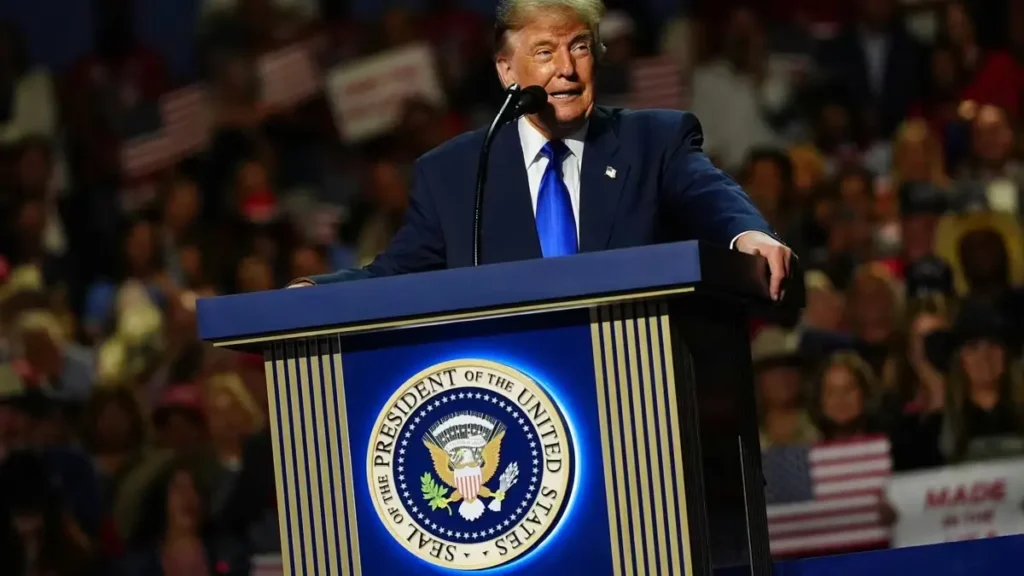
President Donald Trump launched a 32-day campaign blitz this week, hitting the trail in states across the country as Republicans fight to preserve their narrow congressional majorities in the November 3 midterm elections. With control of both the House and Senate hanging in the balance, the president and Vice President JD Vance are concentrating their efforts on shoring up Republican turnout—often in deep-red territory where once-safe seats have become unexpectedly competitive.
Trump Kicks Off October Campaign Sprint
President Trump began his final-stretch campaigning on Thursday with stops in Texas and Oklahoma, followed by a rally in Alabama on Friday. The events mark the start of what the president has described as an intensive, near-daily travel schedule through Election Day.
White House chief of staff Susie Wiles privately presented the president’s upcoming travel calendar to Republican senators on Capitol Hill this week, describing a sprint that one attendee characterized as “extensive and almost every day, all across the country”.
Trump’s itinerary for the coming days includes:
- Thursday, October 1: Texas (Denton) and Oklahoma (Durant)
- Friday, October 2: Alabama (Mobile)
- Saturday, October 3: Ohio (Vandalia)
- Monday, October 5: Nebraska (Grand Island)
Vice President Vance has been campaigning in parallel, holding events in Texas and Florida this week. Vance rallied with Republican candidate Eric Flores in a competitive South Texas House race on Wednesday before heading to Lakeland, Florida, to campaign alongside gubernatorial candidate Rep. Byron Donalds.
Why Deep-Red States Are Getting Top Billing
While Trump had promised to barnstorm the 35 most competitive districts in the country, his first week of campaigning is taking him primarily through reliably Republican territory. The choice reflects a strategic calculation: Republicans need to energize their base and maximize turnout among low-propensity voters in states and regions that typically lean heavily conservative.
Republican National Committee spokesperson Natalie Baldassarre said the president’s “ability to engage with and activate low-propensity voters is unmatched,” adding that he will be “barnstorming the country to activate the voters we need to win in November”.
Republican officials have noted that the locations are chosen with media markets in mind. Trump’s rally in Durant, Oklahoma, sits near the Texas border and within the Dallas-Fort Worth media market, allowing his message to reach Texas voters even while he campaigns in a neighboring state. Similarly, his Mobile, Alabama, event is intended to shore up support in Florida’s adjacent panhandle.
A person familiar with the party’s strategy, speaking on condition of anonymity, said Republican officials will not send Trump to places where they believe his presence could hurt candidates—a tacit acknowledgment that the president’s popularity varies significantly by region.
Key Congressional Races and Candidates
Texas Senate Race
Trump’s Thursday visit includes a stop at a truck manufacturing facility in Denton, Texas, where he is expected to appear with Attorney General Ken Paxton. Paxton, whom Trump backed over incumbent Sen. John Cornyn in the Republican primary, faces Democratic state Rep. James Talarico in a race that has drawn significant national attention.
Talarico has maintained a slight lead in most recent polling averages, though the race remains within the margin of error. Republicans have spent heavily in Texas to bolster Paxton, and Trump’s visit is aimed at driving turnout among conservative voters in the state’s vast suburban and rural areas.
Oklahoma Governor’s Race
In Oklahoma, Trump will campaign with Republican gubernatorial nominee Mike Mazzei, who faces Democratic state House Minority Leader Cyndi Munson. The event is being held on the Choctaw Nation of Oklahoma, making Trump one of only a handful of U.S. presidents to visit a tribal nation while in office.
Democratic Governors Association spokesperson Kevin Donohoe said the rally demonstrates that Republicans “are in full-on panic mode” regarding the Oklahoma race.
Florida Governor’s Race
Vice President Vance’s Thursday stop in Lakeland, Florida, is focused on Rep. Byron Donalds, the Republican nominee for governor. Donalds faces David Jolly, a former Republican congressman who is now running as a Democrat.
Florida Republicans have encountered turbulence in the governor’s race, with voter concerns about affordability and data center development becoming central issues in the campaign.
Ohio and Nebraska
Trump’s scheduled stops in Ohio (Vandalia) and Nebraska (Grand Island) reflect the expanded map of competitive races. Both states feature Republican incumbents or candidates who are facing stronger-than-expected Democratic challenges.
The Broader 2026 Political Landscape
House Control at Stake
Republicans currently hold a narrow majority in the House of Representatives. Democrats need a net gain of just three seats to reclaim control of the chamber, which would give them the ability to set the legislative agenda and chair committees.
The Cook Political Report shifted 15 House races toward Democrats in late September, with the nonpartisan handicapper now favoring Democrats in 208 races compared to 205 for Republicans. Seventeen Republican-held seats are currently rated as toss-ups, versus just five Democratic-held seats.
The National Republican Congressional Committee disputed the significance of the ratings, arguing that House races are decided district by district and pointing to Republican advantages in campaign organization and financing.
Senate Math
Democrats face a more challenging path in the Senate. Republicans currently hold 53 seats, and Democrats would need to win four seats—assuming they hold all their current seats—to gain control, given the vice president’s tie-breaking vote.
However, several Republican-held Senate seats are now considered competitive, including in Texas, Maine, Ohio, Iowa, Alaska, and North Carolina. Democratic candidates have held polling leads in several of these states, though analysts caution that polling can shift and that Republicans retain a significant financial advantage in many races.
Cook Political Report founder Charlie Cook said in a television interview that Democrats retaking the House has been “kind of a done deal for a good while,” while calling Democratic chances of flipping the Senate “very realistic”.
The Trump Factor
President Trump’s approval ratings have fallen to their lowest levels of his second term. A Reuters/Ipsos poll cited in multiple reports put his approval at 32 percent, with a disapproval rate of 66 percent. CNN’s analysis noted that Trump’s numbers are “worse than any modern president heading into a midterm”.
The president’s handling of the economy and the ongoing conflict with Iran have emerged as central issues for voters. Gas and diesel prices have risen since the conflict began in late February, and surveys show most Americans believe the country is headed in the wrong direction.
Vice President Vance, speaking in Harlingen, Texas, on Wednesday, acknowledged voter frustration over high prices but sought to shift blame to the previous administration. “I know that there are people out there who are frustrated by the pace of progress,” he said, adding that the administration has “spent every single day fighting for you”.
Where the Parties Stand
Republican messaging has focused on base mobilization and framing the election as a choice between Republican economic policies and Democratic alternatives. The RNC has emphasized the president’s ability to energize voters and pointed to Republican financial advantages in key races. Delanie Bomar, an RNC spokesperson, said Republicans are “full steam ahead to protect and expand our majorities”.
Democratic messaging has centered on affordability, the Iran conflict, and Trump’s unpopularity. DNC Deputy Communications Director Kendall Witmer said Trump and Vance “started a deadly and costly war with Iran that sent the economy spiraling and pushed prices even higher” and are now “desperately pleading with voters”.
Independent analysts note that while the national environment favors Democrats, individual races will be decided by candidate quality, local issues, and turnout. Nathan Gonzales of Inside Elections cautioned that “there’s no such thing as a generic congressional race,” emphasizing that candidates have “different levels of fundraising, different levels of name ID, different levels of baggage”.
What to Watch Next
- Trump’s campaign schedule: The president is expected to hold rallies nearly every day through November 3, with additional stops in traditional battleground states beginning October 3.
- Vance’s travel: The vice president is expected to continue campaigning in competitive House and Senate districts, with additional stops in Ohio planned.
- Fundraising and ad spending: Republicans have reserved more airtime in all nine of the most competitive Senate races, according to AdImpact data. How that financial advantage translates into polling movement will be closely watched.
- Early voting: Early and absentee voting deadlines vary by state. Voters can check their state election office for specific dates and requirements.
- Final Cook Political Report ratings: The nonpartisan handicapper is expected to issue additional race rating updates before Election Day.