






Smart toothbrushes have evolved far beyond simple timers and vibration modes. The newest generation of oral-care devices combines cameras, artificial intelligence, and visual feedback to show users exactly what their brushing routine may be leaving behind.





Two products have defined this emerging category in 2026. Dyson’s CameraJet, launched September 1, arrived as a $499.99 camera-equipped toothbrush that uses AI to detect gaps between teeth and automatically blast them with a mouthrinse jet. Then there’s the Usmile D50 OralCam — a $199.99 device that takes a different approach. Instead of hunting for gaps, the D50 uses a camera and violet light to visualize plaque-associated buildup on tooth surfaces.
The price difference is substantial. But the two products are designed around fundamentally different technological objectives. A lower price does not automatically mean equivalent functionality — and it doesn’t mean the D50 is “better.” It means buyers have a new option to consider, with different strengths and trade-offs.
This article breaks down what each device does, how their cameras work, and what you should know before choosing between them.
What Is the Usmile D50 OralCam?
The Usmile D50 OralCam is the flagship product in Usmile’s new D Series oral-care system. It is an electric toothbrush with a built-in intraoral camera designed to help users visualize areas of their mouth that may need more attention during brushing.
Key verified features include:
- 300,000-pixel intraoral camera integrated into the brush handle
- Six 405nm violet LEDs for specialized illumination
- Quantitative Light-induced Fluorescence (QLF) technology that causes plaque-associated compounds to fluoresce red or pink under violet light
- Machine-learning-assisted feedback that highlights areas for extra attention
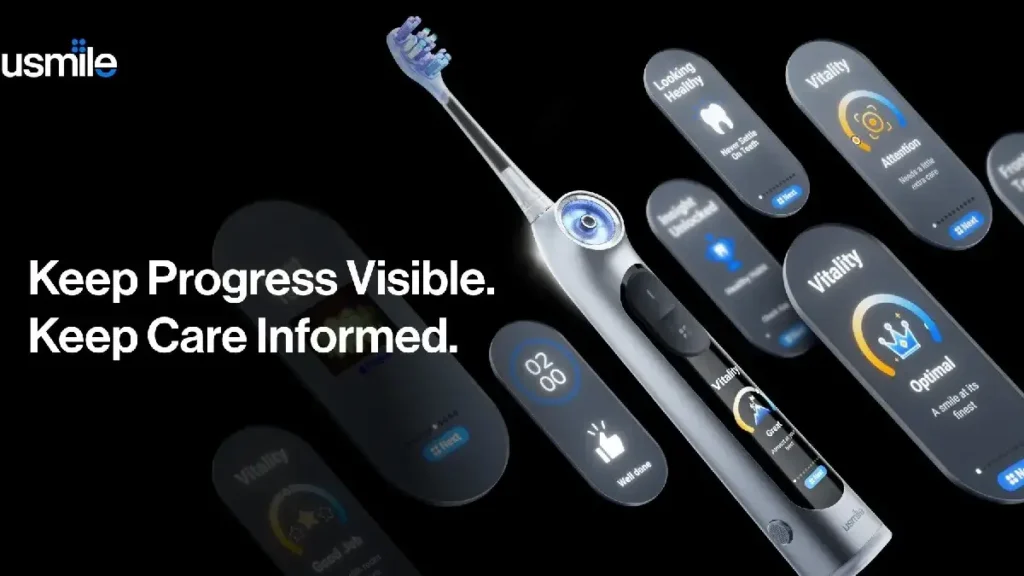
- On-handle display for real-time scan guidance and feedback
- Bluetooth connectivity to the Usmile app for sending scans
- Local processing — Usmile says the D50 has no Wi-Fi and does not upload images to the cloud
The D50 is designed to help users see what their brushing may have missed. It is not a medical diagnostic device. Usmile explicitly states that the D50 does not diagnose dental disease or replace exams, X-rays, professional cleaning, or clinical judgment.
How the D50 Camera Works
The D50’s imaging system relies on a technique called Quantitative Light-induced Fluorescence, or QLF.
Here’s how it works in simple terms:
Violet light exposure: The six 405nm LEDs illuminate the tooth surface with violet light.
Fluorescence: Certain compounds associated with plaque bacteria fluoresce — they glow red or pink — under this specific wavelength of light.
Camera capture: The 300,000-pixel intraoral camera captures images of these glowing areas.
Machine learning: On-device processing helps identify and highlight these plaque-associated signals for the user.
Visual feedback: The handle display shows users where these signals appear, suggesting areas that may need more thorough brushing.
This is fundamentally different from Dyson’s approach. The D50 is designed to visualize plaque-associated signals on oral surfaces — not to detect gaps between teeth or automatically floss.
Important context: A visible red or pink fluorescent area does not automatically mean disease. It indicates the presence of compounds associated with plaque bacteria. Consumer imaging is not the same as professional dental diagnosis.
What Makes the D50 Different From a Normal Smart Toothbrush?
To understand the D50’s place in the market, it helps to understand the evolution of toothbrush technology.
Traditional electric toothbrush: Focuses on brushing duration, pressure, movement, and brushing modes. It helps you brush, but doesn’t tell you what you missed.
Smart toothbrush: Adds sensors, app connectivity, and brushing coverage tracking. It logs data for later review but doesn’t show you your mouth in real time.
Camera-based toothbrush (D50): Adds visual information. The D50’s central proposition is showing users more information about the visible result of brushing — not simply measuring how the brush moved.
The D50 is designed to close the feedback loop during brushing, not after. The on-handle display provides immediate visual information rather than requiring users to check an app later.
Dyson CameraJet: What Does It Do?
The Dyson CameraJet represents a different technological philosophy. Priced at $499.99, it combines an electric toothbrush, liquid flosser, and intraoral camera into a single device.
According to Dyson’s official information, the CameraJet features:
- 100,000-pixel macro lens camera with a 1mm intraoral field of view
- Gap Optical Targeting — an AI machine-learning algorithm that scans 28 live images per second to identify, track, and predict gaps between teeth
- Conical jet that triggers within 100 milliseconds of detecting a gap, delivering a burst of mouthrinse to clean between teeth
- Anti-gravity tank with 12.5ml capacity that works in any orientation
- Variable sonic oscillation designed to prevent bristle stalling
- MyDyson app for live camera viewing and cleaning insights
- Three brushing intensities including a Gentle mode
- Wi-Fi and Bluetooth connectivity
Dyson’s camera serves two purposes: it identifies gaps for the automatic flossing jet, and it provides a live view of the mouth through the app.
Dyson states that camera images processed on the device or in the app are never stored or shared, and that Dyson and third parties cannot access them.
Usmile D50 vs Dyson CameraJet: Price
The most obvious difference between these two products is cost.
| Product | Verified U.S. Price | Camera | Primary Smart Feature |
|---|---|---|---|
| Usmile D50 OralCam | $199.99 | 300,000-pixel intraoral camera | Visual plaque-associated imaging |
| Dyson CameraJet | $499.99 | 100,000-pixel macro camera | Gap detection + targeted liquid jet |
Important pricing notes:
- These are U.S. prices at the time of publication.
- Usmile pricing can vary depending on promotions and region.
- Dyson’s $499.99 is the standard U.S. retail price for the complete system.
- The price difference reflects different technological approaches, not necessarily a quality difference.
The D50 costs $300 less than the CameraJet, but the two devices are not interchangeable. Each is designed to solve a different problem.
Camera Technology Comparison
The cameras in these two devices serve fundamentally different purposes.
Usmile D50 OralCam
- Resolution: 300,000 pixels
- Illumination: Six 405nm violet LEDs
- Technique: Quantitative Light-induced Fluorescence (QLF)
- Primary function: Visualize plaque-associated signals on tooth surfaces
- Processing: On-device, local
- Display: On-handle screen for real-time feedback
- Connectivity: Bluetooth only, no Wi-Fi
Dyson CameraJet
- Resolution: 100,000 pixels
- Illumination: Stroboscopic light with dome-shaped target lens
- Technique: Gap Optical Targeting — AI machine learning trained on 470,000 dental images
- Primary function: Identify interdental gaps and trigger targeted liquid jets
- Processing: On-device or in app; images not stored or shared
- Display: MyDyson app for live viewing and insights
- Connectivity: Wi-Fi and Bluetooth
The D50’s higher camera resolution supports its plaque-visualization function. The CameraJet’s lower resolution camera is optimized for rapid gap detection at 28 frames per second, which requires different engineering priorities than capturing detailed still images.
D50 vs Dyson: What the Camera Actually Does
This is the most important distinction for potential buyers.
The Usmile D50 focuses on visualizing oral surfaces and plaque-associated signals. It shows you areas where plaque-related compounds are present so you can brush more thoroughly. It does not identify gaps or automatically floss.
The Dyson CameraJet uses its camera primarily to identify interdental gaps and guide targeted liquid flossing. It also provides live visualization through the app, but its core function is automated flossing — detecting gaps and blasting them with mouthrinse while you brush.
In simple terms: the D50 is a visualization tool that helps you see what you missed. The CameraJet is an automation tool that cleans between teeth for you.
Both provide visual feedback. Both use AI. But they are designed around different user needs and different definitions of “smart oral care.”
Does the Usmile D50 Replace a Dentist?
No. Neither device does.
A camera toothbrush can provide consumer-level visual information and brushing guidance, but it cannot replace:
- Dental examinations
- Professional cleaning
- X-rays
- Periodontal assessment
- Cavity diagnosis
- Professional treatment
Usmile explicitly states that the D50 does not diagnose dental disease and is not a substitute for professional care. Dyson similarly does not claim that the CameraJet can diagnose cavities or gum disease.
The cameras in these devices are designed to help with daily hygiene awareness — not to serve as medical diagnostic instruments.
If you notice persistent bleeding, pain, sensitivity, or other concerning symptoms, consult a dentist regardless of what any at-home device shows.
Is the Usmile D50 Really a Cheaper Dyson Alternative?
This is the central question, and the answer requires nuance.
The D50 can be described as a lower-priced camera-based smart toothbrush option, but it is not a one-for-one replacement for every Dyson CameraJet feature.
Here’s how the capabilities compare:
| Feature | Usmile D50 OralCam | Dyson CameraJet |
|---|---|---|
| Built-in camera | Yes, 300K pixels | Yes, 100K pixels |
| Visual oral imaging | Yes, on-handle display | Yes, via MyDyson app |
| 405nm violet illumination | Yes, six LEDs | Not the same system |
| Plaque visualization | Yes, via QLF technology | Different approach |
| AI/machine learning | Yes, for image analysis | Yes, Gap Optical Targeting |
| Interdental gap targeting | No | Yes |
| Targeted liquid jet | No | Yes, conical mouthrinse jet |
| Companion app | Yes, Bluetooth only | Yes, MyDyson |
| On-device processing | Yes | Yes |
| Wi-Fi | No | Yes |
| Water flossing system | No | Yes, 12.5ml anti-gravity tank |
| Current U.S. price | $199.99 | $499.99 |
What this means for buyers:
If you want to see plaque-associated buildup on your teeth and get visual feedback on your brushing, the D50 offers that at a lower price. If you want automated interdental flossing with a liquid jet, only the CameraJet provides that function.
The D50 is not a “Dyson killer.” It’s a different product for a different need at a different price point.
Usmile D50 Technology Behind the Product
Usmile has positioned the D50 as the result of extensive development in oral-care technology.
Company-stated development details include:
- Six years of development
- LumaSight imaging technology
- 300,000-pixel intraoral camera
- Six 405nm violet LEDs
- Tooth-level recognition and motion sensing
- On-device computing for image processing
- Five-zone guided scanning
Privacy and Data
For any camera-equipped device that goes inside your mouth, data privacy is a legitimate concern.
Usmile D50
According to Usmile’s published information:
- No Wi-Fi connectivity — the device uses Bluetooth only
- Core image processing occurs locally on the device
- Images are not uploaded to the cloud for Usmile to view
- Account registration may be required for app use, but the handle display works without a phone
Dyson CameraJet
According to Dyson’s published information:
- Camera is active only during live viewing or automatic jetting
- Images processed on the device or in the MyDyson app are never stored or shared
- Dyson and third parties cannot access them at any time
- Wi-Fi and Bluetooth connectivity are available for app features
Important caveat: Privacy policies can change. Buyers should verify current data practices directly with the manufacturer before purchasing.
Battery, Charging and Everyday Use
Practical ownership factors matter as much as flashy AI features.
Usmile D50
- Battery life: Not independently verified at publication time; Usmile has not published specific battery life figures in available materials
- Charging method: Not confirmed in available documentation
- Water resistance: Designed for bathroom use; specific IP rating not confirmed
- On-handle display: Provides guidance without requiring a phone
Dyson CameraJet
- Battery life: 10 days (manufacturer specification)
- Charging type: USB-C to pogo-pin, with a refill dock that also charges
- Water resistance: IPX7
- Weight: 0.51 lb (brush only)
- Dock dimensions: 12.4 x 4.13 x 1.97 inches
- Travel case: Included
The Dyson system includes a larger countertop footprint due to its refill dock, which holds 6.76 fl oz of liquid and refills the brush’s tank in three seconds. The D50’s charging setup has not been detailed in available public materials.
Consumer Reports noted that the CameraJet’s dock is bulky and the device has a learning curve, describing the setup as “unintuitive” in a September 2026 first look.
Replacement Costs and Long-Term Price
A cheaper upfront price does not necessarily mean a cheaper long-term ownership cost.
Dyson CameraJet
- Replacement brush heads: Pricing not publicly confirmed at publication; each head is designed for three months of use with RFID tracking
- Mouthrinse and toothpaste: Dyson recommends nonfoaming formulations specifically designed for the CameraJet
- Consumables: The device uses mouthrinse in its 12.5ml tank during operation
Usmile D50
- Replacement brush heads: Pricing not publicly confirmed at publication
- Consumables: Standard toothpaste; no special liquid required for core function
- D-lite accessory: $69.99 separately, for smartphone-based oral inspection
Long-term cost considerations: Both devices require ongoing purchases of brush heads. Dyson’s system also involves mouthrinse consumables and specific toothpaste recommendations. Buyers should research current replacement costs before purchasing.
Who Might Be Interested in the Usmile D50?
Could appeal to people who:
- Want visual feedback on their brushing without automated flossing
- Are interested in plaque visualization technology
- Prefer a lower-priced entry into camera-based oral care
- Want on-device feedback rather than app-dependent operation
- Prefer a device with no Wi-Fi connectivity
May want to look at other options if:
- They specifically want automated interdental flossing with a liquid jet
- They prefer a device with a companion app that offers live streaming over Wi-Fi
- They want Dyson’s Gap Optical Targeting system specifically
- They are looking for a clinically tested automated flossing solution
Pros and Considerations
Usmile D50 — Potential Advantages
- $199.99 price point — significantly lower than CameraJet
- 300K-pixel camera — higher resolution than Dyson’s 100K camera
- QLF plaque visualization — shows plaque-associated signals
- On-handle display — real-time feedback without a phone
- Local processing, no Wi-Fi — potential privacy benefit
- Six years of development per Usmile
Usmile D50 — Potential Considerations
- No automated flossing — does not detect gaps or jet liquid
- Consumer imaging is not diagnosis — cannot replace dental exams
- Limited independent reviews — not yet widely reviewed by tech publications
- Battery and charging details not fully specified in available materials
- No clinical testing data publicly available for plaque reduction vs. other brushes
Dyson CameraJet — Potential Advantages
- Gap Optical Targeting — automated interdental flossing
- Conical jet mouthrinse — cleans between teeth while brushing
- Live camera view via MyDyson app
- Clinically tested claim for plaque removal vs. manual brush
- IPX7 waterproof and 10-day battery
Dyson CameraJet — Potential Considerations
- $499.99 price — significantly higher
- Learning curve — Consumer Reports found it unintuitive
- Bulky dock — takes up counter space
- Specific consumables required — nonfoaming toothpaste and mouthrinse
- Reliability concerns — Consumer Reports unit stopped working within 24 hours
What Independent Reviewers Say
Dyson CameraJet
PCMag tested the CameraJet at IFA and called it “easily the most advanced oral hygiene product I’ve ever experienced.” The reviewer found the real-time gap detection impressive and said it “appears truly useful.”
Consumer Reports had a different experience. Their review unit stopped working within 24 hours. The reviewer found the device “unintuitive” and noted challenges with the LED indicator system and brushing method.
Usmile D50
Independent hands-on reviews of the D50 are not yet widely available from major tech or consumer publications. Digital Trends mentioned the D50 in a September 2026 article but did not provide a full hands-on review.
Important distinction: PCMag’s positive experience and Consumer Reports’ negative experience with the same product illustrate that individual results vary. Neither review represents a universal outcome.
Final Takeaway
The Usmile D50 OralCam is interesting because it brings camera-based visual oral-care technology into a lower-priced category than Dyson CameraJet. At $199.99, it offers a 300K-pixel camera and QLF plaque visualization — features that could help users see what their brushing routine may be leaving behind.
But the two products are designed around different feature sets:
- D50 emphasizes visual oral imaging and plaque-related feedback
- Dyson emphasizes gap targeting, live camera visualization, and precision liquid flossing
- Price is an important difference — $199.99 vs. $499.99
- Long-term costs — brush heads, consumables, and accessories — should be considered
- Neither replaces professional dental care
The D50 is not a “Dyson killer” or a direct competitor to every CameraJet feature. It’s a different product at a different price point for a different set of user priorities. Buyers should match features to their own needs rather than assuming a lower price means equivalent functionality.
FAQ
What is the Usmile D50 OralCam?
The Usmile D50 OralCam is a $199.99 electric toothbrush with a built-in 300,000-pixel intraoral camera and six 405nm violet LEDs. It uses Quantitative Light-induced Fluorescence to visualize plaque-associated signals on tooth surfaces.
How much does the Usmile D50 cost?
The D50 is priced at $199.99 in the U.S. Promotional pricing may vary.
Does the Usmile D50 have a camera?
Yes. It has a 300,000-pixel intraoral camera integrated into the brush handle, along with six violet LEDs for plaque visualization.
What does the Usmile D50 camera detect?
The D50 camera is designed to visualize plaque-associated signals that fluoresce red or pink under 405nm violet light. This is not the same as diagnosing dental disease.
Is the Usmile D50 cheaper than Dyson CameraJet?
Yes. The D50 costs $199.99, while the Dyson CameraJet costs $499.99 — a $300 difference.
What is the difference between Usmile D50 and Dyson CameraJet?
The D50 focuses on visualizing plaque-associated signals on tooth surfaces. The CameraJet uses its camera to detect interdental gaps and automatically jet them with mouthrinse. They have different technological objectives.
Can the Usmile D50 detect cavities?
No. Usmile explicitly states that the D50 does not diagnose dental disease or replace professional dental examinations.
Can a camera toothbrush replace a dentist?
No. Camera toothbrushes provide consumer-level visual information and brushing guidance. They cannot replace dental exams, X-rays, professional cleaning, or clinical judgment.
Is the Usmile D50 worth considering?
Whether the D50 is worth considering depends on your priorities. If you want visual feedback on plaque-associated buildup at a lower price point than Dyson, the D50 offers that. If you want automated interdental flossing with a liquid jet, the CameraJet is the only option with that feature. Neither is universally “better” — they serve different needs.