





About 400 schools and other educational establishments across France were expected to remain closed on Friday, October 2, 2026, after a wave of student protests over education conditions escalated into violence in several cities. French Education Minister Édouard Geffray said late Thursday that “a little over 400 schools and other educational establishments” were known to be closed.




The protests, which began in the Paris region last month over teacher shortages, overcrowded classrooms and deteriorating school buildings, have spread nationwide. Some demonstrations turned violent, with fires reported at high schools, clashes between protesters and police, and hundreds of arrests. The French government has described the situation as “urban violence” and convened an emergency cabinet meeting.
Here is what is known so far about the protests, the school closures, and the government’s response.
What Happened in France?
On Friday, October 2, 2026, approximately 400 schools and educational institutions remained closed across France. Education Minister Édouard Geffray told France 2 television on Thursday evening that “a little over 400 schools and other educational establishments” would be closed.
The closures affected high schools (lycées) that serve students aged 15 to 18 during their final three years of secondary education. Some closures occurred because fire protection systems had been destroyed during protests, while others were shuttered because staff had been “deliberately targeted,” Geffray said.
The protests have spread from the Paris region—where they began in late September—to cities across the country, including Nantes, Marseille, Strasbourg, Toulouse, Lille, and Rouen. University students have also joined the movement, blocking access to approximately 30 university campuses in Paris, Marseille and other cities, according to student unions.
Police reported approximately 900 protests, blockades and related incidents near high schools across France on Thursday alone. The situation remained developing as of Friday morning, with further updates expected from authorities.
Why Are French Students Protesting?
The protests were initially sparked by grievances over the conditions of France’s public education system. Students have cited several core issues:
Teacher shortages: A chronic shortage of teachers has left many classes without qualified instructors, a problem that has persisted in various regions of France.
Overcrowded classrooms: Students report class sizes of up to 35 pupils per room, making learning conditions difficult. One 17-year-old protester in Strasbourg told reporters: “There are 35 of us per classroom. With 35°C in summer, it’s unbearable”.
Deteriorating school buildings: Many students have described crumbling infrastructure, including water leaks, insufficient toilet facilities, and cafeterias that are too small to accommodate the student population.
Class schedules: Excessive timetables have also been cited as a source of student frustration.
The protests began at Saint-Exupéry High School in Créteil, southeast of Paris, on September 21, 2026, initially over teacher staffing shortages. The movement quickly expanded to other schools in the Paris region before spreading nationally on September 29.
The timing of the protests coincides with the French government’s preparation of its 2027 budget, which includes plans for billions of euros in public spending cuts. Teacher unions, firefighters, and healthcare workers have also announced strikes and demonstrations over these austerity measures.
How Did Some Student Protests Turn Violent?
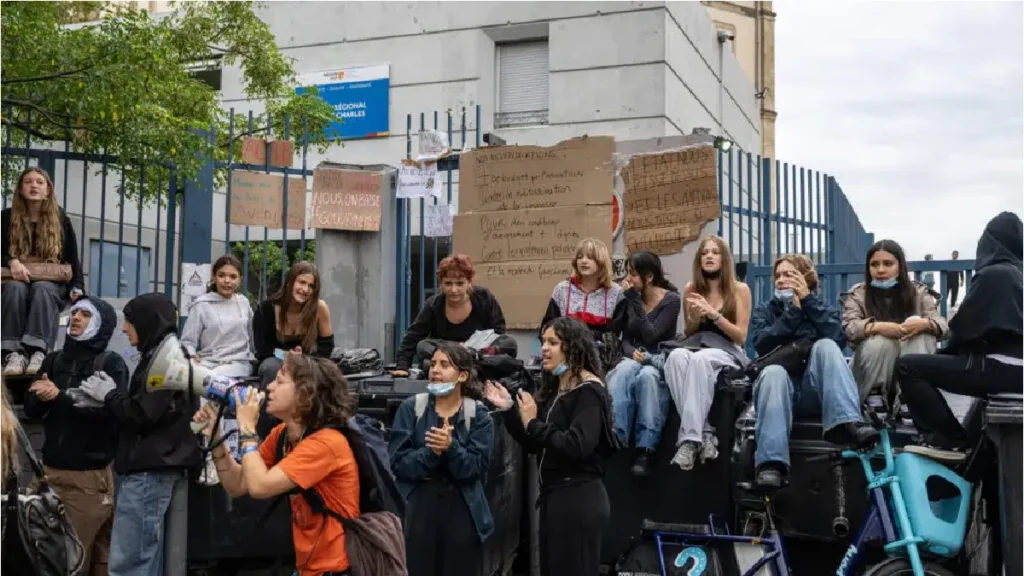
While many protests remained peaceful—with students staging blockades, demonstrations, and sit-ins—violence was reported in multiple locations.
Fires at schools: In the western city of Nantes, fires were reported at two high schools. At the Nelson Mandela High School, a fire that began in a trash bin spread to the building. In Rouen, footage showed flames at a school entrance. In Marseille, a fire was reported at a high school, and firefighters who responded were reportedly attacked by protesters.
Attacks on staff: At Victor Hugo High School in Marseille, the principal, deputy principal, and two other staff members were attacked and sprayed with gasoline, according to authorities. In Auchel, a vocational school principal was injured in the ear by a pyrotechnic projectile and taken to hospital.
Clashes with police: Riot police clashed with young people in Toulouse, Strasbourg, and other cities. In Strasbourg, tram services were ordered to halt to “restrict the movements of rioters and demonstrators”. In Saint-Denis, fireworks and tear gas were used during confrontations.
Arrests: French Interior Ministry figures indicated that 1,949 people were arrested on Thursday alone, the vast majority of them minors. Since the protests began, cumulative arrests have reached approximately 3,000.
Injuries: According to the Education Minister, 170 students and 65 education staff members have been injured since the movement began. Police reported that 305 officers were injured in clashes on Thursday. In Marseille, teachers were accidentally sprayed with gasoline during an incident.
The government has characterized the escalation as “urban violence,” with Prime Minister Sébastien Lecornu’s office stating that the surge in violence has made it “practically impossible” to maintain the continuity of public education and that staff and students are being exposed to risk.
How Many French Schools Were Closed?
According to Education Minister Édouard Geffray, “a little over 400 schools and other educational establishments” were expected to remain closed on Friday, October 2, 2026. The minister stated that the figure was based on information available at the time of his interview with France 2 on Thursday evening.
The number refers to schools that were either confirmed or expected to be closed. Some closures resulted from physical damage—such as destroyed fire protection systems—while others occurred because staff had been deliberately targeted and could not safely operate.
It is important to note that school closure figures can change as demonstrations develop. Readers should rely on the latest official updates from French authorities for real-time information.
Separately, more than 160 schools were reported closed on Thursday as a direct result of protests, according to police and media reports. The figure of “about 400” for Friday represents the anticipated closures for the following day.
What Are Authorities Saying About the Protests?
French authorities have made several statements about the protests, including claims about political involvement.
Intelligence claims about political organizers: According to a source close to Prime Minister Sébastien Lecornu, intelligence services reported at a crisis meeting on Thursday that the protest movement was initiated by far-left politicians, including members of the France Unbowed (LFI) party.
Denial from LFI: Louis Boyard, a parliamentarian from LFI, denied the claim in statements to French media. LFI’s 2027 presidential candidate, Jean-Luc Mélenchon, said on Wednesday that his party “called for non-violent methods of struggle”.
Government characterization: Prime Minister Lecornu’s office stated that the escalation of violence has made it “practically impossible” to guarantee the normal continuation of public education. The Interior Ministry has described the situation as uncontrolled violence.
Police conduct investigation: Interior Minister Laurent Nunez said an internal police watchdog (IGPN) has opened three separate investigations following accusations of brutality against three students during clashes.
The claim that far-left politicians organized the protests should be understood as an attributed statement from government sources, not as an independently established fact. LFI has denied the allegation, and no independent verification has been reported.
What Is the French Government Saying?
The French government has taken several documented actions in response to the protests:
Emergency cabinet meeting: Prime Minister Sébastien Lecornu convened a crisis cabinet meeting on Thursday and instructed ministers to cancel planned travel to manage the situation.
Switch to online learning: The government announced that a number of schools would switch to online learning to guarantee the safety of students and teaching staff.
Education Minister meeting: Édouard Geffray was scheduled to meet with student representatives on Friday, October 2, to hear their demands.
Dialogue commitment: Geffray expressed regret that the student movement had fallen under the influence of aggressive groups and said he intended to continue dialogue with unions and student organizations.
The government has not announced any changes to education policy or budget plans in response to the protests as of publication.
What Do French Students Want?
Based on statements from protesters and reporting on the demonstrations, students are demanding improvements to the French public education system. Documented demands include:
- More teachers to address chronic staffing shortages
- Smaller class sizes to reduce overcrowding
- Better school facilities including repairs to deteriorating buildings
- Improved resources including adequate toilets, cafeterias, and climate control during heatwaves
- Reduced class schedules to ease excessive timetables
One student in Strasbourg described the conditions: “The building is falling apart, the cafeteria is too small. There’s zero budget, zero resources, not enough supervisors”.
These demands have emerged from student statements and protest actions rather than from a formal published platform from a single organizing body.
What We Know and What Remains Unclear
| Issue | What Is Known |
|---|---|
| Schools affected | Approximately 400 schools and educational establishments expected closed on October 2, per Education Minister |
| Date | October 2, 2026 (closures); protests began September 21, 2026 |
| Main protest issues | Teacher shortages, overcrowded classrooms, deteriorating buildings, excessive schedules |
| Violence | Fires at schools in Nantes, Rouen, Marseille; clashes in Toulouse, Strasbourg; staff attacks |
| Arrests | 1,949 on Thursday; approximately 3,000 cumulative, per Interior Ministry |
| Injuries | 305 police officers; 170 students and 65 education staff since movement began |
| Cause of individual incidents | Under investigation; government blames “violent groups” and far-left politicians (LFI denies) |
| Political involvement | Intelligence claims attributed to government sources; LFI denies involvement |
| Investigation | IGPN opened three investigations into police conduct |
Why Education Conditions Matter in France
France’s public education system is one of the largest in Europe and is considered a cornerstone of the country’s republican values. The system serves millions of students from primary through secondary education, with high schools (lycées) playing a critical role in preparing students for the baccalauréat examination and higher education.
Teacher shortages have been a persistent challenge in France, particularly in certain regions and subjects. The issue has been exacerbated by working conditions, pay concerns, and the broader context of public sector budget constraints.
School infrastructure concerns have also been documented, with reports of aging buildings, inadequate facilities, and classrooms that become unbearably hot during summer heatwaves. These conditions have been cited by students as motivations for their protests.
Education issues carry significant political weight in France, where the government’s budget priorities are currently under intense scrutiny. The planned €54 billion savings program has drawn opposition from multiple public sector unions, extending beyond students to include teachers, firefighters, and healthcare workers.
What Happens Next?
No definitive nationwide outcome had been announced at the time of publication. However, several developments were expected or possible:
Education Minister meeting: Édouard Geffray was scheduled to meet with student representatives on Friday, October 2, to discuss their demands.
Further dialogue: The Education Minister has indicated his intention to continue dialogue with unions, parent associations, student organizations, and the National Council of School Life.
School reopening updates: Authorities are expected to provide updated information on school closures and reopening timelines as the situation develops.
Police investigations: The IGPN is conducting three internal investigations into police conduct during clashes with students.
Potential further protests: The situation remained fluid. No confirmed plans for additional demonstrations had been announced by organizers at the time of publication.
Newz18 will update this article as new verified information becomes available.
France Student Protests 2026 Timeline
| Date | Event |
|---|---|
| September 21, 2026 | Protests begin at Saint-Exupéry High School in Créteil, southeast of Paris, over teacher shortages |
| Late September | Protests spread across the Paris region; university students begin joining |
| September 29, 2026 | Movement expands to national scale across France |
| October 1, 2026 (Thursday) | Approximately 900 protests and blockades reported nationwide; fires at schools in Nantes, Rouen, Marseille; 1,949 arrests; 305 police injured; Prime Minister convenes crisis cabinet meeting |
| October 1, 2026 (evening) | Education Minister Édouard Geffray announces approximately 400 schools to be closed Friday on France 2 |
| October 2, 2026 (Friday) | Approximately 400 schools remain closed; Education Minister scheduled to meet student representatives |
Frequently Asked Questions
What is happening in France on October 2, 2026?
Approximately 400 schools and educational establishments are closed across France following student protests over education conditions. The protests, which began in September, have spread nationwide, with some demonstrations turning violent. The government has convened an emergency cabinet meeting and authorized online learning for affected schools.
Why are students protesting in France?
Students are protesting against teacher shortages, overcrowded classrooms, deteriorating school buildings, and excessive class schedules. The movement began at a high school in Créteil over staffing shortages and expanded to include broader grievances about the state of public education in France.
How many French schools were closed?
Education Minister Édouard Geffray said “a little over 400 schools and other educational establishments” were expected to be closed on Friday, October 2, 2026. Some closures were due to damaged fire protection systems, while others occurred because staff were targeted.
Why did some French student protests become violent?
Violence was reported in multiple cities, including fires at high schools in Nantes, Rouen, and Marseille, clashes between protesters and police in Toulouse and Strasbourg, and attacks on school staff. The government has blamed “violent groups” and far-left politicians for the escalation, while LFI has denied involvement.
What are French students protesting about?
Students are demanding more teachers, smaller class sizes, better school facilities, and improved resources. They cite conditions including 35 students per classroom, inadequate toilets, water leaks, and deteriorating buildings.
Are schools in France closed because of the protests?
Yes. Approximately 400 schools were expected to remain closed on Friday, October 2, 2026. Some schools have switched to online learning. The Education Minister stated that closures resulted from both physical damage and staff being deliberately targeted.
Has anyone been arrested during the French protests?
Yes. Interior Ministry figures indicate 1,949 people were arrested on Thursday, October 1, alone—the vast majority of them minors. Cumulative arrests since the protests began have reached approximately 3,000.
What is the French government saying about the protests?
The government has characterized the escalation as “urban violence” and convened an emergency cabinet meeting. Prime Minister Lecornu’s office stated that the violence has made normal continuation of public education “practically impossible.” The Education Minister is scheduled to meet student representatives on Friday.
Are political groups involved in the protests?
A source close to the Prime Minister said intelligence services reported that far-left politicians, including members of the LFI party, initiated the movement. LFI parliamentarian Louis Boyard denied the claim. This remains an attributed claim from government sources, not an independently verified fact.
Will French schools reopen soon?
No definitive timeline for nationwide reopening has been announced. The situation remained developing as of October 2, 2026. Some schools have switched to online learning. Authorities are expected to provide updates as the situation evolves.