





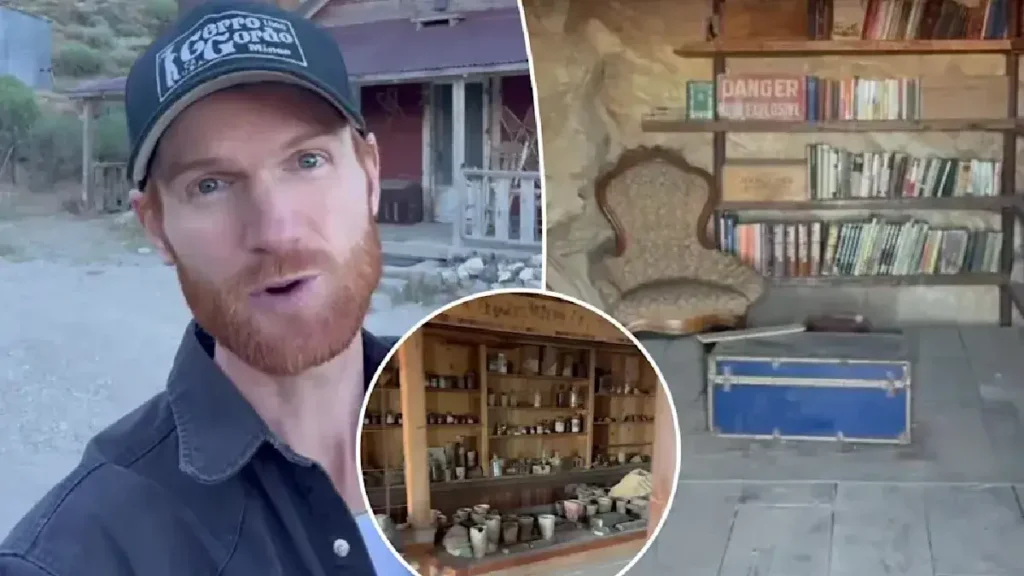
Brent Underwood wakes each morning 8,200 feet above sea level, surrounded by the weathered remains of an abandoned 1800s mining town in California’s Inyo Mountains. There’s no running water, no cell service, and the nearest grocery store is about two hours away. In winter, snow can leave him stranded for days as water lines freeze and food supplies dwindle.




“I left a comfortable life with a decent apartment, great friend group and supportive family to move to the middle of nowhere and try to figure it out,” the 39-year-old says.
What began as a real estate joke has become one of the most unusual restoration projects in the American West—and a viral social media phenomenon that has attracted millions of followers.
Who Is Brent Underwood?
Originally from Tampa, Florida, Underwood had been making his way west for years before fate brought him to Cerro Gordo. He moved to New York City for graduate school and later to Austin, Texas, where he operated a bed-and-breakfast out of a Victorian home dating to the 1800s.
His background in hospitality and his fascination with historic properties would prove unexpectedly relevant to his next venture. Underwood’s grandfather, who lived with his family before his death, loved watching Gunsmoke, often replaying the same episodes. As a kid growing up in Florida, Underwood would pull on cowboy boots and hats and stomp through the swamps, captivated by an American West he knew mostly through stories and television.
How He Found Cerro Gordo
In 2018, as Underwood itched to start a new project, a friend happened to send him a real estate listing for Cerro Gordo, a former silver-mining town tucked high in the mountains above Death Valley.
“He sent it in a text in the middle of the night, mostly as a joke,” Underwood recalls. “I woke up in the morning, researched everything I could about the town, and booked a flight out to see it.”
But photographs hadn’t prepared Underwood for Cerro Gordo itself. He still remembers rounding the final bend on his first visit and watching the town suddenly come into view: a collection of weathered buildings high in the mountains, seemingly frozen in the 1800s.
How Much Did Brent Underwood Pay for Cerro Gordo?
In July 2018, Underwood purchased Cerro Gordo for $1.4 million. The deal, which closed on Friday the 13th, included more than 300 acres of land and 22 surviving structures, among them a 19th-century hotel, a bunkhouse, and a former superintendent’s house.
Underwood used every penny of his personal savings, supplemented by a loan and a handful of small contributions from friends who wanted to be part of the project. The sellers—a trust made up of brothers who had inherited the property after it stayed in family hands for decades—chose Underwood’s offer specifically because his plan prioritized preserving the town’s history and keeping it accessible to the public, rather than simply developing the land for private use.
What Is Cerro Gordo?
Cerro Gordo—Spanish for “fat mountain”—was founded in 1865, when silver, lead, and zinc were discovered in the high climes of the Inyo Range. At its peak, more than 4,000 miners lived and worked there, their efforts helping to make it California’s most prosperous silver mine.
The wealth generated from the mines helped fuel the growth of nearby Los Angeles. Nearly a billion dollars’ worth of minerals was once pulled from the mountain. But as mining declined, residents gradually abandoned Cerro Gordo. By the middle of the 20th century, the once-bustling settlement had become a ghost town.
Cerro Gordo sits in a remote stretch of the Inyo Mountains, reachable only by a mix of paved and dirt roads roughly 25 miles from Lone Pine, the nearest town with a grocery store. The property also includes more than 30 miles of underground tunnels—a labyrinth of old mine workings that once anchored the town’s economy.
What Is It Like Living Alone in a Ghost Town?
Day-to-day life in Cerro Gordo looks more or less the same. After waking up, Underwood feeds his goats, alpacas, and chickens, and then spends the cooler morning hours doing physical work. Right now, that means shoveling rocks, insulating and backfilling the basement of the American Hotel, which burned down in 2020.
By midday, the heat usually drives him indoors, where he coordinates with contractors, designers, engineers, architects, builders, suppliers, and government officials. In the evenings, he often rides his dirt bike to a peak above town to watch the sunset, with the Sierra Nevada and the snow-capped peaks surrounding Mt. Whitney to the west and Death Valley stretching to the east.
“One of my favorite scenes up here is watching the light chase the shadows down the Sierra Nevada across the valley and into the valley floor,” he says.
“It’s impossible to overhype the beauty and feeling of Cerro Gordo,” Underwood adds. “No matter how much you think you’re prepared for it, the town is more beautiful, more haunting, has a greater feeling than what you could prepare for before coming.”
No Cell Service, No Running Water: What Are the Biggest Challenges?
The practical challenges of living in Cerro Gordo are significant. The property has no running water, a problem Underwood has addressed through temporary measures like trucked-in water and pumping operations drawing from deep within the old mine shafts.
There is no cell service, and the nearest grocery store is about two hours away. In winter, snow can leave Underwood stranded for days as water lines freeze, the internet goes out, and food supplies dwindle. The only road into town climbs nearly 5,000 feet in just under eight miles.
Getting workers, materials, and permits to such a remote location has proven difficult. The town’s historic buildings require constant maintenance, and the isolation can wear on even the most committed resident.
What Happened to the American Hotel?
Underwood’s restoration plans suffered a severe setback less than two years into the project. In the early hours of June 15, 2020, a fire broke out at the American Hotel—a building that had first opened its doors on that same date back in 1871. The blaze destroyed the hotel completely, along with an adjoining icehouse and a nearby residence once known as the home of a notorious 19th-century killer.
The fire was one of the most devastating moments of Underwood’s life, since the hotel had stood as both the literal and symbolic center of his plans to revive the town. Investigators later pointed to the building’s old electrical wiring, combined with decades-old newspapers stuffed into the walls as insulation, as the likely cause.
Despite the setback, Underwood is rebuilding the hotel from the ground up. The reconstructed American Hotel is planned to have eight rooms with panoramic valley views, as well as a bar and restaurant that would serve as the “heartbeat” of the town.
“The hotel is an exercise in patience,” Underwood has said. “There’s only so much I can do. A lot of this work needs to be done by licensed contractors, and so it’s a waiting game at the moment.”
How Brent Underwood Became a Social Media Star
Underwood started a YouTube channel called Ghost Town Living in 2020 to document his journey, announcing that he’d moved into the ghost town to restore it. The channel has since grown into a significant platform, with more than 3 million TikTok followers and nearly half a million Instagram followers.
His videos offer viewers a window into a world most people will never experience: exploring abandoned mine shafts, restoring century-old buildings, and surviving the elements in one of California’s most remote locations. The content is part history documentary, part survival story, and part adventure travelogue.
“Social media has allowed more people to learn about the town, and I think that’s awesome,” Underwood says.
From Solo Project to Community Project
The restoration of Cerro Gordo is no longer just one man’s project. An example of the growing community involvement came when a concrete company would not make the trip to Cerro Gordo. Around a dozen volunteers helped mix and pour approximately 40 yards of concrete for the hotel’s foundation.
The town is also attracting increasing numbers of visitors. More than 300 people attended the annual Silver Run event, which Underwood believes may have been the largest gathering there since its mining heyday.
“At first, it was the romance that drew me out here—the West, the mines, the abandoned buildings and possibility of adventure,” Underwood says. “Six years later, the romance is still there, but what keeps me here has changed. What keeps me here now is a sense of responsibility—to the history, to the people who helped build the town, and to the future we’ve all imagined for it.”
The Bigger Story: Restoring a Town Instead of Escaping Society
The most interesting part of Underwood’s story may not be that he lives alone. It is that the abandoned town he chose has gradually become less abandoned because of his efforts. He has turned a solitary restoration project into an effort to bring a historic community back to life.
“I hope to be working on Cerro Gordo for the rest of my life,” he says.
Frequently Asked Questions
1. Who is the man living alone in Cerro Gordo?
Brent Underwood is a 39-year-old entrepreneur who bought the abandoned mining town of Cerro Gordo, California, in 2018 for $1.4 million and now lives there full-time, restoring its historic buildings and documenting the process online.
2. Where is Cerro Gordo located?
Cerro Gordo is located in California’s Inyo Mountains, above Death Valley, near Lone Pine. The town sits at approximately 8,200 feet above sea level and is accessible via a mix of paved and dirt roads.
3. Is Cerro Gordo a real ghost town?
Yes. Cerro Gordo was a thriving silver-mining town in the 1800s, with a peak population of around 4,000. By the 1940s, mining had largely ceased and the town was abandoned. It is now a historic ghost town.
4. How much did Brent Underwood pay for Cerro Gordo?
Underwood paid $1.4 million for Cerro Gordo in 2018, using his personal savings and contributions from investors.
5. Does Cerro Gordo have cell service?
No. Cerro Gordo has no cell service. Communication with the outside world is limited to patchy internet access.
6. Does Brent Underwood live there year-round?
Yes. Underwood moved to Cerro Gordo full-time in early 2020 during the pandemic and has remained there, living year-round in the abandoned mining town.
7. How does Brent Underwood get groceries?
The nearest grocery store is about two hours away in the town of Lone Pine. Underwood must plan trips carefully, especially during winter when snow can make travel impossible.
8. What is life like in Cerro Gordo during winter?
Winter brings snow, freezing temperatures, frozen water lines, and road closures. Underwood can be stranded for days at a time and must plan ahead for food and supplies.
9. Can people visit Cerro Gordo?
Yes, the town is gradually becoming more accessible. Visitor numbers have increased, with events like the annual Silver Run drawing hundreds of attendees. However, restoration work is ongoing and some areas remain closed.
10. What happened to the American Hotel?
The American Hotel, the town’s historic centerpiece, was destroyed by a fire on June 15, 2020. It is currently being rebuilt from the ground up.
11. How many people live in Cerro Gordo?
Brent Underwood is the only full-time resident of Cerro Gordo. However, contractors, volunteers, and visitors are frequently on-site.
12. Does Brent Underwood still live in Cerro Gordo?
Yes, as of 2026, Underwood continues to live in Cerro Gordo and work on restoring the town.