






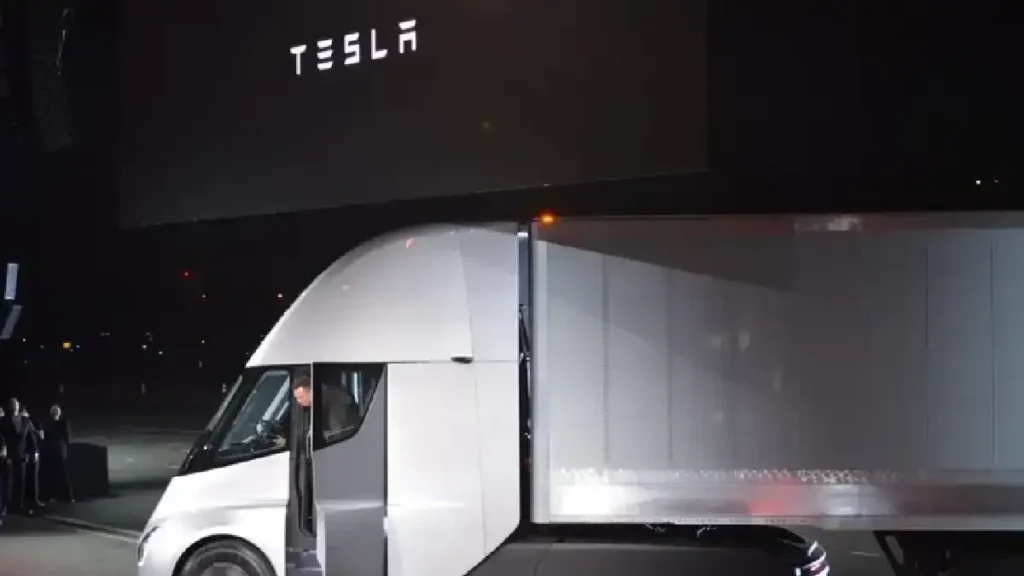
Tesla has begun delivering its Semi electric trucks to a first group of customers, marking a significant milestone for a vehicle that was first unveiled nearly nine years ago. Executives announced the start of deliveries this week at the company’s plant in Sparks, Nevada, according to Reuters.




The Semi, designed for long-haul freight, represents Tesla’s entry into the commercial trucking market—a sector long dominated by diesel-powered vehicles. The development comes at a time when diesel prices in the United States have reached record highs, potentially making electric alternatives more attractive to fleet operators.
Tesla did not disclose production volume plans or pricing for the trucks at the event, which was webcast late Thursday. The company reiterated its stated goal of building 50,000 Semis per year at the Nevada facility.
Tesla Semi Deliveries Begin in Nevada
The delivery event took place at Tesla’s Sparks, Nevada plant, where customers including PepsiCo, DHL, and US Foods were invited on stage. Trucks bearing their logos were shown parked outside the facility.
Elon Musk, Tesla’s CEO, did not attend the event in person. In a recorded video message, he encouraged potential buyers to place orders soon, noting that “the waiting list is already pretty significant.”
The customers represented at the event are among the first to receive the production version of the Semi, though Tesla did not specify how many trucks each company received or when individual deliveries would occur.
Tesla Semi’s Long Road From 2017 to 2026
The path to this week’s delivery milestone has been lengthy and marked by multiple timeline adjustments.
Tesla first unveiled the Semi in November 2017, with production originally expected to begin in 2019. Those plans shifted repeatedly over the following years.
Limited customer deliveries began in late 2022, with PepsiCo among the early recipients. However, volume production did not materialize as quickly as initially anticipated. The first truck eventually rolled off a high-volume production line in April 2026, and Tesla’s July shareholder letter indicated that volume production would begin in 2026—removing an earlier forecast for volume production within the same year.
The current rollout represents Tesla’s most significant step yet toward entering the commercial freight market, where it will compete with established truck manufacturers that have decades of experience serving fleet operators.
Tesla Semi Range: 500 Miles for Long-Range Version
Tesla’s current official specifications list two range options for the Semi:
The Standard Range version offers an estimated 325 miles of range. The Long Range version offers an estimated 500 miles of range.
Dan Priestley, Tesla’s director of Semi truck engineering, said at the event that the 500-mile figure represents “500 real-world miles” and that “our customers have validated it.”
Tesla’s website lists the Long Range figure as based on an 82,000-pound gross combination weight. These are estimated figures under specific testing conditions. Real-world range can be affected by factors including payload weight, weather conditions, terrain, vehicle speed, trailer configuration, and accessory loads such as heating and air conditioning.
Independent analyses of electric truck range suggest that real-world performance often falls below manufacturer estimates. One industry guide notes that electric truck range can be 15-30% below stated figures depending on operating conditions, with payload weight and cold weather being particularly significant factors.
Tesla Semi Charging
Tesla states that the Semi supports Megacharging, the company’s high-power charging infrastructure. According to Tesla, the Long Range version can recover up to 60% of range in 30 minutes under stated charging conditions.
The Long Range model supports peak charging speeds of 1.2 MW, while the Standard Range version supports up to 800 kW. The charging standard is MCS 3.2.
These figures come from Tesla and have not been independently verified across a wide range of real-world operating conditions. For commercial fleet operators, charging speed is a critical consideration because trucks operate on schedules and downtime has direct economic consequences. Depot charging infrastructure and route planning around available charging locations are significant factors in whether electric trucks can match the operational flexibility of diesel vehicles.
Why Tesla Is Entering the Commercial Truck Market
Tesla has historically been associated with electric passenger vehicles—sedans, SUVs, and crossovers—along with energy storage products. The Semi expands the company’s vehicle portfolio into heavy-duty commercial freight, a market with different requirements and purchasing dynamics than consumer vehicles.
Commercial trucking involves larger vehicles, higher payload demands, longer operating hours, and fleet purchasing decisions that prioritize total cost of ownership over individual vehicle features. Fleet operators evaluate factors including upfront purchase price, fuel or electricity costs, maintenance requirements, route planning, driver availability, and charging infrastructure availability.
The commercial truck market is also heavily influenced by regulations. California’s Advanced Clean Trucks rule and Advanced Clean Fleets regulation require increasing percentages of zero-emission vehicle sales and fleet purchases in the state, with several other states having adopted or considering similar rules. These regulations create both opportunities and compliance pressures for manufacturers and fleet operators.
Who Are the Early Tesla Semi Customers?
The customers represented at the Nevada delivery event included PepsiCo, DHL, and US Foods.
PepsiCo has been associated with Tesla’s Semi program since the limited-delivery phase that began in late 2022. The company has been among the most visible early adopters of the electric truck.
It is important to note that these companies have not converted their entire fleets to electric trucks. The deliveries represent initial deployments within much larger commercial operations. Fleet adoption of electric trucks remains in early stages across the industry.
Tesla’s Nevada Semi Production Plans
Tesla has reiterated its stated plan to build 50,000 Semis per year at its Nevada plant. This figure represents a company production target or planned capacity, not current actual production.
There is a significant difference between planned production capacity, actual production, and customer deliveries. Tesla has not disclosed current production rates. Analyst projections cited in industry coverage have suggested 2026 deliveries could range from 5,000 to 15,000 units, though these are external estimates rather than company guidance.
The gap between stated capacity and projected near-term production reflects the challenges of ramping up manufacturing for a new vehicle platform.
Tesla Semi Price Has Not Been Disclosed at the Latest Event
Tesla did not disclose pricing for the Semi at the September 24 event, according to Reuters.
Some industry publications have cited figures around $290,000 for the Long Range version based on earlier disclosures or reports, but this has not been confirmed by Tesla as the current price at the time of the delivery event.
Tesla has not made claims that the Semi is cheaper to purchase than a diesel truck. The company’s stated advantages focus primarily on operating costs rather than upfront purchase price.
Tesla’s Claimed Advantages Over Diesel Trucks
Tesla promotes the Semi around several stated benefits compared to diesel-powered trucks.
According to Tesla, the Semi offers lower operating costs per mile through fuel savings, reduced maintenance requirements due to fewer moving parts, and better uptime. Dan Priestley, Tesla’s Semi program director, has said that “EV heavy trucks provide lower costs per mile from fuel savings, reduced maintenance, and better uptime over diesel trucks.”
These are Tesla’s claims. Actual operating economics depend on multiple variables including local electricity rates, diesel prices, route characteristics, vehicle utilization, maintenance costs, charging infrastructure availability, available incentives, vehicle financing terms, and fleet size.
Electricity prices vary significantly by region and time of day. Demand charges from utilities can increase effective charging costs. Diesel prices fluctuate based on global markets. Maintenance savings depend on actual operating conditions and vehicle lifespan.
Electric Trucks vs. Diesel Trucks
The comparison between electric and diesel trucks involves trade-offs across multiple operational dimensions.
Electric trucks offer potential advantages including electric drivetrains that may require less maintenance than diesel engines, no tailpipe emissions, potentially lower energy costs depending on local electricity prices, and quieter operation. Challenges include charging infrastructure availability, charging time compared to diesel refueling, range management, battery weight, higher upfront purchase costs, and the need for route planning around charging locations.
Diesel trucks benefit from an established fueling infrastructure with fast refueling, a mature supply chain, and an extensive service network. Challenges include fuel costs, engine maintenance requirements, tailpipe emissions, and exposure to diesel price fluctuations.
Neither technology is universally superior across all applications. The appropriate choice depends on specific operational requirements, route patterns, access to charging or fueling infrastructure, and total cost of ownership calculations for each fleet.
Tesla Semi Competition
Tesla is entering a market where other manufacturers are already developing or selling electric heavy-duty trucks.
Freightliner, a Daimler brand, offers the eCascadia with approximately 230 miles of range, targeting port drayage and short-haul applications. Volvo Trucks offers the VNR Electric with approximately 275 miles of range, popular in California for regional distribution. PACCAR, through its Kenworth and Peterbilt brands, also has electric models in development or limited production.
Kenworth, RIDE, and Volvo were named as secondary suppliers in the recent 2,500-truck order from the ZET SCALE alliance, with Tesla serving as the primary supplier.
The presence of multiple manufacturers means fleet operators have options when evaluating electric trucks for their operations.
The 2,500-Truck Order
Reuters reported that Tesla received an order for 2,500 Semis from a coalition of large cargo-owning shippers, including Microsoft and PepsiCo, according to clean transportation nonprofit Catalyst Mobility.
The order was organized through ZET SCALE, a program run by Catalyst Mobility and the Smart Freight Centre that aggregates freight demand from major shippers to enable bulk purchases of electric trucks.
This order, if fully executed, would nearly double the existing U.S. fleet of electric Class 8 trucks, according to Catalyst Mobility.
It is important to distinguish between an announced order and actual delivered vehicles. The order represents a commitment or intent to purchase, but deliveries will occur over time. Tesla is named as the primary supplier, with other manufacturers also participating.
Einride’s 500-Truck Deal
In August 2026, Swedish freight technology company Einride AB announced a deal to add 500 Tesla Semis to its fleet.
The trucks are being deployed across North America, serving Amazon and other customers, with operations concentrated in California, Texas, New Jersey, Illinois, and Georgia. Deliveries were scheduled to begin in September 2026 and continue in phases over 24 months.
This was the largest disclosed Tesla Semi order prior to the ZET SCALE announcement. It is important to note that the announcement represents a planned deployment, not proof that all 500 trucks have been delivered.
Challenges Facing Tesla Semi
Tesla faces several documented challenges as it attempts to scale Semi production and adoption.
Production delays have characterized the Semi program since its 2017 unveiling. Timelines shifted multiple times before the first high-volume production truck rolled off the line in April 2026.
Competition is increasing from established truck manufacturers and other electric truck makers. Fleet operators have multiple options when considering electric trucks.
Charging infrastructure for heavy-duty commercial vehicles remains limited compared to diesel fueling networks. Building out Megacharger locations and depot charging requires significant investment and coordination with utilities.
Demand uncertainty exists amid changes in U.S. electric vehicle policy. Reuters noted that a reversal in EV policies has raised concerns about demand.
Scaling production from initial deliveries to the stated 50,000-per-year target will require manufacturing execution and supply chain management for a new vehicle platform.
What Tesla Semi Means for the U.S. Trucking Industry
The start of Semi deliveries gives fleet operators another electric heavy-duty option to evaluate alongside offerings from Freightliner, Volvo, and other manufacturers.
The broader transition toward electrification in commercial transportation involves factors including fleet electrification planning, charging infrastructure development, energy demand considerations, operating cost calculations, fleet procurement processes, and competition among truck manufacturers.
The 2,500-truck order organized through ZET SCALE, with its lease structure designed to remove residual value risk from fleet operators, represents a new model for enabling adoption. Whether this model proves effective at scale will be a development worth monitoring.
Tesla’s entry does not automatically transform the trucking industry. The company’s ability to produce and deliver trucks at scale, and the operational experience of fleets using Semis in real-world conditions, will determine the actual impact.
What to Watch Next
Rather than predicting outcomes, here are measurable developments to monitor:
Production ramp: Whether Tesla can increase Semi production from initial deliveries toward its stated capacity target.
Customer deliveries: How many trucks reach customers and on what timeline.
Fleet deployment: How customers like PepsiCo, DHL, and US Foods integrate Semis into their operations and what operational data they share.
Charging infrastructure: The pace of Megacharger deployment and availability of depot charging solutions.
Real-world range: Independent verification of range performance across different routes and conditions.
Fleet operating data: Reports from fleets on actual cost per mile, uptime, and maintenance requirements.
Additional orders: Whether the ZET SCALE order and Einride deal are followed by more large-scale commitments.
Pricing disclosure: Whether Tesla publicly confirms current pricing for the Semi.
FAQ Section
When did Tesla Semi deliveries begin?
Tesla began delivering Semi trucks to a first set of customers in the week of September 24, 2026. This followed earlier limited deliveries that began in late 2022.
How far can the Tesla Semi travel?
Tesla’s stated range is 325 miles for the Standard Range version and 500 miles for the Long Range version. These are estimated figures under specific conditions.
How much does the Tesla Semi cost?
Tesla did not disclose pricing at the September 24, 2026 delivery event. Some industry reports have cited figures around $290,000 for the Long Range version, but this has not been confirmed by Tesla as current pricing.
Who is buying Tesla Semi trucks?
Publicly identified customers include PepsiCo, DHL, and US Foods, which were represented at the delivery event. Einride has announced plans to deploy 500 Semis, and the ZET SCALE alliance has placed an order for 2,500 Class 8 electric trucks with Tesla as primary supplier.
Where is Tesla Semi made?
Tesla produces the Semi at its plant in Sparks, Nevada.
How fast can Tesla Semi charge?
Tesla states that the Long Range version supports peak charging of 1.2 MW and can recover up to 60% of range in 30 minutes under stated conditions.