
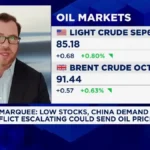






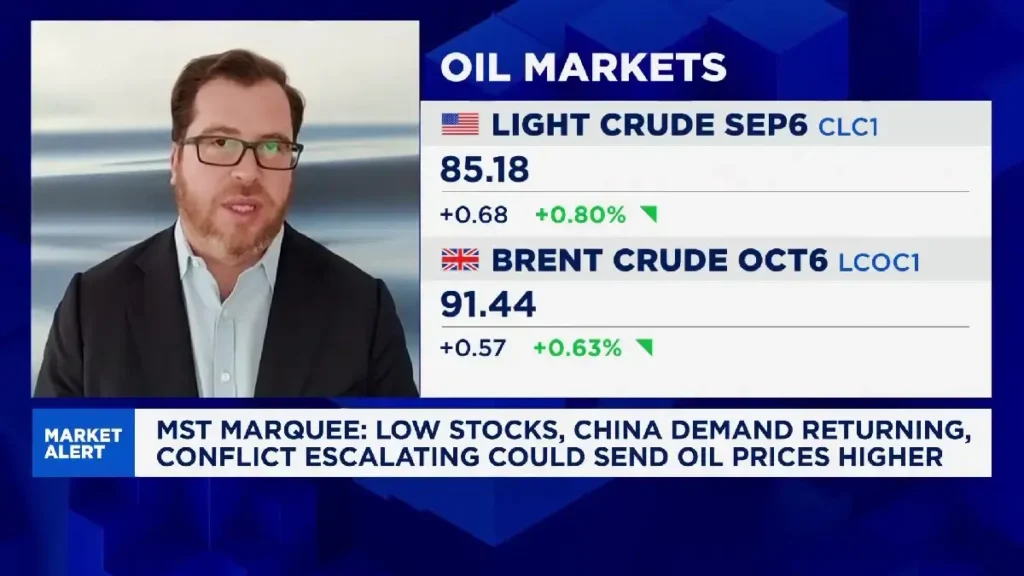
Brent crude oil fell below $100 per barrel on Tuesday, closing at $99.25 as diplomatic signals and improving Middle East supply flows eased the geopolitical risk premium that had pushed prices toward $110 just days earlier.





The move marks the first time Brent has closed below $100 since September 8, and it comes as President Donald Trump signaled openness to diplomacy with Iran during his United Nations General Assembly address. West Texas Intermediate, the U.S. benchmark, settled at $94.59, down 1.2%.
The decline matters beyond energy markets. Oil prices feed directly into inflation through gasoline, transportation, and manufacturing costs. They influence Federal Reserve policy expectations, Treasury yields, and ultimately the discount rate applied to stocks and risk assets like Bitcoin.
Why Did Brent Oil Fall Below $100?
Three overlapping developments drove the decline.
Diplomatic signals from Washington. President Trump told the UN General Assembly that he was open to meeting Iranian President Masoud Pezeshkian and suggested a deal could be reached after upcoming elections, though he also threatened to “obliterate” Iran if negotiations failed. Markets focused on the diplomatic path rather than the threat.
Improving supply flows. Saudi Arabia’s East-West pipeline, damaged by Houthi attacks, has begun restarting. Satellite data showed supertankers with combined capacity of approximately 14 million barrels at Saudi Gulf export terminals — the highest number since June. Saudi crude flows through the Strait of Hormuz reached 2.9 million barrels per day over six days.
OPEC+ holding steady. The alliance announced on September 6 that it would keep October production unchanged, pausing a months-long增产 cycle that had been largely symbolic due to Iran war disruptions.
What Is Brent Crude and Why Does $100 Matter?
Brent crude is the global benchmark for oil prices, sourced from North Sea fields and used to price roughly two-thirds of the world’s internationally traded crude. WTI, by contrast, reflects U.S. domestic supply dynamics and typically trades at a slight discount or premium depending on regional factors.
The $100 threshold carries psychological weight because it represents a round-number barrier that often shapes consumer expectations and political narratives around energy costs. When Brent trades above $100, gasoline prices at the pump tend to feel elevated to U.S. drivers, and headlines about “expensive oil” become more common.
Economically, $100 is not a magic threshold. The real impact depends on how long prices stay elevated and how much they pass through to consumer prices.
What Lower Oil Prices Mean for Inflation
The U.S. Consumer Price Index rose 3.4% year-over-year in August, with gasoline prices up 27.4% over the same period. Energy was a primary driver of the 0.4% monthly increase in August CPI.
Falling oil prices can ease some of that pressure — but not immediately or uniformly. Retail gasoline prices adjust with a lag and depend on refinery margins, regional supply, and taxes. Natural gas and electricity prices, which also feed into energy inflation, do not track crude oil directly.
The broader inflation picture also depends on shelter costs, services, and wage growth. A sustained decline in oil would reduce one input, but it would not automatically bring headline CPI back to the Fed’s 2% target.
Could Cheaper Oil Help the Stock Market?
Wall Street opened higher Tuesday, with the S&P 500 near record highs and the Nasdaq adding 0.4%. The immediate catalyst was oil’s decline.
Potential positive channels for stocks:
- Lower fuel costs reduce operating expenses for airlines, shipping companies, and manufacturers
- Cheaper gasoline can free up household disposable income
- Reduced inflation pressure could ease expectations for further Fed tightening
- Lower Treasury yields reduce the discount rate applied to future corporate earnings
Potential negative channels:
- Energy sector earnings decline when crude prices fall
- Oil producers cut capital spending, weighing on industrial suppliers
- If oil is falling because global demand is weakening, that signals economic slowdown
- Geopolitical uncertainty remains unresolved
The critical distinction is why oil is falling. Tuesday’s decline was driven by supply restoration and diplomacy — a relatively constructive backdrop. If prices were falling due to collapsing demand, the stock market reaction would likely be different.
Which Stock Sectors Could Be Affected?
Airlines and cruise operators: American Airlines gained 0.5% and Carnival rose 1.5% on Tuesday as lower jet fuel and marine fuel costs improved the outlook for their expense lines.
Oil producers: ConocoPhillips fell 0.7%, reflecting the direct revenue impact of lower crude prices.
Banks: JPMorgan Chase dropped 3.7%, the heaviest weight on the S&P 500, continuing pressure from the Fed’s rate hike last week. Banks profit from the spread between short-term and long-term rates, which narrows when the Fed raises short-term rates.
Technology: The Nasdaq reached a new record Tuesday. Tech valuations are sensitive to interest rates — lower Treasury yields reduce the discount applied to future earnings, which disproportionately benefits growth stocks.
Consumer discretionary: Lower gasoline prices could support spending at retailers and restaurants, though the effect is gradual.
What Does Falling Oil Mean for the Federal Reserve?
The Fed raised its benchmark rate by 25 basis points to 3.75%–4.00% on September 16 — its first hike in three years. The statement characterized inflation as “elevated” and removed prior language attributing price pressures to “supply shocks from energy”.
Chair Kevin Warsh emphasized data dependence: “I won’t give fixed forward guidance… subsequent hikes depend entirely on inflation, employment, and economic data”.
Oil’s decline could modestly ease headline inflation if sustained, but the Fed’s core focus is on broader price pressures. The median FOMC participant expects the fed funds rate to end 2026 at 4.1%, implying one more hike this year.
The 10-year Treasury yield edged down to 4.95% from 4.96% — still far above the 3.97% level before the Iran war began. Lower oil has pulled yields down from their recent spike above 5%, providing some relief to equity valuations.
Could Lower Oil Prices Help Bitcoin and Crypto?
Bitcoin traded around $86,035 Tuesday morning after surging more than 13% in four days, reaching an eight-month high of $87,381. Ethereum stood at approximately $2,746.
The transmission mechanism from oil to crypto is indirect:
Oil ↓ → inflation pressure ↓ → rate expectations may ease → liquidity/risk appetite may improve → crypto can benefit
But crypto markets have their own drivers. Bitcoin’s rally this week tracked a broad rebound in risk assets, including stocks. The cryptocurrency remains well below its January high above $97,000, with retail enthusiasm competing against AI-related trades for speculative capital.
Ethereum’s price action reflects similar macro sensitivity, with ETH breaking above $2,700 as risk appetite improved.
Key caveat: The relationship between oil and crypto is not mechanical. Bitcoin and Ethereum respond to liquidity conditions, dollar strength, ETF flows, regulation, leverage, and crypto-specific news. A single oil move does not determine crypto direction.
Bitcoin, Ethereum and Oil Prices
Historical correlations between oil and crypto have been inconsistent and time-varying. During periods of dollar strength or risk-off sentiment, both oil and crypto can fall together. During supply-driven oil shocks, the relationship can invert or break down entirely.
No credible framework treats oil prices as a reliable leading indicator for Bitcoin or Ethereum. The current rally in crypto is occurring alongside falling oil, but it is also occurring alongside rising stocks, easing yields, and improving risk sentiment broadly.
Correlation is not causation. The shared driver is likely macroeconomic risk appetite, not a direct oil-to-crypto transmission channel.
Why Crypto Could React Differently From Stocks
Several structural differences make crypto’s response to macro data less predictable:
- 24/7 trading: Crypto never closes, so it can react to news outside U.S. market hours
- Higher volatility: Leverage and thinner liquidity amplify moves
- Institutional flows: ETF inflows and outflows can dominate short-term price action
- Crypto-specific catalysts: Regulatory decisions, protocol upgrades, and exchange events can override macro signals
- Retail vs. institutional mix: Crypto has a larger retail component, which can make sentiment-driven moves more pronounced
For these reasons, crypto may rally or sell off independently of oil’s direction on any given day.
What Consumers Could See From Lower Oil Prices
Retail gasoline prices do not fall one-for-one with Brent crude. The pass-through depends on:
- Refinery utilization and margins
- Regional supply disruptions
- State and federal fuel taxes
- Retail competition
AAA data typically shows a lag of one to three weeks between crude price moves and pump prices. Natural gas and electricity prices are driven by separate supply-demand dynamics and weather, not crude oil.
Airlines may adjust ticket prices gradually, but fuel surcharges are often baked into fares rather than itemized. Heating oil costs, primarily a Northeast U.S. concern, track diesel and crude more closely.
What Happens If Brent Stays Below $100?
Scenario 1: Oil remains below $100 because supply improves
Saudi pipeline restoration and Hormuz flows normalize. Inflation pressure from energy eases. Consumers see modest relief at the pump. Stocks benefit from lower input costs and reduced rate pressure. This is the constructive interpretation.
Scenario 2: Oil falls because global demand weakens
If Chinese or European demand slows meaningfully, lower oil signals economic weakness rather than supply relief. Energy earnings decline. Cyclical stocks underperform. The stock market reaction could be negative despite cheaper oil.
Scenario 3: Geopolitical risks push prices back up
The Iran conflict remains unresolved. Trump’s diplomatic overture could fail. Houthi attacks on Saudi infrastructure could resume. Hormuz flows could be disrupted again. The current decline would reverse.
These are scenarios, not predictions.
What Investors Are Watching Next
- Brent crude: Whether prices hold below $100 or rebound toward $110
- WTI crude: Spread to Brent and U.S. inventory data
- U.S. gasoline prices: AAA weekly averages
- CPI and PCE: Upcoming inflation prints for September
- Federal Reserve: FOMC meeting dates and speaker comments
- Treasury yields: 10-year and 2-year spreads
- U.S. dollar: DXY index and implications for commodities
- S&P 500 and Nasdaq: Whether records hold or reverse
- Bitcoin and Ethereum: Whether crypto’s rally extends or fades
- OPEC+: October 4 meeting and production decisions
- Geopolitical developments: U.S.-Iran diplomacy, Strait of Hormuz flows
Frequently Asked Questions
Why did Brent oil fall below $100?
Brent fell below $100 on September 22, 2026, driven by diplomatic signals from President Trump regarding Iran, improving Saudi supply flows through the Strait of Hormuz, and the restart of the East-West pipeline.
What happens when oil prices fall?
Lower oil prices can reduce inflation pressure, lower transportation and manufacturing costs, and free up consumer spending. However, they also reduce revenue for energy companies and can signal weakening global demand if the decline is demand-driven.
Does lower oil help stocks?
It depends on why oil is falling. If supply is improving, lower oil can support stocks by reducing costs and inflation pressure. If demand is weakening, lower oil may coincide with broader economic concerns.
Can falling oil prices affect Bitcoin?
Indirectly. Lower oil can ease inflation pressure, which may influence Fed policy expectations and risk appetite. But Bitcoin has its own drivers including liquidity, ETF flows, and crypto-specific news.
Is Brent crude the same as WTI?
No. Brent is the global benchmark for internationally traded crude, while WTI reflects U.S. domestic supply dynamics. They typically trade at different prices.
Why is $100 important for oil?
$100 is a psychological threshold that shapes consumer expectations, political narratives, and media coverage around energy costs. It is not a formal economic threshold.