







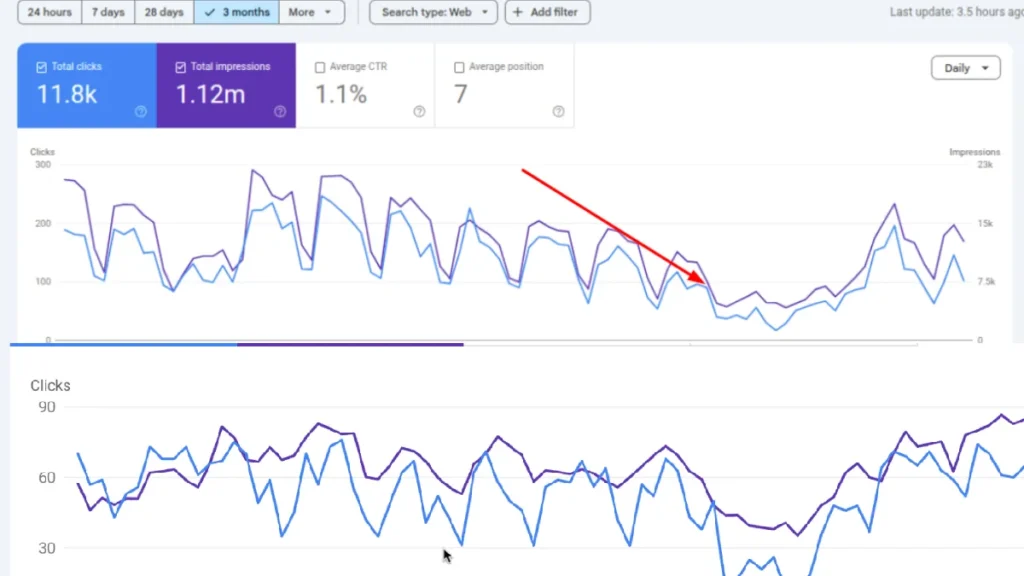
If you woke up to find your website’s organic traffic has dropped significantly in April 2026, you are not alone. Google completed the rollout of its March 2026 Core Update on April 8th, and webmasters across every industry are reporting sudden shifts in impressions, clicks, and rankings .





The combination of this core update, ongoing changes to AI Overviews, and recent bug fixes in Google Search Console has created a perfect storm of volatility. This comprehensive guide will walk you through exactly why your traffic dropped, how to diagnose the real cause, and a proven step-by-step recovery plan that has helped enterprise sites restore millions of organic sessions.
You will learn the difference between a core update penalty, an AI Overviews traffic loss, and a reporting glitch, and you will get actionable fixes for each scenario.
Why Did My Traffic Drop in April 2026? Understanding the Three Possible Causes
Before you change anything on your website, you need to identify what actually caused your traffic drop. April 2026 presents three distinct potential causes, and each requires a different recovery strategy. The first and most common cause is the March 2026 Core Update, which finished rolling out on April 8th .
Like all core updates, this one re-evaluates how Google ranks every page across the web, rewarding sites that demonstrate genuine expertise, authoritativeness, and trustworthiness while penalizing thin content, poor site architecture, and outdated SEO tactics . If your rankings fell across many pages or entire sections of your site, you are likely dealing with a core update impact.
The second cause is the continued expansion of Google AI Overviews. Liz Reid, Google’s head of Search, recently explained that AI Overviews are reducing what she calls “bounce clicks” – visits where users quickly return to search after finding only a fact . Independent data tells a more significant story.
One analysis found that click-through rates for queries with AI Overviews fell from 1.76% in 2024 to 0.61% in 2025, a 61% drop . The Pew Research Center studied 68,000 real search queries and found users clicked on results only 8% of the time when AI Overviews appeared, compared with 15% when they did not .
AI Overviews now appear on more than 40% of informational queries, and for those queries, CTR impact ranges from negative 55% to negative 70% . If your impressions are stable or growing but your clicks and click-through rates have collapsed, especially for how-to guides, explainer articles, or FAQ content, AI Overviews are almost certainly the cause.
The third possible cause is actually a reporting change, not a real traffic loss. Google announced in March 2026 that it had discovered a bug causing inflated impression counts in Google Search Console since May 2025. The fix for this bug is now being applied, which will cause impression numbers to drop .
Additionally, a change Google made in September 2025 limited third-party tracking tools to viewing only the first 20 search results instead of the top 100, which also reduces reported impression counts for keywords where you rank between positions 21 and 100 . If your Google Search Console shows a sudden drop in impressions but your actual website traffic from analytics remains stable, you are seeing a reporting glitch, not a real problem. In this case, no recovery action is needed.
How to Diagnose Your Traffic Drop: A 45-Minute Audit
Before you panic or start making random changes, run this diagnostic audit. It will take about 45 minutes and tell you exactly what you are dealing with. Open Google Search Console and pull your performance data for the last 90 days compared to the same 90-day period last year. Filter by queries and sort by impressions. If impressions are stable or growing while clicks and CTR are falling for informational queries, AI Overviews are your culprit.
If impressions are also dropping across a wide range of queries, you are likely dealing with a core update penalty . Next, export your top 200 queries by impressions and flag any queries where CTR has dropped below 2% but was previously above 5%. These are your most affected keywords.
Cross-reference them against query types – informational, navigational, transactional, or local. If most of your affected queries are informational, prioritize AI Overviews recovery strategies. If the drop is spread across all query types, focus on core update recovery.
Finally, check whether you are blocking AI crawlers. This step catches a problem that roughly 34% of sites have without knowing it . Pull your robots.txt file and look for any rules blocking bots like OAI-SearchBot, ChatGPT-User, PerplexityBot, Google-Extended, or ClaudeBot. If any of these are set to disallow, you are invisible to those AI systems entirely. Add explicit allow directives for all major AI crawlers – this is the single highest-impact technical change you can make and it takes less than five minutes .
Core Update Recovery: What Actually Works
If your audit confirms a core update penalty, the path to recovery is not about quick fixes or tactical SEO tricks. Google’s core updates reward sites that demonstrate E-E-A-T – Experience, Expertise, Authoritativeness, and Trustworthiness – and penalize sites that have coasted on thin content, poor site architecture, and weak authority signals .
One enterprise marketing agency recently documented how they recovered 2.4 million organic sessions for a client after a core update wiped out 61% of their traffic. Their recovery took six months and followed a three-phase approach that any site owner can adapt .
In the first month, they conducted a full-site content audit, categorizing every page as keep and improve, consolidate, or remove. Out of more than 1,500 articles, they flagged 620 for removal or consolidation because those pages were under 300 words with no unique value, duplicated other pages on the site, or targeted keywords the business no longer served .
They then prioritized the top 150 pages by traffic potential and rewrote them completely, adding original research, updated data, clear author bios, source citations, and first-hand expertise from subject matter experts.
In the second and third months, they rebuilt the site’s technical infrastructure. They cleaned up over 340 redirect chains, fixed broken internal links, implemented proper canonical tags across all location pages, compressed images site-wide, and brought mobile page load times down from 5.1 seconds to under 2.5 seconds .
They also rebuilt the internal linking architecture from scratch because the existing structure had no defined hierarchy, meaning Google’s crawlers were wasting budget on low-value pages while missing high-priority content.
In months four through six, they focused on authority and trust rebuilding. They launched a digital PR campaign targeting high-authority backlinks from industry publications and regional news outlets. Over four months, they secured 78 new referring domains with an average domain authority above 55 .
They also refreshed the client’s Google Business Profiles across all locations, adding updated photos, service descriptions, and consistent name, address, and phone data to reinforce local trust signals. The result was a full recovery to 4 million organic sessions, exceeding pre-update traffic by 12% by month eight.
For your own core update recovery, apply the MUD framework: Merge, Update, and Delete. Take two or three thin content pages that target similar keywords and merge them into one comprehensive pillar article, then redirect the old URLs. Update your most important pages by transforming them into the ultimate guides on their topics, adding new data, visuals, and real experience.
Delete content that is genuinely low-quality, outdated, or irrelevant, and redirect it to relevant category pages . Strengthen your E-E-A-T signals by ensuring every article has a credible author bio, adding detailed About Us and Contact Us pages, and linking to authoritative sources for every claim or statistic you make. Fix your technical foundation by cleaning up redirect chains, improving internal linking, and optimizing Core Web Vitals, especially Largest Contentful Paint and Interaction to Next Paint metrics .
AI Overviews Recovery: How to Get Cited Instead of Crushed
If your traffic drop is coming from AI Overviews, traditional SEO fixes will not help because your rankings may still be intact. Users simply get their answer from the AI summary without clicking through to your site. In 2024, roughly 75% of AI Overview citations came from pages ranking in the top 10.
By early 2026, that number dropped to somewhere between 17% and 38% depending on the query category . High rankings no longer guarantee AI Overview inclusion. You now need a separate optimization layer on top of traditional SEO.
The first and most important fix is unblocking AI crawlers in your robots.txt file as described above. The second fix is implementing IndexNow, a protocol that immediately notifies Bing’s index whenever you publish or update a page.
Because OpenAI’s ChatGPT live-web browsing runs on Bing’s index, passive crawling is not fast enough. IndexNow is available natively in Rank Math and in Yoast SEO version 19.0 and above. For manual implementation, you can submit a POST request to the IndexNow API with your page URL and API key .
The third fix is switching your high-value informational pages from client-side rendering to server-side rendering. AI crawlers cannot execute JavaScript the way a browser does. If your top pages load content dynamically via React, Angular, or Vue without server-side rendering, AI systems may be crawling an empty shell.
Use Google Search Console’s URL Inspection tool and select View Crawled Page to see what Googlebot actually received. If your key content is missing, implement server-side rendering or pre-rendering for those pages .
The fourth fix is adding Speakable schema markup to your summary sections. This schema property marks specific HTML sections as ideal for AI extraction. Add the cssSelector property pointing to your direct answer blocks and article summaries. This provides a direct signal to Google’s AI extraction layer that your content is ready to be cited .
Finally, restructure your content to answer questions directly and concisely at the beginning of your articles, use clear headings that mirror natural language questions, and include data tables and lists that AI systems can easily extract.
Why You Should Wait Before Making Drastic Changes
If your traffic drop occurred in the last few days, the most important action you can take right now is to wait. After the rollout of a core update, volatility is expected. Things usually even out after a few weeks, and more importantly, SEO professionals across the industry need time to share and compare data to reverse-engineer what the update actually changed .
Rash decisions like deleting large sections of your site or completely changing your URL structure can make the problem worse. Use the waiting period to run your diagnostic audit, gather data, and plan your recovery strategy. Do not implement major changes until you are certain about the cause of your traffic drop.
About Of FAQs
Q: How long does it take to recover from a Google Core Update penalty?
A: Recovery from a core update rarely happens before the next core update is released, which is typically three to six months later. The key is consistency and patience. Implement fundamental quality and trust improvements, and your site will likely recover in the next update cycle .
Q: What is the difference between a core update and a spam update?
A: A core update re-evaluates how Google ranks every page based on quality and relevance signals. A spam update specifically targets manipulative tactics like keyword stuffing, link farming, and cloaking. The March 2026 rollout included both a core update and a separate spam update .
Q: If my impressions dropped but traffic stayed the same, do I need to recover?
A: No. If your actual website traffic from analytics is stable but Google Search Console shows lower impressions, you are likely seeing the impact of Google’s bug fix or the September 2025 change that limited third-party tracking to the top 20 results. This is a reporting change, not a real traffic loss .
Q: Will Google notify me if my site has a manual penalty?
A: Yes. Manual actions appear as a notification in Google Search Console. Core update impacts are not manual penalties and Google does not send any notification. Traffic simply drops, and you must diagnose the cause yourself .
Q: Does AI Overviews traffic loss mean my content is bad?
A: Not necessarily. Your rankings may still be intact and your content may still be high quality. AI Overviews simply answer informational queries directly on the search results page, removing the need for users to click through. Recovery requires shifting from ranking optimization to AI citation optimization .
Q: How do I check if my robots.txt is blocking AI crawlers?
A: Pull your robots.txt file by going to yourdomain.com/robots.txt. Search for lines containing OAI-SearchBot, ChatGPT-User, PerplexityBot, Google-Extended, or ClaudeBot. If you see Disallow: / for any of these, add explicit Allow: / directives to unblock them .
Final Suggestions: Turn Your Traffic Drop Into a Growth Opportunity
A traffic drop after a Google update is painful, but it is often a growth opportunity in disguise. The same audit that identifies what went wrong will usually reveal untapped keyword opportunities and content gaps that your competitors have not filled . Do not panic, do not make random changes, and do not chase quick fixes.
Run your diagnostic audit, identify whether you are dealing with a core update penalty, an AI Overviews issue, or a reporting glitch, and then apply the specific recovery strategies outlined in this guide. Focus on creating people-first content that demonstrates real expertise and provides genuine value. The sites that recover fastest are the ones willing to treat the drop as a full audit of their content, their technical health, and their competitive position. Your hard work will pay off in the next update cycle. Good luck.