







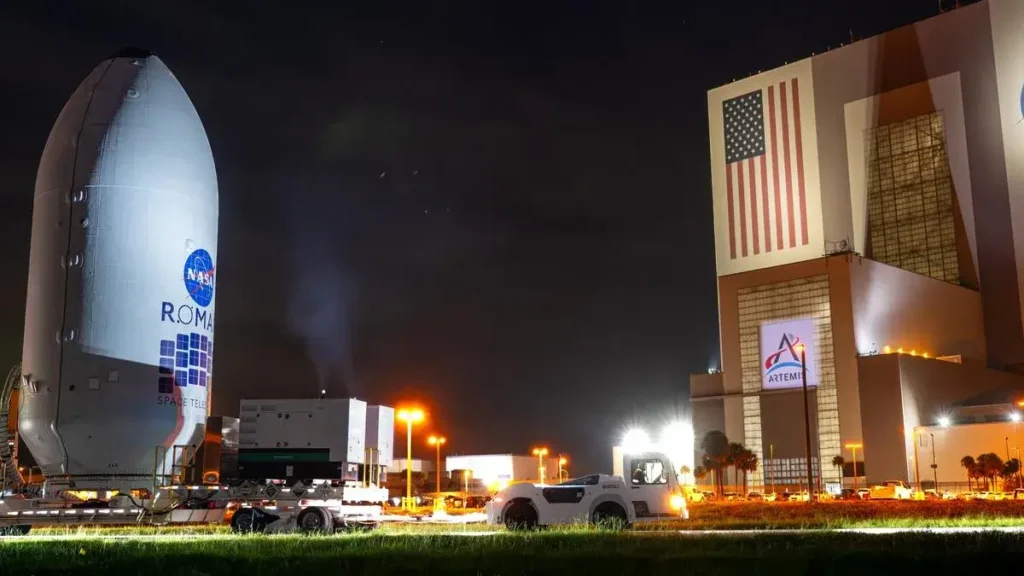
NASA is in the final stages of preparation for the launch of its next major space observatory, the Nancy Grace Roman Space Telescope. The mission, which is scheduled to lift off on Sunday, August 30, 2026, represents a significant step forward in humanity’s ability to explore the universe.





The telescope, often referred to simply as “Roman,” is designed to create an unprecedented panoramic map of the cosmos. Its primary goals are to investigate the mysteries of dark energy and dark matter, discover thousands of new exoplanets, and provide a sweeping view of billions of galaxies.
What Is the Nancy Grace Roman Space Telescope?
The Nancy Grace Roman Space Telescope is NASA’s newest flagship astrophysics mission. It is a state-of-the-art observatory with a primary mirror that is 7.9 feet (2.4 meters) in diameter, the same size as the Hubble Space Telescope’s mirror. However, what sets Roman apart is its extraordinary field of view. Its primary camera can capture images with Hubble-like sharpness but can observe a patch of sky at least 100 times larger in a single exposure.
The mission is named after Dr. Nancy Grace Roman (1925–2018), NASA’s first chief astronomer. She was a pioneering scientist and a driving force behind the development of space-based observatories. She is often remembered as the “Mother of Hubble” for her instrumental role in making the Hubble Space Telescope a reality. Her vision helped lay the foundation for modern space astronomy.
Why Is NASA Launching the Roman Space Telescope?
The Roman Space Telescope has three primary scientific goals that will help answer some of the most profound questions in astrophysics.
First, it will investigate the nature of dark energy and dark matter. Dark energy is the mysterious force believed to be driving the accelerating expansion of the universe, while dark matter is an invisible form of matter whose presence is inferred through its gravitational effects. Together, they make up about 95 percent of the universe, yet their origins remain unknown. Roman’s wide surveys will map the distribution of galaxies and dark matter over cosmic time, providing crucial data to help scientists understand these phenomena.
Second, Roman will conduct a statistical census of planetary systems in the Milky Way. It is expected to discover tens of thousands of new exoplanets by using a technique called gravitational microlensing, which detects planets by observing how their gravity warps the light from a background star.
Third, the telescope will be a powerful tool for general astrophysics. It will measure light from more than a billion galaxies, investigate black holes, and study the structure of the Milky Way, creating one of the largest and most detailed views of the universe ever produced.
Nancy Grace Roman Space Telescope Launch Timeline
The launch of the Nancy Grace Roman Space Telescope is scheduled for August 30, 2026.
- Launch Date: Sunday, August 30, 2026
- Launch Time: 7:26 a.m. EDT (11:26 UTC)
- Launch Vehicle: A SpaceX Falcon Heavy rocket
- Launch Site: Launch Complex 39A at NASA’s Kennedy Space Center in Florida
After liftoff, the telescope will begin a roughly 90-day journey to its destination: the second Sun-Earth Lagrange point, known as L2, which is located about 1 million miles (1.5 million kilometers) from Earth.
What Will the Roman Space Telescope Study?
The Roman Space Telescope is equipped with two main instruments that will enable its wide-ranging science mission.
Wide Field Instrument: This is a 300-megapixel infrared camera that will be the telescope’s primary tool for surveying the cosmos. It will allow scientists to look back in time, capturing light that has been traveling for billions of years to study the universe’s early history. Its ability to see in the infrared is crucial for observing distant galaxies and stars hidden by cosmic dust.
Coronagraph Instrument: This instrument is designed to block the glare from a star, making it possible for astronomers to see the faint reflected light from planets in orbit around it. This is the most powerful coronagraph ever flown in space and will test advanced technologies for directly imaging exoplanets, particularly giant worlds in orbits similar to Jupiter’s.
How Is Roman Different From the James Webb Space Telescope?
While both the Roman Space Telescope and the James Webb Space Telescope (JWST) are powerful infrared observatories that will operate from the L2 point, they serve complementary roles.
The difference is often described using a photography analogy. If JWST and Hubble are like “zoom lenses,” providing extremely detailed, high-resolution images of a small patch of sky, then Roman is like a “wide-angle lens” or “panoramic camera.” Roman’s superpower is its ability to survey vast swaths of the sky quickly and efficiently. It can cover more than 50 times as much sky as Hubble did in 30 years during just its first five years of operations.
These telescopes will work together. Roman’s wide-field surveys can detect interesting targets, which Hubble or Webb can then follow up on with their more focused, ultra-sharp capabilities to provide a more detailed view.
What Could Roman Discover?
The scientific potential of the Nancy Grace Roman Space Telescope is vast, and its greatest discoveries might be the ones scientists haven’t yet predicted.
- It may help determine if the standard model of cosmology is correct or if it needs to be revised. If the model doesn’t fit the data Roman provides, it could point to a fundamental gap in our understanding of the universe.
- It will provide unprecedented data on the distribution of dark matter, offering crucial clues about what this invisible substance is made of and how it shaped the universe’s structure.
- Its coronagraph instrument could directly image “older, colder” exoplanets, and possibly even planets in the habitable zones of their stars, a key step in the search for life beyond Earth.
As Julie McEnery, Roman’s senior project scientist, noted, the most exciting science from Roman may be a surprise—something we couldn’t predict—that will set the stage for the next generation of even deeper questions.
Key Facts: Nancy Grace Roman Space Telescope
- NASA Mission: NASA’s next flagship astrophysics observatory
- Telescope Type: Space-based infrared telescope
- Main Wavelength Range: Infrared and visible light
- Primary Scientific Goals: Investigate dark energy/dark matter, discover exoplanets, and survey billions of galaxies
- Launch Status: Scheduled for August 30, 2026
- Expected Mission Duration: Primary mission of 5 years, with a goal of up to 10 years
- Major Instruments: Wide Field Instrument (300-megapixel camera) and Coronagraph Instrument
Frequently Asked Questions
What is the Nancy Grace Roman Space Telescope?
It is NASA’s new flagship space telescope designed to take wide-angle, panoramic views of the universe to investigate dark energy, dark matter, and exoplanets.
When will the Roman Space Telescope launch?
The telescope is scheduled to launch on Sunday, August 30, 2026, at 7:26 a.m. EDT aboard a SpaceX Falcon Heavy rocket.
What will the Roman Space Telescope discover?
It is expected to map billions of galaxies, discover tens of thousands of exoplanets, and provide key data to help scientists understand the nature of dark energy and dark matter.
Is Roman better than James Webb?
No, Roman is not “better” but complementary. Roman has a much wider field of view (a “wide-angle lens”), while Webb has a larger mirror and provides more detail on smaller areas (a “zoom lens”). They will work together.
How far can the Roman Space Telescope see?
Because it observes in the infrared, it can detect light that has traveled for billions of years, looking back in time to see some of the most distant galaxies and the early universe.
Why is NASA building the Roman Space Telescope?
Roman is being built to answer fundamental questions about the universe, including what dark energy and dark matter are, and to find out how common planets are throughout the Milky Way.