







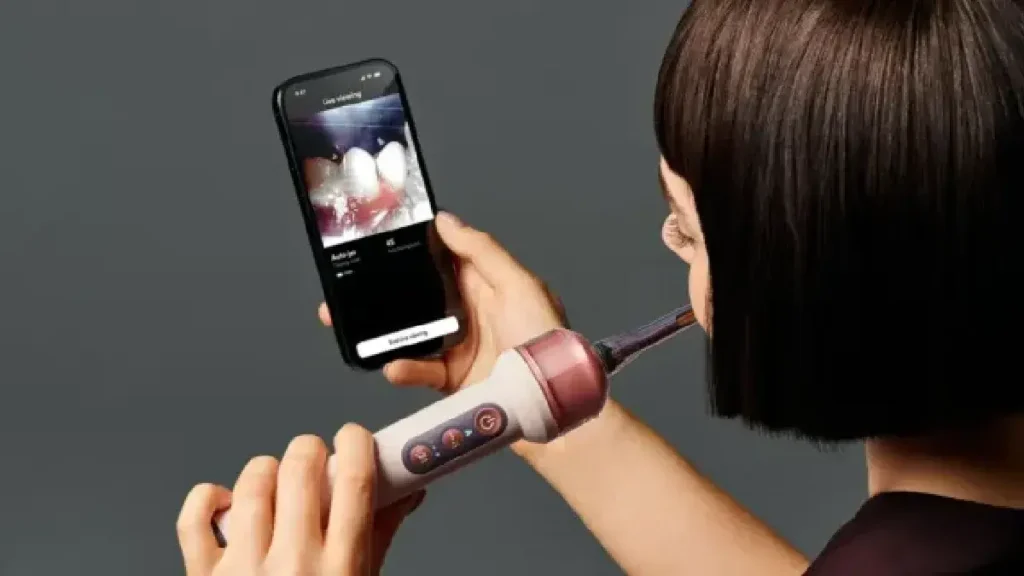
Dyson has officially entered the oral care market with the launch of the Dyson CameraJet, a $499.99 electric toothbrush that features a built-in camera and AI technology to detect gaps between teeth. The device, which combines an electric toothbrush with a precision flosser, was unveiled on September 1, 2026, marking the company’s first foray into dental hygiene products after six years of research and development.





The CameraJet uses a 100,000-pixel macro lens camera to analyze 28 images per second, identifying interdental spaces and automatically releasing bursts of mouthrinse to clean those hard-to-reach areas. The toothbrush connects to the MyDyson app for live viewing and personalized feedback, and Dyson emphasizes that all images are processed on-device and never stored or shared.
What Is Dyson CameraJet?
The Dyson CameraJet is an AI-powered electric toothbrush and flosser designed to address what Dyson calls the fundamental problem of oral care: cleaning the gaps between teeth where plaque builds up. The device is the result of six years of work involving 661 engineers and 38 patents.
Unlike traditional electric toothbrushes, the CameraJet features an integrated intraoral camera powered by Dyson’s proprietary Gap Optical Targeting algorithm. This machine learning system was trained on over 470,000 dental images and runs on 16 million lines of code. The camera’s role is to detect gaps between teeth in real time, allowing the device to deliver targeted cleaning where it is needed most.
According to Dyson founder James Dyson, “Flossing is an awkward and time-consuming chore. Few of us do it even though we know we should. By combining a camera, machine learning, precision fluid dynamics, advanced brushing technologies, connectivity and Wi-Fi, Dyson CameraJet introduces an entirely new way to keep your mouth healthy.”
Dyson CameraJet Price
The Dyson CameraJet is priced at $499.99 in the United States. It is available in two color options: Ceramic Pink and Ceramic Ultra Blue.
What is included in the box:
- Dyson CameraJet electric toothbrush with flosser
- Two dual-bristle brush heads
- Refill dock for charging and storage
- USB-C to Pogo-pin charging cable
- Transparent travel case
- Swappable lithium-ion battery
- Non-foaming toothpaste and low-foaming mouthrinse samples
The toothbrush is currently available in select markets, including the US. Dyson has stated that pricing and availability for India will be shared closer to the local launch. The CameraJet is available for purchase through Dyson’s official website and Dyson Demo Stores.
How Does the Camera Toothbrush Work?
The CameraJet’s core technology revolves around its built-in camera and Gap Optical Targeting system. Here is how it works:
Camera scanning: The 100,000-pixel macro lens camera captures images of the teeth and gums while the user brushes. A stroboscopic light provides illumination for optimal visibility.
AI analysis: Dyson’s machine-learning algorithm processes up to 28 images per second, identifying gaps between teeth and tracking their location in real time.
Targeted flossing: Within 100 milliseconds of detecting a gap, the device triggers a conical jet that releases up to 0.15ml of mouthrinse between the teeth.
Brushing action: The dual-bristle brush head uses variable sonic oscillation (245 oscillations per second) to clean along the gumline and lift surface stains while the jetting occurs simultaneously.
The toothbrush features a 12.5ml anti-gravity mouthrinse tank with a diaphragm pump and pressure chamber, allowing consistent jetting regardless of brush orientation.
How Does Dyson CameraJet Detect Gaps Between Teeth?
The gap-detection technology, known as Gap Optical Targeting, relies on a combination of hardware and software:
Hardware: A 100,000-pixel macro lens camera with a target lens that expands the field of view, paired with a 257Hz stroboscopic light for optimal imaging.
Software: Dyson’s proprietary AI machine-learning algorithm, trained on 470,000 dental images, can detect, track, and predict interdental gaps in real time.
When the camera identifies a gap, the system calculates the optimal position for the jet nozzle and triggers the release of mouthrinse. The entire process from detection to jetting takes approximately 100 milliseconds.
Dyson developed a non-foaming toothpaste and low-foaming mouthrinse specifically for the CameraJet, as foam can obstruct the camera’s view during brushing.
How Does It Target Plaque?
The CameraJet’s plaque-targeting mechanism works through a combination of mechanical brushing and precision flossing:
Conical jet technology: Unlike traditional water flossers that use a needle-shaped stream, Dyson’s conical jet produces a broad, cone-shaped spray designed to sweep plaque away more effectively. Dyson says this lower-pressure spray is gentler on gums and enamel.
Dual-bristle brush head: The brush head features inner bristles designed to lift surface stains and outer bristles that clean along the gumline.
Variable sonic oscillation: The sonic motor oscillates at 245 times per second and maintains bristle movement even when encountering tooth surfaces, preventing the “stalling” that can reduce cleaning effectiveness in other sonic toothbrushes.
The device offers three cleaning modes and three intensity settings (Gentle, Variable, and Deep Clean), allowing users to customize their brushing experience.
Dyson CameraJet Features
- Built-in 100,000-pixel intraoral camera with macro lens
- Gap Optical Targeting AI powered by machine learning
- Conical jet precision flossing with up to 0.15ml per burst
- Live view through MyDyson app
- Three cleaning modes: Auto-jet and Brush, Auto-jet only, Brush only
- Three brushing intensities: Gentle, Variable, Deep Clean
- Variable sonic oscillation at 245 oscillations per second
- RFID-enabled brush head with wear tracking
- 12.5ml anti-gravity mouthrinse tank
- Wi-Fi (2.4GHz) and Bluetooth connectivity
- IPX7 water resistance
- Swappable lithium-ion battery with up to 10 days of battery life
- Refill dock for charging and storage
- Privacy-first design: Images processed on-device, never stored or shared
Is the $499 Dyson Toothbrush Worth It?
The $499 price tag places the CameraJet in a premium category far above conventional electric toothbrushes, which typically cost between $30 and $200. Here are some factors consumers should consider:
Who may find it useful:
- Those who struggle with traditional flossing
- Users seeking real-time feedback on their brushing technique
- Technology enthusiasts interested in connected health devices
Key differences from cheaper alternatives:
- The CameraJet combines brushing and flossing in one device
- Real-time gap detection and targeted cleaning is unique
- Live camera view and personalized app feedback
Considerations before buying:
- The premium price is significantly higher than most electric toothbrushes
- The device requires Dyson’s non-foaming toothpaste and mouthrinse for optimal performance
- Clinical claims are based on specific testing conditions
It is worth noting that Dyson has built a business around premium-priced products like the Supersonic hair dryer, and the CameraJet represents a similar bet on consumer willingness to pay for advanced technology. However, this is not a medical device, and Dyson does not claim it can diagnose dental conditions.
Dyson CameraJet vs Regular Electric Toothbrush
| Feature | Dyson CameraJet | Standard Electric Toothbrush |
|---|---|---|
| Price | $499.99 | $30 – $200 |
| Camera | Built-in 100k pixel intraoral camera | None |
| Technology | AI-powered gap detection | Basic timer/pressure sensors |
| Flossing | Integrated conical jet | Separate flossing required |
| App Features | Live view, coverage maps, guided cleaning | Basic tracking (on premium models) |
| Battery Life | Up to 10 days | Typically 7-14 days |
| Brush Head | RFID-enabled | Standard replacement heads |
| Privacy | On-device processing, no storage | N/A |
Frequently Asked Questions
1. How much does Dyson CameraJet cost?
The Dyson CameraJet is priced at $499.99 in the US. It is currently available in select markets, with India pricing to be announced closer to local availability.
2. What is Dyson CameraJet?
The Dyson CameraJet is an electric toothbrush with a built-in camera and AI technology that detects gaps between teeth and delivers targeted bursts of mouthrinse to clean those areas.
3. Does Dyson CameraJet have a camera?
Yes, it features a 100,000-pixel macro lens camera that analyzes 28 images per second to identify interdental gaps.
4. How does Dyson CameraJet detect gaps between teeth?
The device uses Gap Optical Targeting technology, a machine-learning algorithm trained on 470,000 dental images that analyzes camera footage in real time to detect, track, and predict interdental gaps.
5. Does the Dyson CameraJet use AI?
Yes, it uses AI-powered machine learning for its Gap Optical Targeting system, running on 16 million lines of code.
6. Is Dyson CameraJet available in the US?
Yes, it launched in the US on September 1, 2026, and is available in Ceramic Ultra Blue and Ceramic Pink.
7. Is Dyson CameraJet worth $499?
That depends on individual needs. It offers unique camera-based targeting and integrated flossing, but the premium price is significantly higher than conventional electric toothbrushes. Consumers should consider whether the advanced features justify the cost for their personal oral care routine.
The Dyson CameraJet represents a significant departure from conventional electric toothbrushes, bringing advanced imaging and AI technology to daily oral care. By combining a built-in camera, machine learning, and precision fluid dynamics, Dyson aims to solve the challenge of cleaning the gaps between teeth — areas that traditional brushing often misses. The toothbrush’s ability to visually detect gaps and respond with targeted cleaning sets it apart from products that simply track brushing habits.
While the $499 price point places it firmly in the premium category, the CameraJet’s unique approach to oral care has attracted attention from tech enthusiasts and those seeking smarter solutions for dental hygiene. As with any new technology, potential buyers should weigh the innovative features against the cost and consider whether the integrated flossing and AI-driven feedback align with their personal oral care needs.