







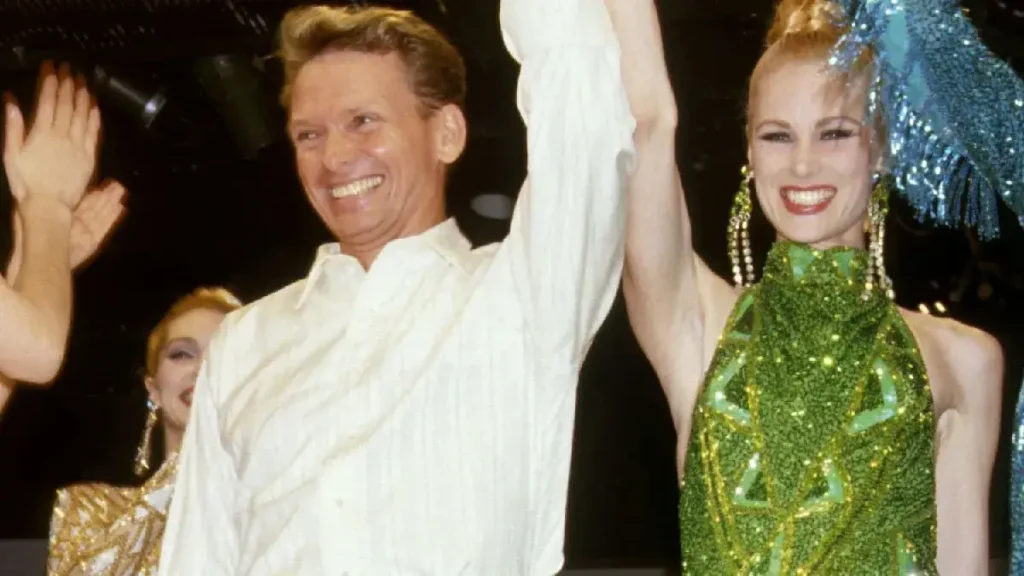
Bob Mackie, the legendary costume and fashion designer whose dazzling creations helped define the public images of Cher, Carol Burnett and countless other entertainment icons, has died. He was 87.




The designer’s death was announced Monday, September 14, 2026, in a statement posted to his official social media accounts. “It is with a heavy heart that we share the news that Mr. Bob Mackie passed away today,” the statement read. “He lived his 87 years to the fullest, fulfilling his dream of being a Fashion and Costume Designer, which is all he ever wanted to do.”
The cause of death has not been publicly disclosed. A statement from his team confirmed his passing but did not provide additional details about the circumstances.
Bob Mackie Dies at 87
Mackie passed away on Monday, according to the announcement shared across his social media platforms. The statement described a life lived with purpose and passion, noting that his “genius and extraordinary designs will live on forever, continuing to bring beauty into this world.”
The designer’s career spanned more than six decades, during which he became one of the most recognized and celebrated figures in entertainment costume design. His work earned him nine Emmy Awards, a Tony Award, and three Academy Award nominations, along with induction into the Television Academy Hall of Fame in 2002.
Tributes from fellow designers and performers began circulating shortly after the news broke. Actor Kristin Chenoweth called him a “legend,” while designer Isaac Mizrahi wrote simply, “heartbroken.” Actor Alyssa Milano described him as “one of the best that ever was,” and model Mikhaila “Coco” Rocha noted that “his clothes had wit, drama, fantasy and joy.”
Who Was Bob Mackie?
For readers who may not recognize his name, Bob Mackie was the creative force behind some of the most memorable visual moments in American entertainment history. He was a costume designer first and foremost—an artist who understood that what a performer wears is not merely clothing but an extension of their stage persona, their character, and their story.
A native of Southern California, Mackie began his career in 1961 as a sketch artist for film costume designers, including the legendary Edith Head and Jean Louis. That early apprenticeship gave him a foundation in the technical and narrative demands of costume design that would serve him throughout his career.
His big break came in 1966 when entertainer Mitzi Gaynor hired him to design costumes for her Las Vegas revue and television specials. Gaynor was looking for a completely new look, and Mackie delivered—combining dance-friendly construction with glamour and comedy in a way that would become his signature.
What set Mackie apart was his understanding that costumes for performers must do more than look beautiful in a sketch. They must move with the body, catch the light, photograph well, and communicate character instantly. His motto, as he told The Associated Press in 2018, was simple: “You don’t try to change anybody, you just try to make them look better than ever.”
Bob Mackie’s Extraordinary Career
Mackie’s career trajectory was remarkable for both its longevity and its range. After his work with Mitzi Gaynor caught the attention of Carol Burnett, he was hired to design the entire wardrobe for the first season of The Carol Burnett Show—a role he would hold for the show’s entire eleven-year run.
The Carol Burnett Show became a showcase for Mackie’s comedic sensibility as well as his technical skill. He designed dozens of costumes each week, often on extremely tight deadlines. His work on the show included the now-legendary “Went With the Wind” sketch, in which Burnett descended a staircase wearing a green velvet curtain complete with the curtain rod still attached. Mackie reportedly created that costume the night before filming, hoping the absurdity would land. It became one of the most famous costumes in television history and is now part of the permanent collection of the Smithsonian Museum of American History.
Around the same time, Mackie began working with Cher, who had appeared as a guest on Burnett’s show and admired his work. He went on to design for The Sonny and Cher Show, creating the leopard-print jumpsuits, dangling earrings, and glamorous looks that helped define Cher’s early television persona.
His reputation grew throughout the 1970s and 1980s. He designed gowns for Madonna, Barbra Streisand, Sharon Stone, Diana Ross, and Julia Louis-Dreyfus, and concert costumes for Pink. He launched his own ready-to-wear line in 1982 and became an early partner with QVC, bringing his designs to a wider audience.
In 1999, the Museum at the Fashion Institute of Technology honored him with a retrospective exhibition titled Unmistakably Mackie, which became one of the most highly attended exhibitions in New York City history.
Bob Mackie and Cher
No collaboration was more defining for Bob Mackie than his decades-long creative partnership with Cher. Their relationship began when Cher was a guest on The Carol Burnett Show, and it evolved into one of the most recognizable designer-performer partnerships in entertainment history.
Mackie designed for Cher on The Sonny and Cher Show, for her concert tours, and for her most memorable red-carpet appearances. His creations for Cher were characterized by sheer fabrics, elaborate beadwork, feathers, dramatic silhouettes, and what became known as the “naked dress”—a design that used skin-toned mesh and strategic beading to create the illusion of nudity while remaining technically covered.
One of their most famous collaborations was the gown Cher wore to the 1974 Met Gala: a sheer, beaded design with white feathered sleeves and a white feathered skirt. The dress was so striking that Cher and the gown appeared on the cover of Time magazine.
Mackie also designed the infamous 1986 Academy Awards look—a beaded spiderweb design worn with a complementary Mohawk—and the barely-there gown Cher wore when she won the Best Actress Oscar in 1988. His work on Cher’s 1999 Live in Concert from Las Vegas special and her 2003 Farewell Tour earned him Emmy Awards.
Their collaboration continued well into the 21st century. Mackie designed costumes for The Cher Show, the Broadway musical based on Cher’s life, which earned him a Tony Award in 2019.
Zendaya honored Cher—and Mackie’s legacy—at the 2024 Rock & Roll Hall of Fame induction ceremony by wearing a Mackie gown.
Bob Mackie and Carol Burnett
Mackie’s work with Carol Burnett was equally significant, though its tone was comedic rather than glamorous. On The Carol Burnett Show, he was responsible for the visual humor that made so many sketches memorable.
The show’s format demanded an extraordinary output. Mackie created up to 70 costumes each week for Burnett, her cast, and guest stars. He had only days—sometimes just hours—to conceive designs, source materials, and get costumes made.
His approach to designing for Burnett was rooted in an understanding of her personality. As he told The Idaho Statesman in 1972, “When I am designing for people, I take into consideration their personalities. I try to enhance what exists.” For Burnett, that meant clothing with “comfortable elegance”—designs with pockets, simple lines, and an effortless quality that suited her comedic style.
The curtain dress from the “Went With the Wind” sketch remains the most famous example of their collaboration. But Mackie also created Burnett’s cleaning lady character’s ragged skirt and headscarf, elaborate headdresses for historical parodies, and countless other looks that helped make the show a visual as well as comedic landmark.
Mackie and Burnett remained friends and collaborators for decades. He designed costumes for her in the Broadway revue Putting It Together and Moon Over Buffalo.
Bob Mackie’s Other Famous Clients
Beyond Cher and Carol Burnett, Mackie’s client list read like a who’s who of entertainment. He designed for Tina Turner, Diana Ross, Dolly Parton, Liza Minnelli, Elton John, Barbra Streisand, Madonna, and many others.
For Diana Ross, he created gowns that matched her elegance and stage presence. For Tina Turner, he designed costumes that moved with her explosive performance style. For Liza Minnelli, he created looks for Minnelli on Minnelli in 1999.
His influence extended beyond the performers he dressed directly. When Taylor Swift wanted to evoke a showgirl aesthetic for her 2025 album The Life of a Showgirl, she turned to Mackie originals. Miley Cyrus, Anya Taylor-Joy, and Kendall Jenner have all worn archival Mackie pieces, demonstrating that his designs remain visually powerful decades after their creation.
Bob Mackie and Marilyn Monroe
One of the most frequently misunderstood aspects of Mackie’s career involves his connection to Marilyn Monroe. When Monroe delivered her famous breathy rendition of “Happy Birthday” to President John F. Kennedy in 1962, she wore a sheer, beaded gown that became one of the most iconic garments in American history.
That gown originated as a sketch by Bob Mackie, who was then a young sketch artist working for costume designer Jean Louis. Louis was responsible for the gown’s execution, but Mackie’s sketch was the genesis of the design. This distinction matters: Mackie did not independently design the dress, but his early creative contribution to it has been documented and acknowledged.
It is important to note that the gown itself is often inaccurately attributed solely to Mackie. The historical record credits Jean Louis as the designer who brought the sketch to reality, with Mackie providing the original concept.
Bob Mackie’s Iconic Costume Designs
What made Mackie’s designs distinctive was their unabashed embrace of theatricality. In an era when fashion could be understated and minimal, Mackie’s work was maximalist, celebratory, and unapologetically glamorous.
His signature elements included:
Sequins and Beadwork: Mackie’s costumes were often covered in thousands of hand-sewn sequins and beads, creating surfaces that caught and reflected stage lighting in spectacular fashion. This earned him nicknames like the “Sultan of Sequins” and the “Rajah of Rhinestones.”
Feathers: Ostrich plumes, marabou, and other feathers featured prominently in his designs, adding movement and drama to performances.
Nude Illusion: Mackie pioneered the use of skin-toned mesh and strategic embellishment to create dresses that appeared to reveal more than they actually did. This technique became a hallmark of his work for Cher and influenced red-carpet fashion for decades.
Dramatic Silhouettes: From flowing caftans to form-fitting gowns to elaborate headpieces, Mackie’s designs created striking visual shapes that read clearly from the back of a theater or through a television screen.
Bold Colors: Mackie favored vibrant hues—hot pinks, electric blues, brilliant reds—that photographed well and conveyed energy.
His costumes were not designed for static display. They were engineered for movement, for the way a performer’s body would move across a stage, for the way fabric would catch the light during a spin or a dance number.
Bob Mackie’s Work in Television
Television was where Mackie’s work reached its largest audience, and his impact on the medium was profound.
His eleven-year tenure on The Carol Burnett Show established him as the preeminent costume designer in variety television. The show’s format—sketch comedy with musical numbers and recurring characters—demanded an enormous range from Mackie, who had to move seamlessly between comedy, glamour, and historical parody.
His first Emmy Award came in 1967 for Alice Through the Looking Glass, shared with Ray Aghayan. Notably, this was the first Emmy ever awarded in the costume design category. He would go on to win eight more Emmys across his career, for projects including Cher’s concert specials.
Mackie was inducted into the Academy of Television Arts & Sciences Hall of Fame in 2002, recognizing his lasting contribution to the medium.
Bob Mackie’s Work on Broadway and Stage
Mackie’s theatrical work extended from Broadway to ballet to opera. He designed costumes for On the Town in 1971, Lorelei with Carol Channing in 1974, Debbie with Debbie Reynolds in 1976, and Moon Over Buffalo with Carol Burnett in 1995.
His most celebrated theatrical achievement came with The Cher Show, the jukebox musical based on Cher’s life and career. Mackie’s costumes for the production earned him the 2019 Tony Award for Best Costume Design of a Musical, along with a Drama Desk Award and an Outer Critics Circle Award.
He also designed costumes for the San Francisco Opera’s production of Alban Berg’s Lulu and the world premiere of the ballet Blue Suede Shoes, featuring the music of Elvis Presley.
Bob Mackie’s Awards and Achievements
Mackie’s awards cabinet was among the most decorated in entertainment design.
Emmy Awards: Nine wins, including the first-ever Emmy for costume design in 1967 and awards for Cher’s concert specials in 1999 and 2003.
Tony Award: Won in 2019 for The Cher Show.
Academy Award Nominations: Three nominations, including one for Barbra Streisand’s Funny Lady, in which she wore a sheer batwing gown.
Television Academy Hall of Fame: Inducted in 2002.
Additional Honors: TDF Irene Sharaff Lifetime Achievement Award (2007), Hollywood Arts Council “Charlie” Award (2008), Otis College of Art and Design Design Legend Award and Honorary Doctorate (2011), Chicago History Museum Designer of Excellence Award (2016), and the Geoffrey Beene CFDA Lifetime Achievement Award (2019).
Why Bob Mackie’s Designs Were So Influential
Mackie’s influence extended far beyond the specific garments he created. He helped establish a visual language for celebrity performance that continues to shape how stars present themselves today.
Before Mackie, costume design for television and stage was often functional—clothing that served the needs of a scene without necessarily making a broader statement. Mackie understood that in the age of television, costumes were not just garments but images. They would be photographed, broadcast, and remembered. They needed to work as visual icons.
His collaboration with Cher was particularly significant in this regard. The “naked dress” and other bold designs Cher wore on red carpets and stages helped establish the red carpet as a space for fashion risk-taking and personal expression. The idea that a celebrity’s appearance at an awards show could be as culturally significant as the awards themselves owes something to the visual impact of Mackie’s designs.
His archival pieces continue to be worn by contemporary stars—Zendaya at the 2024 Rock & Roll Hall of Fame ceremony, Miley Cyrus and Anya Taylor-Joy at red carpet events—demonstrating that his designs have not dated. They remain visually powerful and culturally resonant.
Bob Mackie’s Design Philosophy and Style
Mackie was clear-eyed about the distinction between fashion and costume. In a 1999 interview with the Associated Press, he explained: “The outfits are sometimes mistaken for fashion, but they’re costumes like for a character in a play. I want people to have fun.”
This philosophy shaped everything he did. His designs were not intended to be worn to the grocery store or to a dinner party. They were intended to create a moment, to support a performance, to help a star become larger than life.
His approach to design began with the performer, not the garment. As he told The Idaho Statesman in 1972: “When I am designing for people, I take into consideration their personalities. I try to enhance what exists.”
For Cher, that meant glamour and provocation. For Carol Burnett, it meant comfortable elegance and comedic flexibility. For Diana Ross, it meant sophistication and stage presence. Mackie did not impose a single aesthetic on his clients. He adapted his skills to serve their individual needs.
Bob Mackie’s Legacy
Bob Mackie leaves behind a body of work that is unlikely to be matched in scale or influence. Over more than sixty years, he created thousands of costumes for hundreds of performers across television, film, theater, and concert stages.
His legacy is visible in several ways:
The performers he dressed: Cher, Carol Burnett, Diana Ross, Tina Turner, Liza Minnelli, and countless others whose public images were shaped in part by his designs.
The designers he influenced: Contemporary costume designers working in television, film, and theater have absorbed lessons from Mackie’s approach to character, movement, and visual storytelling.
The archival pieces: His designs are preserved in the Smithsonian and other museum collections, and continue to be worn by contemporary stars.
The cultural moments: The curtain dress, the naked dress, the Oscar gowns—these are not just costumes but cultural artifacts that remain recognizable decades after their creation.
The documentary: Bob Mackie: Naked Illusion, released in 2024, introduced his work to a new generation and underscored his lasting importance.
Reactions to Bob Mackie’s Death
Tributes to Mackie began appearing shortly after his death was announced. Fellow designers and performers who had worn his creations shared their remembrances.
Actor Kristin Chenoweth called him a “legend.” Designer Isaac Mizrahi wrote simply, “heartbroken.” Actor Alyssa Milano described him as “one of the best that ever was.” Model Mikhaila “Coco” Rocha wrote that “his clothes had wit, drama, fantasy and joy.”
The full scope of tributes from the entertainment industry is still emerging, but the immediate reactions suggest a deep appreciation for Mackie’s contribution to the visual culture of American entertainment.
Bob Mackie Cause of Death: What We Know
The cause of Bob Mackie’s death has not been publicly confirmed. The statement announcing his passing did not include information about how he died, and no further details have been released by his family or representatives.
Readers should treat any specific claims about the cause of his death with caution unless they come from an official source. The absence of a confirmed cause is not unusual in initial death announcements and may be clarified in the coming days.
Bob Mackie Timeline
1961: Begins career as a sketch artist for film costume designers, including Edith Head and Jean Louis.
1966: Hired by Mitzi Gaynor to design costumes for her Las Vegas revue and television specials.
1967: Wins first Emmy Award (shared with Ray Aghayan) for Alice Through the Looking Glass—the first Emmy ever awarded for costume design.
1967-1978: Serves as costume designer for The Carol Burnett Show throughout its eleven-year run.
1970s: Begins long collaboration with Cher, designing for The Sonny and Cher Show, concert tours, and red-carpet appearances.
1971: Designs costumes for On the Town on Broadway.
1974: Designs Lorelei with Carol Channing; attends Met Gala with Cher in the famous naked dress.
1982: Launches Bob Mackie ready-to-wear collection and Bob Mackie Barbie collectible dolls.
1995: Designs costumes for Moon Over Buffalo with Carol Burnett.
1999: Retrospective exhibition Unmistakably Mackie at the Museum at FIT; wins Emmy for Cher’s Las Vegas concert special.
2002: Inducted into the Academy of Television Arts & Sciences Hall of Fame.
2003: Wins Emmy for Cher: The Farewell Tour.
2019: Wins Tony Award for The Cher Show; receives Geoffrey Beene CFDA Lifetime Achievement Award.
2024: Documentary Bob Mackie: Naked Illusion released.
2026: Dies on September 14 at age 87.
FAQs
Who was Bob Mackie?
Bob Mackie was a costume and fashion designer known for creating iconic looks for Cher, Carol Burnett, Diana Ross, and many other entertainment stars. He won nine Emmy Awards, a Tony Award, and was nominated for three Oscars.
How old was Bob Mackie when he died?
Bob Mackie was 87 years old at the time of his death.
When did Bob Mackie die?
He died on Monday, September 14, 2026, according to a statement posted to his social media accounts.
What was Bob Mackie known for?
Mackie was known for his glamorous, theatrical costume designs featuring sequins, feathers, beadwork, and bold silhouettes. He created looks for television, film, Broadway, and concert performances.
What did Bob Mackie design for Cher?
Mackie designed numerous iconic looks for Cher, including the sheer beaded gown worn to the 1974 Met Gala, the 1986 Oscar spiderweb dress, and the nude illusion gown she wore when winning the Best Actress Oscar in 1988. He also designed for The Sonny and Cher Show, her concert tours, and The Cher Show on Broadway.
Did Bob Mackie work with Carol Burnett?
Yes. Mackie was the costume designer for The Carol Burnett Show for its entire eleven-year run, creating up to 70 costumes per week. His most famous design for Burnett was the curtain dress from the “Went With the Wind” sketch.
What awards did Bob Mackie win?
Mackie won nine Emmy Awards, a Tony Award (for The Cher Show), and received three Academy Award nominations. He was inducted into the Television Academy Hall of Fame in 2002.
Did Bob Mackie design costumes for Marilyn Monroe?
Mackie created the original sketch for the sheer beaded gown Marilyn Monroe wore to sing “Happy Birthday” to President Kennedy in 1962. The gown was executed by designer Jean Louis, for whom Mackie worked as a sketch artist at the time.
What was Bob Mackie’s cause of death?
The cause of death has not been publicly confirmed or disclosed.
What is Bob Mackie’s legacy?
Mackie’s legacy includes thousands of costume designs, nine Emmy Awards, a Tony Award, and a lasting influence on how entertainers present themselves visually. His designs remain in museum collections, continue to be worn by contemporary stars, and have shaped the visual language of celebrity performance.
Conclusion
Bob Mackie was far more than a costume designer. He was a visual architect of celebrity, an artist who understood that what a performer wears can become inseparable from who they are in the public imagination.