







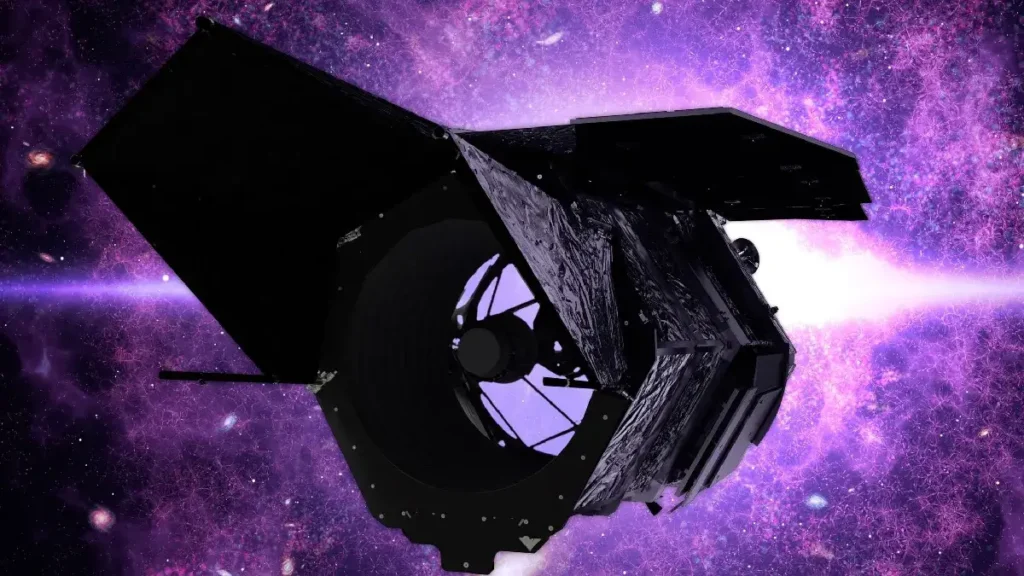
NASA’s Nancy Grace Roman Space Telescope launched in August 2026 to explore the universe’s biggest mysteries. The purpose of the Roman Space Telescope is to investigate dark energy and dark matter, find thousands of exoplanets, and map billions of galaxies, helping answer fundamental questions about what the universe is made of and whether we are alone.





What Is the Nancy Grace Roman Space Telescope?
The Nancy Grace Roman Space Telescope is NASA’s newest flagship space observatory. Named after Nancy Grace Roman, NASA’s first chief astronomer and the “mother of Hubble,” the telescope is designed to capture panoramic views of the cosmos.
The telescope is about the size of a bus and carries a 2.4-meter primary mirror—the same size as Hubble’s. It has two main instruments: a 300-megapixel Wide Field Instrument (a powerful infrared camera) and a Coronagraph Instrument for directly imaging distant planets.
What makes Roman unique is its enormous field of view. It can capture an area of the sky at least 100 times larger than Hubble in a single image, allowing it to survey the cosmos 1,000 times faster.
What Is the Main Purpose of the Roman Space Telescope?
Roman’s primary purpose is to conduct sweeping surveys of the universe that will help scientists tackle three major areas of research: dark energy, dark matter, and exoplanets. The telescope will create an unprecedented 3D map of the universe covering more than 2 billion galaxies while also hunting for planets outside our solar system.
According to NASA, the Roman Space Telescope’s crisp, sweeping surveys will “help scientists investigate dark energy and dark matter, discover and characterise exoplanets, map billions of galaxies, study black holes, and explore objects from our own solar system to the edge of the observable Universe.”
Studying Dark Energy
One of Roman’s most important goals is to study dark energy, a mysterious force believed to be causing the expansion of the universe to accelerate. Dark energy makes up about 68% of the universe, yet scientists don’t know what it is.
Roman will investigate dark energy using several methods:
Measuring supernovae: The telescope will detect thousands of distant exploding stars called Type Ia supernovae, which have a predictable brightness. This allows scientists to measure cosmic distances and understand how the universe’s expansion has changed over time.
Mapping galaxy clustering: Roman will study how galaxies cluster together across cosmic distances, including patterns from sound waves that rippled through the early universe. These patterns help reveal how the universe expanded.
Weak gravitational lensing: The telescope will measure how the gravity of invisible matter slightly bends and distorts the light from distant galaxies, providing insights into both dark matter and dark energy.
Mapping Dark Matter
While dark matter makes up about 27% of the universe, it cannot be seen directly. Scientists know it exists because of its gravitational effects on visible matter and light.
Roman will help map dark matter by observing weak gravitational lensing—the subtle warping of galaxy images caused by dark matter’s gravitational pull. By studying these distortions in hundreds of millions of galaxies, the telescope will create the most detailed 3D map of both ordinary and dark matter distribution in the universe.
Finding and Studying Exoplanets
Roman will conduct one of the most comprehensive searches ever for exoplanets (planets beyond our solar system). NASA expects the telescope to discover tens of thousands of new exoplanets—possibly as many as 100,000—dramatically increasing the roughly 6,000 currently known.
Roman will find planets using several techniques:
Microlensing: When a star passes in front of a more distant star, its gravity acts like a magnifying lens. Roman will detect the telltale brightening patterns that reveal planets orbiting the foreground star.
Transit detection: Roman will monitor millions of stars for periodic dimming caused by planets crossing in front of them.
Direct imaging: The Coronagraph Instrument will block out a star’s blinding light, allowing the telescope to directly image planets orbiting around it. This is the most powerful coronagraph ever flown in space.
Studying Galaxies and the Early Universe
Roman’s wide-field observations will help scientists understand galaxy evolution and the history of the universe. The telescope will map billions of galaxies and tens of billions of stars.
The telescope’s infrared vision is crucial for studying the early universe. As light from distant objects travels across the universe, it gets stretched to longer, redder wavelengths—a phenomenon called “redshift.” Roman’s infrared sensitivity allows it to peer farther back in time than visible-light telescopes.
How Is Roman Different From the James Webb Space Telescope?
While both are powerful infrared space telescopes, they serve different purposes and have different strengths. NASA compares Roman to a wide-angle lens and Webb to a zoom lens.
Roman Space Telescope:
- Wide field of view (100x larger than Hubble)
- Surveys large areas of sky quickly
- Discovers objects and phenomena
- Creates large-scale maps of the universe
James Webb Space Telescope:
- Narrow field of view, highly precise
- Studies individual objects in deep detail
- Follows up on discoveries with detailed analysis
- Zooms in on specific targets
As Julie McEnery, Roman’s senior project scientist, explained: “Webb is designed to be able to probe very deeply and with exquisite sensitivity into the universe, so we can find rare things in the early universe,” while Roman offers “the large vision that complements the deep views that Webb provides.”
Why Is the Roman Space Telescope Important?
The Roman Space Telescope could fundamentally change our understanding of the universe. Its discoveries may:
- Reveal what dark energy is and whether it changes over time
- Map the distribution of dark matter in unprecedented detail
- Find potentially habitable planets by studying their atmospheres
- Provide the first statistical census of planetary systems like our own
- Discover rare and unusual objects that challenge our theories
As NASA Administrator Jared Isaacman said, “Roman will give us a new atlas of the universe, push the boundaries of discovery, and demonstrate what is possible when America’s space program pairs bold ambition with disciplined execution.”
Frequently Asked Questions
What is the purpose of the Nancy Grace Roman Space Telescope?
The purpose of the Nancy Grace Roman Space Telescope is to investigate dark energy and dark matter, discover and study exoplanets, map billions of galaxies, and explore the universe’s largest mysteries. It will survey the cosmos with a wide field of view to help answer fundamental questions about what the universe is made of and whether we are alone.
What will the Roman Space Telescope discover?
Roman is expected to discover tens of thousands of new exoplanets (possibly up to 100,000), thousands of supernovae, billions of galaxies, and tens of billions of stars. It will also create the most comprehensive 3D map of the universe.
Is the Roman Space Telescope better than James Webb?
No—Roman and Webb are complementary. Roman has a wide field of view and surveys large areas of the sky quickly, like a wide-angle lens. Webb has a narrower, more precise view and studies individual objects in deep detail, like a zoom lens. They work together, with Roman often making discoveries that Webb then studies more closely.
What will Roman study?
Roman will study dark energy, dark matter, exoplanets, galaxy evolution, and the early universe. It will also survey objects in our solar system, study black holes, and detect extreme cosmic events.
How will Roman help scientists understand dark energy?
Roman will use multiple methods to study dark energy: measuring distant supernovae to track cosmic expansion, mapping how galaxies cluster together, and observing how gravity warps light to measure the effects of dark energy on the universe.
Will Roman Space Telescope search for exoplanets?
Yes. Roman will search for exoplanets using microlensing, transit detection, and direct imaging with its powerful coronagraph. It is expected to discover tens of thousands of new planets.
Conclusion
The Nancy Grace Roman Space Telescope is NASA’s next great observatory, designed to tackle some of the most profound questions in astrophysics. By studying dark energy, mapping dark matter, discovering exoplanets, and surveying billions of galaxies, Roman will provide an unprecedented view of our universe. Alongside the Hubble and James Webb space telescopes, the Roman Space Telescope will usher in a new era of discovery that could reshape our understanding of the cosmos—and our place within it.