







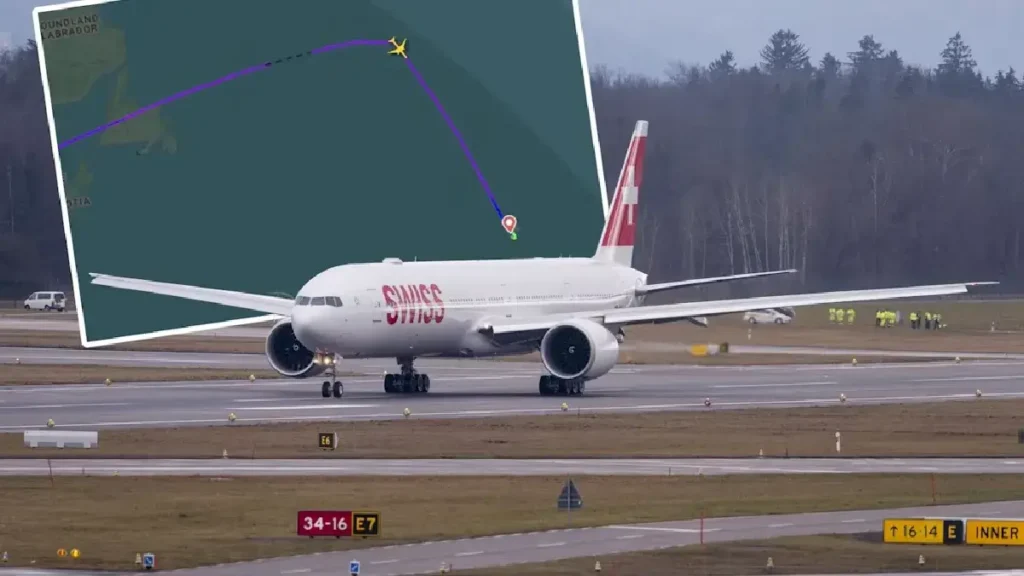
A SWISS Boeing 777 en route from Chicago to Zurich made a precautionary emergency landing on Terceira Island in the Azores on Tuesday morning after crew detected a pungent, unidentified odor in the cabin.





The aircraft, carrying 222 passengers and 16 crew members, landed safely at Lajes Airport at 6:30 a.m. local time (8:30 a.m. Swiss time) following the activation of a Squawk 7700 emergency code over the mid-Atlantic .
What Happened on SWISS Flight LX9?
SWISS Flight LX9 departed Chicago O’Hare for Zurich at approximately 2:35 a.m. Swiss time on Tuesday, August 25, 2026 . Approximately halfway across the Atlantic, the cockpit crew detected a sharp, chemical-like odor in the Economy Class cabin that they could not immediately identify .
In accordance with standard safety protocols, the crew declared an emergency in coordination with air traffic control to secure priority handling in the airspace . The aircraft diverted to the nearest suitable airport, Lajes Airport on Terceira Island in the Azores—a Portuguese archipelago located approximately 1,400 kilometers west of mainland Europe .
Aircraft and Passenger Details
Medical Evaluations and Injuries
Approximately five passengers and one crew member reported brief symptoms including eye irritation, nausea, and headaches after exposure to the odor . All affected individuals underwent precautionary medical examinations upon landing.
None required further medical attention, and all were able to exit the aircraft normally . SWISS emphasized that the well-being of passengers and crew remains the airline’s top priority .
SWISS Official Statement and Response
SWISS confirmed the diversion in an official newsbrief, stating: “In a situation like this, our crews take no risks and make the precautionary decision to land at a suitable airport” .
The airline has scheduled a replacement flight from Zurich to Terceira, expected to depart at approximately 1:00 p.m. Tuesday and arrive back in Zurich at 10:15 p.m. local time . The replacement aircraft will transport passengers and crew to their original destination.
Affected Future Flights
As a result of the diversion and aircraft inspection requirements, the following flights have been canceled :
- Flight LX8 (Zurich → Chicago)
- The subsequent return flight from Chicago to Zurich
SWISS is arranging alternative travel options for affected passengers on these canceled flights .
Investigation and Cause
The exact cause of the pungent odor remains under investigation. SWISS has made clear that experts will thoroughly inspect the aircraft before determining what triggered the incident .
The airline explicitly declined to speculate on possible causes before their investigation concludes .
The Boeing 777-300ER involved (HB-JNF) was delivered to SWISS in July 2016, making it approximately 10 years old at the time of the incident . It is powered by two GE90 engines and features AeroSHARK technology—a specialized surface film applied to the fuselage and engine nacelles that reduces drag and fuel consumption .
Important Timeline
Frequently Asked Questions
What caused SWISS Flight LX9 to divert?
The diversion was caused by a pungent, unidentified odor detected in the Economy Class cabin approximately halfway across the Atlantic . The crew acted out of caution to ensure the safety of passengers and crew .
Where did SWISS Flight LX9 land?
The aircraft diverted to Lajes Airport on Terceira Island in the Azores, a Portuguese archipelago in the mid-Atlantic Ocean .
How many people were on board Flight LX9?
The aircraft carried 222 passengers and 16 crew members (two pilots and 14 cabin crew) .
Were there any injuries on Flight LX9?
Approximately five passengers and one crew member experienced temporary symptoms such as eye irritation, nausea, or headaches. They underwent precautionary medical examinations and none required further medical attention .
Did the flight continue to Zurich?
The original aircraft remains in Terceira for inspection. SWISS has dispatched a replacement flight to pick up stranded passengers and crew, with arrival in Zurich expected at 10:15 p.m. Tuesday .
Is this incident related to overheating power banks?
SWISS has made no connection between this incident and previous power bank-related diversions. The airline has not commented on a possible cause until investigations are complete .
What to Expect Next
Passengers from Flight LX9 are expected to arrive in Zurich on the evening of Tuesday, August 25, 2026, via the replacement aircraft . The original Boeing 777 will be thoroughly inspected by SWISS experts on Terceira before it returns to service. The exact timeline for the aircraft’s return to operations has not been announced .
SWISS has committed to providing updates as the investigation progresses, while reiterating that speculation about the cause remains inappropriate until the investigation concludes .
Conclusion
SWISS Flight LX9’s emergency diversion to the Azores serves as a reminder of the safety-first culture in modern commercial aviation. While the unidentified chemical odor caused significant disruption for 238 people on board, the crew’s swift and precautionary decision-making ensured a safe outcome for all. With a replacement flight already en route and investigations underway, SWISS continues to prioritize passenger safety and transparent communication in line with international aviation standards.