







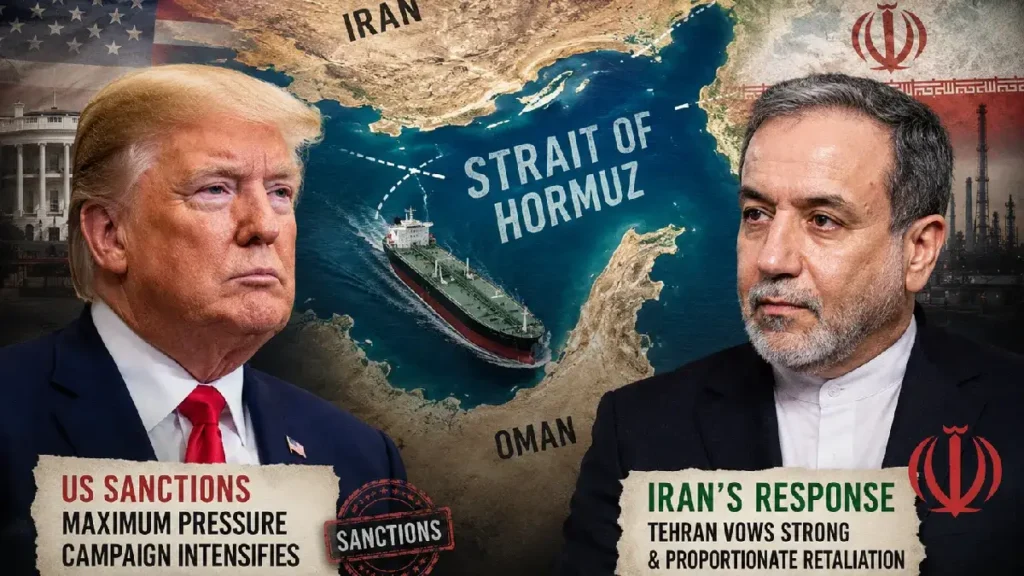
The Trump administration has announced plans for “the toughest sanctions in history” against Iran, labeling it an “economic D-Day” and threatening countries that continue doing business with Tehran with “tremendous economic consequences” . Iran has responded by branding the measures “economic terrorism” and warning that any country participating in the sanctions campaign will be considered an enemy, with threats of “seismic” retaliation .





Latest US Sanctions on Iran
On August 19, 2026, President Donald Trump announced what he called the “most crushing economic operation ever taken against any country” . The move, described as an “Economic D-Day,” aims to intensify pressure on Tehran nearly six months into the ongoing US-Iran war .
Key details of the sanctions announcement:
- Announcement date: August 19, 2026
- Announced by: President Donald Trump
- Supporting official: Treasury Secretary Scott Bessent
- Planned announcement: Bessent stated more details would be shared at a press conference on August 25
- Current status: Announced but not yet fully implemented
Targeted areas according to Trump’s statement include:
- Oil smuggling networks
- Financial transfers and exchange houses
- Ship registries and front companies
- Any “lifeline” to Iran’s economy
Bessent described the strategy as a “one-two punch” combining the existing naval blockade with sweeping new sanctions . He warned, “If you insist on doing business with them, then the U.S. Treasury and U.S. government will put its full might and force against you” .
The Treasury Secretary also urged cooperation from China, which buys more than 80 percent of Iran’s oil shipments . However, China has publicly criticized the initiative, arguing that unilateral US sanctions will not resolve the conflict .
Why Is the US Imposing New Sanctions on Iran?
The stated US reasons for the new sanctions reflect the administration’s position nearly six months into the war .
Official US justification:
- Iran’s nuclear program, which the US has cited as a continued concern
- Failure to reopen the Strait of Hormuz to oil and gas tankers
- Unwillingness of Iran’s leadership to capitulate to US demands
Political context: The announcement comes as the war approaches its six-month mark, with Trump facing declining approval ratings (33% in a recent Reuters/Ipsos survey) and increasing criticism of his Middle East policy ahead of the November midterm elections . Analysts suggest the administration is pivoting from military action to economic pressure as a lower-cost strategy .
Iran’s Response to US Sanctions
Iran has responded forcefully to the US announcement, employing diplomatic, rhetorical, and threats of military-economic retaliation.
Official Iranian statements:
- Foreign Ministry Spokesperson Esmaeil Baqaei: Called the sanctions “economic terrorism” and a “crime against humanity,” arguing they have no basis in international law and violate the UN Charter
- Foreign Minister Abbas Araghchi: Dismissed Trump’s plan as “economic terrorism” threatening the global economy and sovereignty of nations
- President Masoud Pezeshkian: Stated Iran is “in a full-scale economic, military and security war” with the US, adding, “Not only did it not fall, but it became a power that amazed the world with its resistance”
- IRGC Spokesman Hossein Mohebi: Confirmed Iran has a plan of how to respond to each hostile step and avoid negative impacts of the new pressure
Iran Threatens Retaliation: What Has Tehran Said?
Mohsen Rezaei, secretary of Iran’s Supreme National Security Council, delivered the most detailed threat on August 22:
- Three-stage strategy: Iran will first negotiate with countries considering joining the sanctions, ask them to distance themselves from the US, and if they refuse, “we will strike. We will target that country’s interests”
Key threats include:
- Holmuz Strait blockade: Rezaei warned that if countries participate in Trump’s economic warfare, “not even a drop of oil” would leave the Gulf region, including by alternative export routes . Iran has already imposed a blockade on the Strait in response to the US war
- Alternative routes targeted: The threat likely extends to the Bab al-Mandeb Strait gateway to the Red Sea
- “Seismic” retaliation: Iran warned of “earthquake-like” destruction, with a senior official stating that US oil companies and economic corporations operating in the region could become targets
New Iranian doctrine: Researcher Hamidreza Azizi noted that “Tehran appears to be trying to establish deterrence at an earlier stage, by signalling that even preparations for an attack could trigger an Iranian response.” Two elements of the new “offensive doctrine” are preemption and disproportionate retaliation .
What the Staff Departures Mean for Trump
Impact on Iran’s Economy and Oil Markets
Oil market impact:
- Oil prices rose to their highest level in more than three weeks following the US threats
- The war has already disrupted millions of barrels of Middle Eastern oil supplies
- The Strait of Hormuz, through which a fifth of global oil and gas exports pass in peacetime, remains a major concern for international shipping
Iran’s economic situation:
Iran has endured decades of U.S. sanctions, including the “maximum pressure” campaign imposed by Trump during his first term, and believes it has a much higher pain threshold than Washington . The IRGC spokesman stated Iran “has no concerns whatsoever in the economic sphere” and is “developing economic ties right under the United States’ nose, bypassing them” .
Which Countries Could Be Affected?
Primary target: China – Treasury Secretary Bessent urged Beijing to cooperate, as China buys more than 80 percent of Iran’s oil shipments . China has publicly criticized the US initiative, stating sanctions would not resolve the crisis .
Gulf states caught in the middle:
- The UAE has reportedly suspended trade with Iran over an alleged missile attack
- Gulf countries, which are US allies and Iran’s neighbors, are increasingly finding themselves caught in the middle
- Iran has warned its neighbors that if they participate, “not even a drop of oil” would leave the Gulf region
Other nations: Bessent stated, “You’re either with us or against us,” urging allies and the rest of the world to make a decision .
Could the Sanctions Force Iran to Capitulate?
Analysts are divided on the effectiveness of the new sanctions.
Arguments for effectiveness:
- Richard Goldberg, who coordinated diplomatic pressure on Iran in Trump’s first term, argued the combination of US strikes on Iran’s nuclear sites, the war, and the naval blockade have created “the perfect storm for capitulation”
- He described the current situation as “uncharted waters”
Arguments against effectiveness:
- Sanam Vakil at Chatham House noted: “Trump once again appears to underestimate the resolve of Iran’s leadership, which views resistance rather than capitulation as the only viable path” to survival
- Analysts said increased economic pressure is unlikely to force Tehran to cave in, as Iran has endured decades of U.S. sanctions
- The Financial Times reported that Iran believes it has a much higher pain threshold than Washington
- Dennis Ross, former US envoy to the Middle East, said Washington’s approach lacks “the ability to think beyond the immediate next step,” adding “They’re playing checkers. They’re not playing chess”
Iran’s Next Move
Confirmed actions:
- Iran continues to blockade the Strait of Hormuz
- Iran maintains its naval blockade of US ports
- Negotiations with Oman regarding the Strait continue
Reported/possible actions:
- Preemptive strikes: Iran may target countries before they fully join the sanctions campaign
- Disproportionate retaliation: Iran may raise the cost of any attack that does occur
- Targeting economic interests: US oil companies and corporations operating in the region could be targeted
- Alternative trade routes: Iran is developing economic ties to bypass US sanctions
US Sanctions on Iran Latest Update
Updated: August 23, 2026
- President Trump announced “economic warfare and isolation on an unprecedented scale” against Iran on August 19
- Treasury Secretary Scott Bessent will provide more details at a press conference on August 25
- Iran has responded with strong diplomatic statements and threats of “seismic” retaliation against any country joining the US campaign
- The Strait of Hormuz remains a critical flashpoint, with Iran threatening to block alternative export routes
- China has urged all sides to pursue diplomatic solutions instead of economic pressure
- The US has not yet published the full list of sanctions targets