







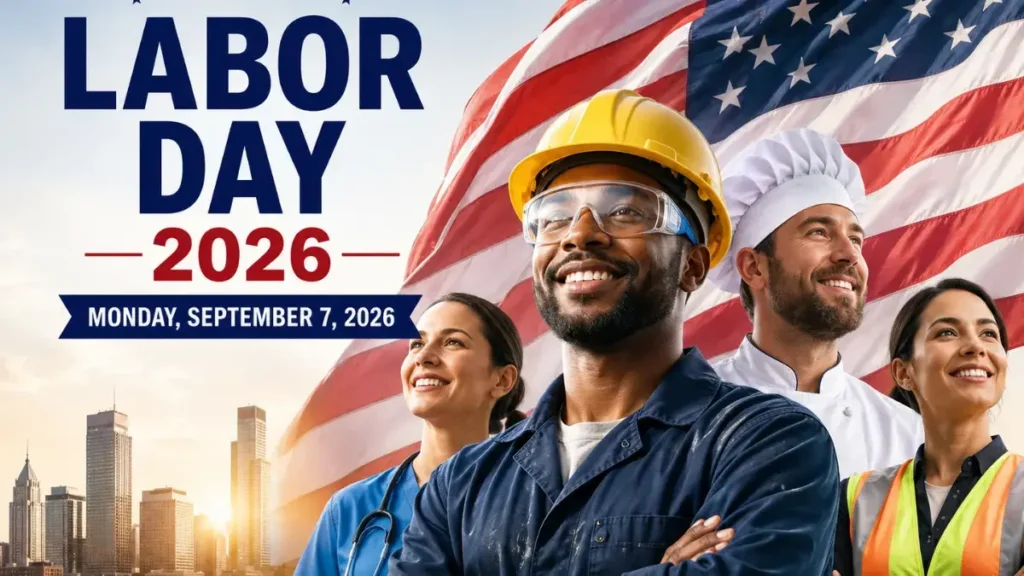
Labor Day is a U.S. federal holiday honoring the contributions and achievements of American workers and the labor movement. Observed annually on the first Monday of September, it stands as a yearly national tribute to the social and economic contributions workers have made to the nation’s strength, prosperity, and well-being.





Quick Answer: Labor Day is celebrated in the United States to honor the contributions and achievements of American workers and the labor movement. It is observed on the first Monday of September and became a federal holiday in 1894.
In 2026, Labor Day falls on Monday, September 7, with the holiday weekend running from Saturday, September 5 through Monday, September 7.
Why Is Labor Day Celebrated?
Labor Day celebrates American workers and their contributions to the country’s economic and social strength. The holiday is rooted in the late 19th century, when labor activists pushed for a federal holiday to recognize the many contributions workers have made to America’s strength, prosperity, and well-being. The U.S. Department of Labor describes the day as “dedicated to the social and economic achievements of American workers” and “a yearly national tribute to the contributions workers have made to the strength, prosperity, and well-being of our country.”
The holiday originated during a difficult period for America’s workers, who faced long hours, low wages, and unsafe working conditions at the height of the Industrial Revolution. As labor unions and activists advocated for better treatment, the idea arose to establish a day dedicated to celebrating the members of trade and labor organizations.
What Is the History of Labor Day?
The history of Labor Day is deeply connected to the industrialization of the United States and the rise of organized labor. In the late 19th century, the average worker was slogging away for 12-hour days, seven days a week, for meager wages, often without the benefits taken for granted today. Working conditions were often dangerous, and industrial accidents were common. Between 1880 and 1900, an average of 35,000 industrial workers were killed on the job each year, and another half-million were injured. The decade of the 1890s saw 37,000 strikes in the United States.
The growth of factories and organized labor led to a movement for a holiday recognizing workers. As the economy recovered from the depression of the 1870s, there was a growing sense among American workers that capitalism had become corrupted by business leaders who had amassed too much power, creating a need for workplace protections and workers’ rights.
When Was the First Labor Day Celebration?
The first Labor Day was celebrated on Tuesday, September 5, 1882, in New York City, in accordance with the plans of the Central Labor Union. On that day, approximately 10,000 workers took unpaid time off to march from City Hall to Union Square. They carried banners calling for reforms, including “Eight Hours for a Legal Day’s Work.” Participants included union leaders Matthew Maguire and Peter J. McGuire.
The parade was both a celebration of the contributions the working class had made in the United States and a protest against inequality. In 1884, the Central Labor Union shifted the holiday to the first Monday of the month, and this tradition generally spread as state governments began to officially adopt the holiday. Detroit held its first Labor Day rally in 1884.
Who Started Labor Day?
Who first proposed the holiday for workers? It is not entirely clear, but two workers can make a solid claim to the title of Founder of Labor Day: Peter J. McGuire and Matthew Maguire.
Peter J. McGuire
Some records show that in 1882, Peter J. McGuire, general secretary of the Brotherhood of Carpenters and Joiners and a co-founder of the American Federation of Labor, suggested setting aside a day for a “general holiday for the laboring classes” to honor those “who from rude nature have delved and carved all the grandeur we behold.” The U.S. Department of Labor credits McGuire as the true father of Labor Day.
Matthew Maguire
However, Peter McGuire’s place in history has not gone unchallenged. Many believe that machinist Matthew Maguire, later the secretary of Local 344 of the International Association of Machinists in Paterson, New Jersey, proposed the holiday in 1882 while serving as secretary of the Central Labor Union in New York. According to the New Jersey Historical Society, after President Cleveland signed the law creating a national Labor Day, the Paterson Morning Call published an opinion piece stating that “the souvenir pen should go to Alderman Matthew Maguire of this city, who is the undisputed author of Labor Day as a holiday.” Recent research seems to support this contention.
Both Maguire and McGuire attended the country’s first Labor Day parade in New York City in 1882. Descendants of both men continue to claim credit for their ancestors.
When Did Labor Day Become a Federal Holiday?
Labor Day became a national holiday in 1894 when President Grover Cleveland signed a law passed by Congress designating the first Monday in September as a holiday for workers. From 1887 to 1894, 23 states had enacted a Labor Day holiday. But according to the Washington Post, the celebration alternated between the first day of September, the first Monday of September, and the first Saturday of September depending on the location.
Senator James Henderson Kyle of South Dakota introduced Bill S. 730 to the 53rd Congress (1893-1895) to declare Labor Day an official holiday. After being introduced in August 1893, S. 730 sat for ten months without debate in the Senate. Once Senate leaders brought it to the floor, however, the bill quickly passed. Four days later, on June 26, 1894, the Chairman of the House Labor Committee, Lawrence McGann of Illinois, began consideration of the Senate bill in the House. The legislation passed with no objection and was sent to the President.
On June 28, 1894, President Grover Cleveland signed S. 730 into law declaring Labor Day a national holiday. In a speech, Cleveland said: “A truly American sentiment recognizes the dignity of labor and the fact that honor lies in honest toil.”
The federal recognition was hard-won, having come after a wave of unrest among workers and labor activists brought the issue of workers’ rights into public view. In May 1894, employees of the Pullman Palace Car Company in Chicago went on strike to protest wage cuts and the firing of union representatives. A month later, the government dispatched troops to Chicago to break up a boycott of the Pullman railway cars initiated by labor activist Eugene V. Debs, unleashing a wave of fatal riots. Congress quickly passed an act making Labor Day a legal holiday in the District of Columbia and the territories. The first official Labor Day parade in Chicago drew 30,000 participants.
Why Is Labor Day Celebrated on the First Monday in September?
The choice of the first Monday in September has historical and practical reasons. The September date was chosen to avoid the radical associations of May Day, which was associated with socialist movements. In 1889, an international meeting of socialists in Paris declared May 1 as International Workers’ Day to commemorate the Haymarket Riot in Chicago on May 4, 1886.
The Haymarket Riot occurred during a national strike for the eight-hour workday, leading to clashes, deaths, and a bomb explosion in Haymarket Square, Chicago. Because the strike turned violent, May 1 became associated with socialist and anarchist movements. In 1894, to appease an increasingly powerful and organized labor movement, President Cleveland decided to establish an official federal holiday in honor of the nation’s workforce, choosing the September date to avoid the radical associations of May Day.
What Does Labor Day Celebrate?
Labor Day celebrates workers, labor contributions, workplace rights, organized labor, improvements in working conditions, and the economic contribution of workers. The House Labor Committee, in a report accompanying bill HR 28 of the 53rd Congress, said that the celebration of Labor Day as a national holiday “would tend to foster a common feeling of brotherhood among men of all trades and professions and, at the same time, would awaken in each guild a laudable desire to surpass the others.”
Today, Labor Day continues to honor the contributions of workers to the building of the nation. It is a day to reflect on the hard-won achievements of America’s labor movement and to recognize what workers have contributed to the nation’s prosperity.
Labor Day vs. May Day: What’s the Difference?
U.S. Labor Day and International Workers’ Day / May Day are distinct holidays with different origins and dates.
| Feature | U.S. Labor Day | International Workers’ Day / May Day |
|---|---|---|
| Date | First Monday in September | May 1 |
| Origins | American labor movement, 1882 | Haymarket Riot, 1886 |
| U.S. Tradition | Parades, picnics, end of summer | Not officially celebrated in U.S. |
| International Labor Movement | Not directly connected | Global workers’ holiday |
In the United States, the first Monday of September each year is commemorated to celebrate the social and economic achievements of American workers. In other parts of the world, Labor Day is commemorated on May 1. This date was chosen during an international meeting of socialists in Paris to commemorate the Haymarket Riot in Chicago on May 4, 1886.
How Is Labor Day Celebrated Today?
Today, Labor Day is often seen as the unofficial end of summer, marked by family gatherings, barbecues, parades, community events, shopping, travel, and sporting events. Public pools typically close after the holiday weekend, and students return to school around this time.
However, the holiday continues to be marked by parades and public events. Detroit hosts its annual Labor Day Parade in Corktown, and the annual Mackinac Bridge Walk shuts down the bridge to vehicle traffic.
Is Labor Day a Federal Holiday?
Yes, Labor Day is a federal holiday. This means non-essential government offices, the U.S. Postal Service, and most banks will be closed on the holiday. Non-essential government offices include state courts, local DMV offices, and public libraries, while public K-12 schools and many public universities also close on the day. Most grocery and retail stores and restaurants remain open on the holiday, albeit some under adjusted hours.
Is Labor Day Always on the Same Date?
Labor Day occurs on the first Monday in September, so its calendar date changes every year.
Labor Day 2026: September 7, 2026
Why Does Labor Day Matter Today?
Labor Day remains relevant because it connects the historical purpose to the modern workforce. It serves as a reminder of the contributions of workers and the importance of workplace protections and labor rights. While working conditions have improved significantly since the 19th century, the holiday continues to honor the legacy of the labor movement and the ongoing need to protect workers’ rights and dignity.
Frequently Asked Questions
Why is Labor Day celebrated?
Labor Day is celebrated in the United States to honor the contributions and achievements of American workers and the labor movement. It became a federal holiday in 1894.
What is the history of Labor Day?
Labor Day’s history is rooted in the late 19th century, when labor activists pushed for a federal holiday to recognize workers’ contributions. The first Labor Day was celebrated on September 5, 1882, in New York City.
Who started Labor Day?
There is a historical debate between two figures: Peter J. McGuire, a carpenter and co-founder of the American Federation of Labor, and Matthew Maguire, a machinist and secretary of the Central Labor Union of New York. Both have strong claims to the title.
When did Labor Day become a federal holiday?
Labor Day became a federal holiday on June 28, 1894, when President Grover Cleveland signed a law passed by Congress.
Why is Labor Day in September?
The September date was chosen to avoid the radical associations of May Day, which was connected to socialist movements. President Cleveland chose the September date to appease the labor movement while avoiding the socialist connotations of May 1.
What does Labor Day celebrate?
Labor Day celebrates the social and economic achievements of American workers. It is “a yearly national tribute to the contributions workers have made to the strength, prosperity, and well-being of our country.”
Is Labor Day a federal holiday?
Yes, Labor Day is a federal holiday. Non-essential government offices, the U.S. Postal Service, and most banks are closed.
When is Labor Day 2026?
Labor Day 2026 falls on Monday, September 7.