
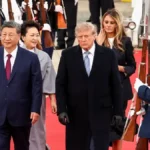


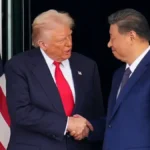
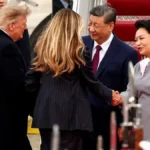


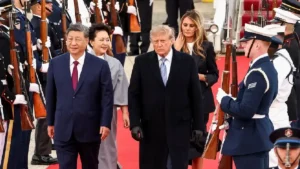
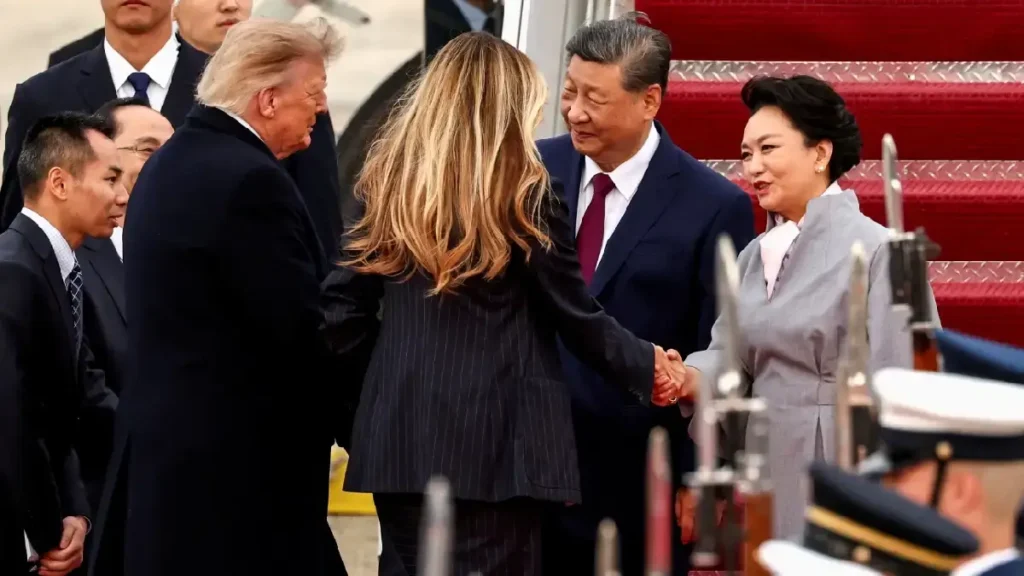
Chinese President Xi Jinping is in Washington for a state visit, with U.S. President Donald Trump hosting him. The meeting marks a historic exchange of visits between the leaders of the United States and China within just over four months, with Chinese Ambassador to the United States Xie Feng describing it as having “milestone significance.” Xi’s previous visit to the United States was more than three years ago.



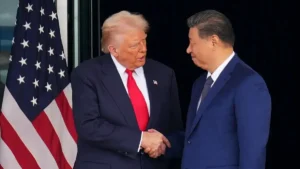
According to the agendas released by both sides, the talks cover several core issues: bilateral trade arrangements and tariff extensions, an intergovernmental dialogue on artificial intelligence, rare-earth export controls, Taiwan, as well as broader regional security issues including Iran.
Both governments have said the meeting is intended to implement the consensus reached in previous economic and trade consultations and provide more stable policy expectations for bilateral relations.
However, although both sides are seeking to stabilize relations, structural differences between the United States and China remain significant in areas including technology controls, market access and geopolitics.
Based on official statements from both governments and information released by authoritative institutions, this article reviews the background, agenda and known outcomes of the meeting while clearly distinguishing confirmed developments from issues that remain under discussion.
Why Are Trump and Xi Meeting in Washington?
The Washington meeting is the latest step in a period of intensive diplomatic engagement between the leaders of the United States and China. President Xi Jinping arrived in Washington on the afternoon of September 23, beginning a state visit to the United States.
This is Xi’s first visit to the United States in three years and also comes as the two countries’ leaders have exchanged visits within a period of less than six months.
From a diplomatic perspective, the leaders’ reciprocal visits in a relatively short period indicate that both governments intend to maintain high-level communication channels. In May, President Trump made a state visit to China, becoming the first U.S. president in nearly nine years to visit the country.
During that meeting in Beijing, the two leaders established a new positioning for U.S.-China relations centered on a “constructive strategic stability,” moving toward a relationship characterized by “cooperation as the main focus, managed competition, controlled differences and prospects for peace.”
Chinese Ambassador to the United States Xie Feng said in an interview with Xinhua before the meeting that leader-level diplomacy plays an “irreplaceable strategic guiding role” in U.S.-China relations and serves as the “anchor and compass” of bilateral ties.
He said Xi had held face-to-face meetings with Trump seven times so far, providing important strategic support for maintaining the overall dynamic stability of U.S.-China relations amid a difficult international environment.
The motivations for maintaining dialogue differ in emphasis for the two governments. For the United States, stabilizing U.S.-China economic and trade relations could help ease cost pressures on domestic businesses and consumers.
For China, maintaining communication with the United States could help stabilize the external economic environment and seek more predictable policy conditions on tariffs, technology controls and other issues.
It is important to note that U.S.-China relations currently combine cooperation and competition. On one hand, the two countries maintain economic and trade consultation mechanisms and have reached preliminary understandings on specific issues including tariffs and rare-earth exports.
On the other hand, fundamental U.S. policies on issues such as semiconductor export controls and arms sales to Taiwan have not undergone a fundamental change.
U.S.-China Trade Truce: Will It Be Extended?
One of the central economic and trade issues at the meeting is whether the U.S.-China economic and trade arrangement reached in Kuala Lumpur in October 2025 will be extended.
According to the official explanation from Chinese Ministry of Commerce spokesperson He Yadong, the Kuala Lumpur joint arrangement suspends certain tariff and non-tariff measures until November 10, 2026.
These measures include the U.S. 24% reciprocal tariff and China’s related countermeasures; the U.S. 50% penetration rule related to export controls and China’s corresponding export-control measures; and U.S. Section 301 investigation measures concerning China’s maritime, logistics and shipbuilding sectors, along with China’s related countermeasures.
The Office of the U.S. Trade Representative announced on November 26, 2025, that it would extend until November 10, 2026, tariff exclusions established under a Section 301 investigation concerning China’s technology-transfer and intellectual-property practices.
The White House had previously stated that the United States would continue suspending high reciprocal tariffs on China until that date while extending the validity of certain Section 301 tariff exclusions.
Before and around the Washington meeting, both sides “reaffirmed that they would continue implementing the results of previous economic and trade consultations.” China’s Ministry of Commerce explicitly stated that “promoting an extension of the relevant arrangements is in the common interests of both countries.”
Ambassador Xie Feng also confirmed before the meeting that the two sides were “continuing to advance the $30 billion reciprocal tariff-reduction arrangement under the Trade Council.”
It is important to clarify that, so far, the United States and China have not announced a comprehensive new trade agreement that fully replaces the existing arrangement. What has been confirmed is that both sides intend to promote an extension of the existing joint arrangement and are discussing a reciprocal tariff-reduction framework on a more limited basis.
China’s Ministry of Commerce said the two sides had “principally agreed to discuss a reciprocal tariff-reduction framework involving products of equal value of $30 billion or more” under the Trade Council, with products of mutual concern potentially subject to most-favored-nation tariff rates or lower. The framework remains at the stage of discussion and negotiation of specific arrangements.
Tariffs: What Do They Mean for the U.S. and China?
Tariffs are one of the most direct issues affecting businesses and consumers in both countries.
In simple terms, a tariff is a tax imposed by one country on imported goods. When the United States imposes tariffs on Chinese products, U.S. importers must pay additional costs to the U.S. government on those goods.
Part of that cost may be passed on to U.S. consumers, while some may be absorbed by importers, distributors or Chinese exporters. For China, higher tariffs increase the cost of Chinese products entering the U.S. market, potentially affecting export companies’ orders and profits.
In February 2026, the U.S. Supreme Court ruled that tariffs imposed by the U.S. government under the International Emergency Economic Powers Act (IEEPA) were unlawful. The United States subsequently launched new Section 301 investigations into several trading partners and indicated that new Section 301 tariffs could replace the earlier IEEPA tariffs.
This means the U.S.-China tariff framework could face further changes, with the exact form and rates still subject to developments.
China’s Ministry of Commerce has clearly stated its position: it wants the United States to honor its commitments and has said that “regardless of the reason or method used to impose or replace tariffs on China in the future, the U.S. tariff level on China should not exceed the level established under the Kuala Lumpur economic and trade consultation joint arrangement.”
This statement indicates that China’s concern is not only about current tariff rates but also about establishing a ceiling for future tariff policies.
For businesses and supply chains, tariff uncertainty itself represents a cost. Companies need relatively stable policy conditions when planning procurement, production and investment. Whether the meeting can provide clearer expectations for U.S.-China economic and trade relations is a key focus for markets and businesses.
Rare Earths: China’s Important Leverage in the Talks
Rare earths are another key issue at the meeting and represent an area where China has significant influence in economic and trade negotiations.
Rare earths are not actually “earth” in the ordinary sense. The term refers to a group of 17 chemical elements. They are widely used in electronics, electric-vehicle motors, wind turbines, defense equipment and advanced manufacturing. Without rare-earth materials, many modern technology products would be difficult to manufacture.
China holds a dominant position in the global rare-earth supply chain, particularly in processing and refining. This means that even when other countries mine rare-earth ores, they may still need to send the material to China for processing before it can be turned into materials suitable for industrial production. The concentration of processing capacity gives China structural influence over rare-earth supplies.
Under the U.S.-China Kuala Lumpur economic and trade consensus, China’s rare-earth export-control measures announced on October 9, 2025, were suspended until November 10, 2026. Chinese Ministry of Commerce spokesperson He Yadong said in April 2026 that applications for rare-earth exports that comply with relevant regulations, including those involving genuine civilian uses, would be approved in accordance with the law.
He also emphasized that China was taking into full consideration “reasonable civilian demand around the world, including that of the United States.”
Before the meeting, on September 21, Chinese Foreign Ministry spokesperson Guo Jiakun reiterated that China’s position on maintaining the safety and stability of global critical-mineral industrial and supply chains had not changed.
He also said China’s restrictions on rare-earth exports to Japan were based on concerns over Japan’s “remilitarization” and “attempts to acquire nuclear weapons,” and that exports to Japanese military users or for military purposes were prohibited.
From a negotiating perspective, the suspension of rare-earth export controls gives China flexibility in economic and trade discussions. Whether the suspension will be extended and under what conditions is an important variable in U.S.-China negotiations.
However, China’s rare-earth influence should not be overstated as “unlimited leverage.” The United States and other countries are working to diversify rare-earth supply chains, although replacing China’s capacity in the short term presents technological and time-related challenges.
Artificial Intelligence: A New Front of Competition and Dialogue
Artificial intelligence has become one of the central issues in U.S.-China technology competition, and AI is also part of the discussions surrounding the current meeting.
According to Chinese Foreign Ministry spokesperson Guo Jiakun in May 2026, President Trump and President Xi had a “constructive exchange” on artificial intelligence during Trump’s visit to China and “agreed to establish an intergovernmental dialogue on artificial intelligence.”
Guo said that as two major AI powers, China and the United States should work together to promote AI development and governance and make AI better serve human civilization and the common interests of the international community.
Competition between the United States and China in AI involves several areas: advanced AI chips, semiconductor manufacturing equipment, AI models, computing infrastructure, as well as AI safety and governance.
On semiconductor export controls, several developments before and around the meeting have attracted attention. Reuters reported that the U.S. Commerce Department had approved around 10 Chinese companies to purchase Nvidia H200 chips, including Alibaba, Tencent and ByteDance.
Under the licensing arrangements, each approved customer could purchase up to 75,000 H200 chips. Analysts viewed the arrangement as an attempt by the United States to maintain controls on high-end chips while preserving commercial opportunities for U.S. companies.
At the same time, pressure within the United States to further strengthen semiconductor restrictions on China has not disappeared. Trump’s comments to reporters while returning from the meeting also reflected this tension. He initially said that chips had “not been discussed,” but later acknowledged that chips had indeed been mentioned because China “needs them.”
AI cooperation and AI strategic competition are two concepts that should be distinguished. Cooperation could involve AI safety standards, risk-communication mechanisms and preventing misunderstandings. Competition, meanwhile, involves chip controls, model capabilities, industrial ecosystems and global market share.
An analysis published by China.org.cn said future U.S.-China AI dialogue could focus on four areas: managing AI safety and risks, coordinating regulatory approaches, connecting multilateral frameworks and expanding practical cooperation.
Taiwan: Why Is It Always Such a Sensitive Issue?
Taiwan is one of the most sensitive and potentially disruptive issues in U.S.-China relations.
The Chinese government’s position is that Taiwan is an inseparable part of China’s territory and that the Taiwan question is purely China’s internal affair. In an article published by China’s Foreign Ministry in January 2026, Beijing described the Taiwan issue as “the core of China’s core interests” and “the first red line that cannot be crossed” in U.S.-China relations.
The U.S. position is expressed through its long-standing “One China” policy framework, while the United States also maintains arms sales and security cooperation with Taiwan under U.S. domestic law. In December 2025, the United States announced $11.1 billion in arms sales to Taiwan, the largest U.S. arms-sale package to Taiwan since the establishment of diplomatic relations between the United States and China. China expressed “strong opposition” and announced “punitive and deterrent countermeasures.”
China’s Taiwan Affairs Office spokesperson Zhang Han reiterated Beijing’s opposition to military cooperation between the United States and Taiwan at a regular press conference in May 2026. She emphasized that China’s determination and capability to resolve the Taiwan issue and achieve national reunification remained firm and described reunification as an “unstoppable trend.”
Taiwan’s strategic importance is not limited to geography. The island also plays a crucial role in the global semiconductor supply chain. TSMC is one of the world’s leading advanced chip manufacturers, making Taiwan’s semiconductor industry systemically important to the global technology economy.
Against the backdrop of the current meeting, some Taiwanese media outlets reported that the acting U.S. Secretary of the Navy had said a $14 billion arms-sale package to Taiwan would be suspended because of the U.S.-Iran conflict. Taiwan’s presidential office denied the report, saying there was “no information that the United States was making any adjustment to the arms sale.” The situation remains developing, and its connection to the Trump-Xi meeting requires further confirmation.
What Does Iran Have to Do With the Trump-Xi Talks?
Iran appears in the broader context of the meeting mainly because of China’s growing role in Middle Eastern diplomacy.
Chinese Foreign Minister Wang Yi said during a phone call with Iranian Foreign Minister Abbas Araghchi in April 2026 that the immediate priority was to “push the United States and Iran back to the negotiating table and seek a political solution.” Wang also said China has consistently advocated resolving international disputes through dialogue and consultation and opposed the use of force.
During his visit to China in May 2026, Iranian Foreign Minister Araghchi said Iran would brief China on its talks with Washington and described Beijing as a “trusted strategic partner.” At the same time, U.S. Secretary of State Marco Rubio said he hoped Beijing could encourage Tehran to reopen the Strait of Hormuz.
This situation shows that although deep mistrust remains between the United States and Iran, both sides in different ways view Beijing as a country capable of influencing the other side. President Xi has proposed a “four-point proposition” for promoting peace and stability in the Middle East, while China and Pakistan jointly issued a “five-point initiative” concerning the restoration of peace and stability in the Gulf and the wider Middle East.
It is important to clarify that U.S.-China interaction over Iran is part of the broader geopolitical context and is not the core component of the bilateral economic and trade agenda. China’s mediation role on Iran and U.S.-China trade negotiations are separate issues operating at different levels.
What Does Each Side Want From the Meeting?
U.S. Priorities
Based on publicly released information and official statements, U.S. priorities include encouraging China to fulfill commitments under the Kuala Lumpur joint arrangement, ensuring the continued suspension of rare-earth export controls, discussing competition and communication mechanisms in AI, and seeking Chinese cooperation on broader geopolitical issues.
Chinese Priorities
China’s publicly stated concerns include extending the Kuala Lumpur joint arrangement, maintaining U.S. tariff levels below the ceiling established by the current arrangement, protecting the stability of global industrial and supply chains, establishing an AI governance dialogue mechanism and reiterating its position on Taiwan.
Confirmed Outcomes and Issues Still to Be Resolved
Confirmed Developments
- President Xi Jinping arrived in Washington on September 23 and began his state visit to the United States.
- The United States and China agreed to establish an intergovernmental dialogue on artificial intelligence.
- Both sides reaffirmed that they would continue implementing the results of the Kuala Lumpur economic and trade consultations and work toward extending the joint arrangement.
- The two sides agreed in principle to discuss a $30 billion reciprocal tariff-reduction framework under the Trade Council.
- China confirmed that its rare-earth export-control measures remain suspended until November 10, 2026.
Issues Still Under Discussion
- Whether the Kuala Lumpur joint arrangement will formally be extended and what conditions would apply.
- The product scope and tariff details of the reciprocal tariff-reduction framework.
- The specific mechanism and agenda for the AI intergovernmental dialogue.
- Arrangements after the suspension of rare-earth export controls ends.
Uncertain or Pending Issues
- Whether a new trade agreement or broader economic arrangement will be reached.
- The future direction of U.S. tariff policy toward China, including alternatives resulting from Section 301 investigations.
- Any specific commitments or changes concerning Taiwan.
- Any concrete coordination results concerning Iran.
How Could the Meeting Affect the Global Economy?
The impact of the meeting on the global economy could be transmitted through several channels, although the specific effects will depend on subsequent policy implementation.
Trade and supply chains: Julie Kozack, Director of the IMF Communications Department, said after Trump’s visit to China that “anything that helps reduce trade tensions and uncertainty is good for the economies of both countries and the global economy.” If the Kuala Lumpur joint arrangement is extended, the policy uncertainty facing businesses could decline, potentially helping supply-chain planning.
Semiconductor markets: Any adjustment to AI-chip export controls could affect global semiconductor supply and demand. If licensing arrangements for H200 chips sold to China expand, U.S. semiconductor companies such as Nvidia could gain additional revenue opportunities.
Rare earths and commodities: An extension or modification of the suspension of rare-earth export controls could affect global rare-earth prices and supply expectations. Electric-vehicle, wind-energy and electronics companies that rely on rare-earth materials will closely monitor the arrangements.
Financial markets: Markets may react to developments from the meeting, but the direction will depend on the actual results announced. Analysts have noted that investors generally value predictability and stability, and greater stability in U.S.-China relations could support market confidence.
It is important to emphasize that these are conditional assessments based on current information, not market predictions. The actual economic impact of the meeting will depend on the specific actions taken by both governments afterward.
Possible Developments After the Meeting
Extension of the Trade Truce
If the Kuala Lumpur joint arrangement is formally extended, U.S.-China economic and trade relations would gain a period of relatively greater policy stability. Companies could plan procurement and production under clearer tariff conditions. This scenario has a basis in official statements, as both sides have said they will continue implementing the results of previous economic and trade consultations.
Limited Agreements in Specific Areas
The United States and China could reach specific arrangements in selected areas, such as launching the AI intergovernmental dialogue, improving compliance procedures for rare-earth exports, or reaching an initial understanding on the reciprocal tariff-reduction framework, while maintaining differences over broader structural issues. Such incremental progress could become a feature of bilateral relations.
Dialogue Continues While Competition Remains
Even if high-level dialogue continues, competition between the United States and China over technology controls and geopolitical issues could continue. The “cooperation as the main focus, managed competition, controlled differences and prospects for peace” positioning described by Ambassador Xie Feng could in practice mean that competition is incorporated into a more controlled framework rather than eliminated.
Why Does This Meeting Go Beyond Trump and Xi Personally?
The significance of the meeting extends beyond the two leaders themselves. As the world’s two largest economies, the direction of U.S.-China relations has broad implications for other regions.
For the Asia-Pacific region: Philippine Star columnist Wilson Lee Flores said that when major powers “compete economically but cooperate strategically to maintain peace,” the Asia-Pacific region could benefit. Regional manufacturing, semiconductor industries and investor confidence could all be affected by greater stability in U.S.-China relations.
For Europe and global manufacturers: Bruce McLaughlin, chief executive of Sinogie Consulting Group, said that stable U.S.-China relations “help reduce the costs caused by supply-chain fragmentation and duplication.” Multinational companies in Europe and Asia will closely monitor changes in tariffs and export-control policies.
For emerging markets: Ivorian journalist Mouhamedi Compaore said improved U.S.-China cooperation could “stabilize the global economy, secure supply chains and ease volatility in international commodity markets,” potentially benefiting African economies that depend on raw-material exports.
For international diplomacy: China’s mediation role on Iran suggests that Beijing is becoming more active in shaping pathways toward regional peace. This trend could influence the future landscape of international crisis management.
Timeline
| Date | Event |
|---|---|
| October 2025 | U.S. and China reached the Kuala Lumpur economic and trade joint arrangement |
| October 9, 2025 | China announced rare-earth export-control measures, later suspended until November 10, 2026 |
| November 1, 2025 | The White House announced a comprehensive U.S.-China economic and trade agreement involving tariff adjustments and critical minerals |
| November 10, 2025 | U.S. adjustments to China tariffs took effect |
| December 2025 | The United States announced $11.1 billion in arms sales to Taiwan |
| May 2026 | President Trump visited China and the two leaders met in Beijing |
| May 18–19, 2026 | China’s Foreign Ministry confirmed that the United States and China agreed to establish an AI intergovernmental dialogue |
| September 23, 2026 | President Xi Jinping arrived in Washington and began his state visit |
Frequently Asked Questions
When are Trump and Xi meeting in Washington?
President Xi Jinping arrived in Washington on the afternoon of September 23, 2026, beginning his state visit to the United States. The visit comes as the two countries’ leaders have exchanged visits within a period of just over four months.
Why is Xi Jinping visiting the United States?
The state visit is intended to implement the consensus reached by the two leaders during their previous meeting in Beijing and further develop a “constructive strategic stability” relationship between the United States and China. The agenda includes trade, AI, rare earths and Taiwan.
What are Trump and Xi discussing?
According to information released by both governments, the talks include extending the U.S.-China trade truce, tariff arrangements, rare-earth export controls, an intergovernmental dialogue on artificial intelligence, Taiwan and broader regional security issues including Iran.
Are Trump and Xi discussing a new trade agreement?
The two sides are discussing an extension of the existing Kuala Lumpur joint arrangement and a $30 billion reciprocal tariff-reduction framework. However, they have not yet announced a comprehensive new trade agreement that fully replaces the existing arrangement.
What is the U.S.-China trade truce?
The Kuala Lumpur joint arrangement was reached in October 2025 and suspends certain tariff and non-tariff measures until November 10, 2026. It covers the U.S. 24% reciprocal tariff, the 50% penetration rule related to export controls, Section 301 measures and corresponding Chinese countermeasures.
Why are rare earths important in Trump-Xi talks?
China holds a dominant position in global rare-earth processing and refining. Rare earths are used in electronics, electric vehicles, defense equipment and other advanced technologies. China’s rare-earth export-control measures remain suspended until November 10, 2026, making their future status an important issue in the talks.
Are Trump and Xi discussing artificial intelligence?
Yes. The two leaders have agreed to establish an intergovernmental dialogue on artificial intelligence. The discussions may involve AI safety, coordination of regulatory approaches and cooperation within multilateral frameworks.
Why is Taiwan an issue in U.S.-China relations?
The Chinese government considers Taiwan part of China and describes the Taiwan issue as a core national interest. The United States maintains its One China policy framework while continuing arms sales and security cooperation with Taiwan. Taiwan’s importance to the global semiconductor supply chain also adds to its strategic significance.